Internet Of Things In Five Minutes

If you’re looking for the quickest way to go from zero to voice-controlled home automation system, you should spend five minutes checking out [Hari Wiguna]’s project on Hackaday.io where he connects up IoT gadgets and services into a functioning lightswitch. (Video below the break.)

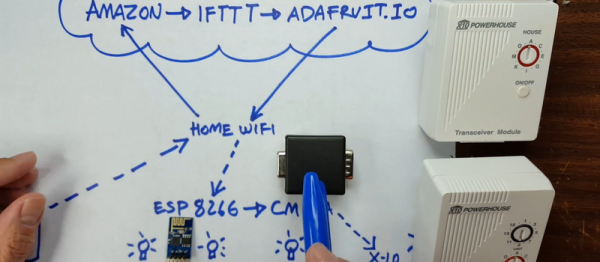
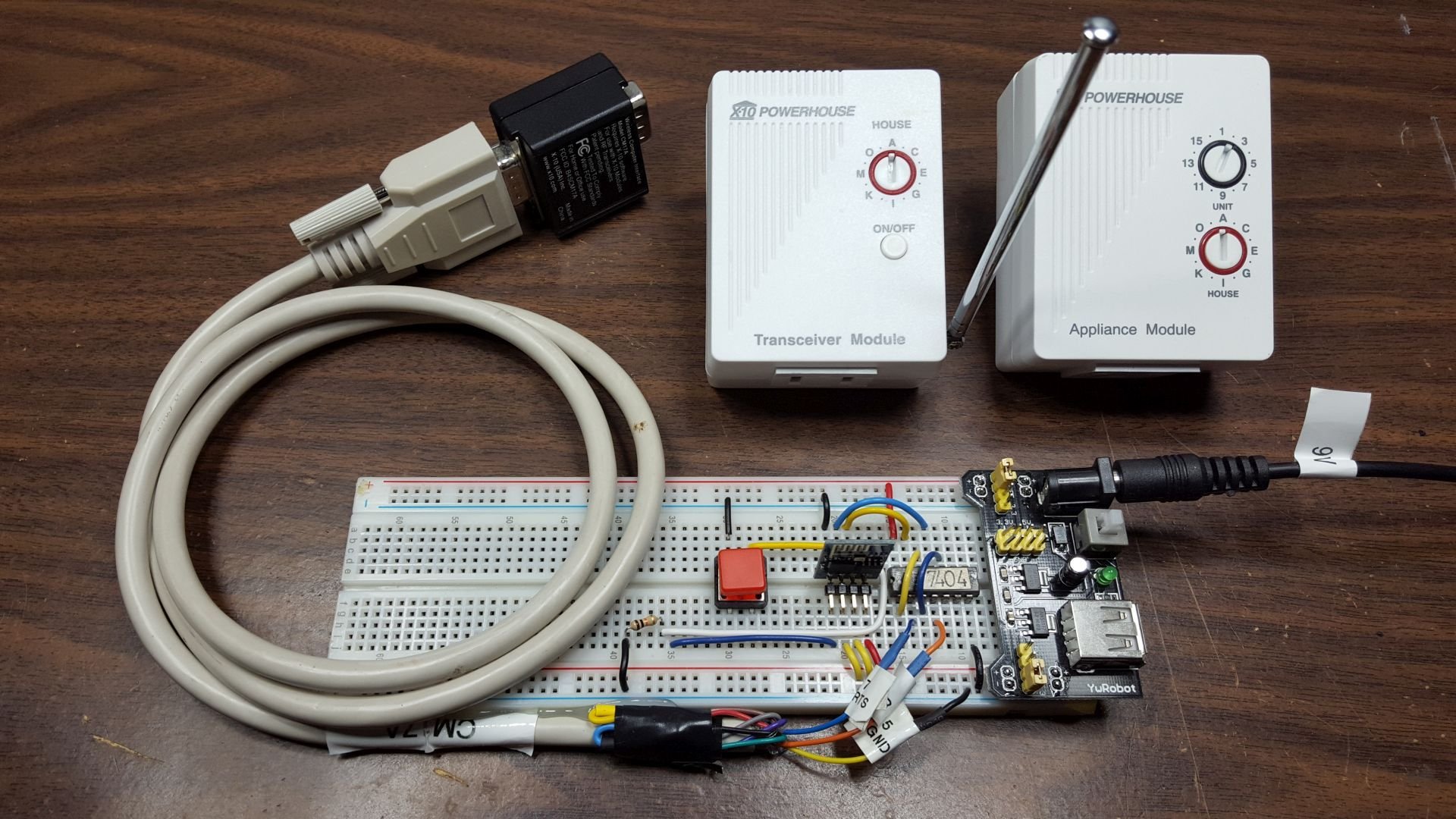
6166971452133983621[Hari] demonstrates how to set up a complex chain: Amazon Echo to IFTTT to Adafruit.io as a data broker, which is then polled by an ESP8266 unit in his home that controls his X10 setup. (Pshwew.) But each step along the way is designed to be nearly plug-and-play, so it’s really a lot like clicking Lego blocks together. [Hari]’s video is a nice overview.

There’s only one catch if you’re going to replicate this yourself: the X10 system that’s used for the last mile. Unless you have one of these setups already, you’re on your own for controlling the outlets that turn the lights on and off. For price and hackability, we suggest the common 433MHz wireless outlet switches and pairing them with cheap 433MHz transmitters, available at eBay for around $1. We’ve seen a lot of hacks of these systems — they’re quite common both in the US and Europe.

We’ve also covered [Hari]’s projects before: both his self-learning TV remote and a sweet Halloween hack. His video production skills are excellent. We’re in awe of how much info he crams into his YouTube videos.

Echo, Meet Mycroft

The Amazon Echo is an attempt to usher in a new product category. A box that listens to you and obeys your wishes. Sort of like Siri or Google Now for your house. Kickstarter creator [Joshua Montgomery] likes the idea, but he wants to do it all Open Source with a Raspberry Pi and an Arduino.

The Kickstarter (which reached its funding goal earlier this month) claims the device will use natural language to access media, control IoT devices, and will be open both for hardware and software hacking. The Kickstarter page says that Mycroft has partnerships with Lucid and Canonical (the people behind Ubuntu). In addition, they have added stretch goals to add computer vision and Linux desktop control to Mycroft.

Continue reading “Echo, Meet Mycroft” →

Voice Command With No Echo

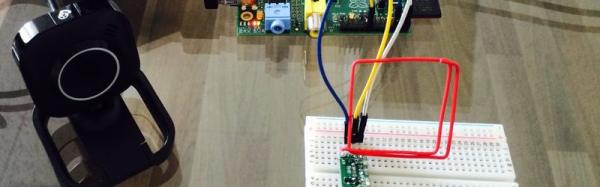
[Naran] was intrigued with the Amazon Echo’s ability to control home electronics, but decided to roll his own. By using a Raspberry Pi with the beta Prota OS, he managed to control some Phillips Hue bulbs and a homebrew smart outlet.

Prota has a speech application, which made the job simpler. He does point out though, that his project doesn’t replace the Echo’s ability to answer questions by searching the Internet. The advantage, though, is it is easily tailored to your specific application. Also, if you have a Raspberry Pi hanging around, you can’t beat the price. Continue reading “Voice Command With No Echo” →

remote control

Hacking Amazon Echo Through Its Remote

This one’s crazy… literally one electronic device is talking to another. In spoken English. And it works.

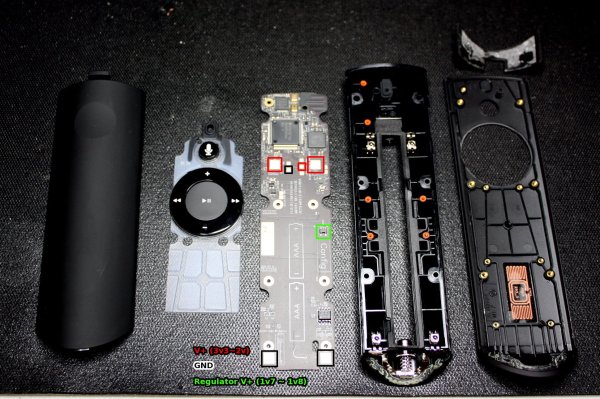
We’ve covered several hacks for the Amazon Echo, but some might be surprised to learn that there is another piece of interesting hardware that comes along with it – a remote control. Wire in a Raspberry Pi to it, and you’ve given yourself a way to automate control of the Echo without ever taking the Echo itself apart. [Gamaral] did just this and gave his Echo some significantly enhanced capabilities.

He started off by identifying the power rails of the remote. Then he wires in a 3.3v voltage regulator and uses a 100 ohm resistor as a voltage divider to bring it down to the 1.8 volt logic level used by the Echo remote. A single wire runs from the Raspi GPIO to one of the tactile switches on the controller.

For software, the Raspi is running RPi buildroot with Espeak and a cron scheduler compiled in. This allows him to send commands to the Echo which makes it say just about anything he wants. But any voice commands accepted by the Echo should work. If you want to go outside of those boundaries check out the method of spoofing WeMo devices we saw the other day.

Be sure to check out the [gamaral’s] entertaining video below to see the hack in action.

Continue reading “Hacking Amazon Echo Through Its Remote” →

How To Make Amazon Echo Control Fake WeMo Devices

[Chris] has been playing with the Amazon Echo. It’s sort of like having Siri or Google Now available as part of your home, but with built-in support for certain other home automation appliances like those from Belkin WeMo and Philips. The problem was [Chris] didn’t want to be limited to only those brands. He had other home automation gear that he felt should work with Amazon Echo, but didn’t. That’s when he came up with the clever idea to just emulate one of the supported platforms.

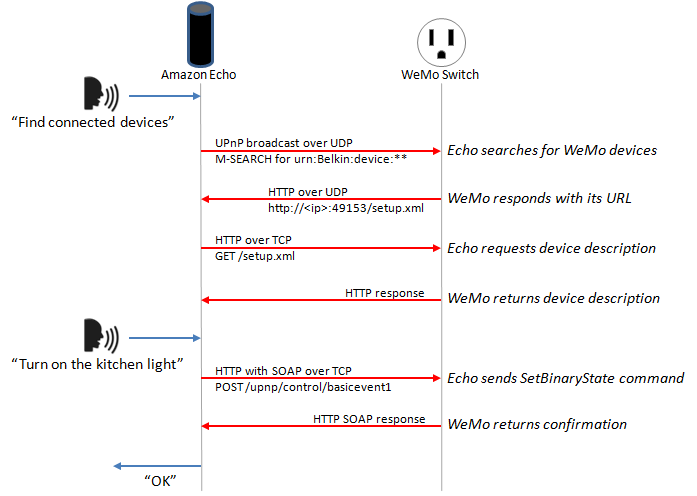
The WeMo devices use UPnP to perform certain functions over the network. [Chris] wanted to see how these communications actually worked, so he fired up his laptop and put his WiFi adapter into monitor mode. Then he used Wireshark to start collecting packets. He found that the device detection function starts out with the Echo searching for WeMo devices using UPnP. The device then responds to the Echo with the device’s URL using HTTP over UDP. The Echo then requests the device’s description using that HTTP URL. The description is then returned as an HTTP response.

The actual “on/off” functionality of the WeMo devices is simpler since the Echo already knows about the device. The Echo simply connects to the WeMo over the HTTP interface and issues a “SetBinaryState” command. The WeMo then obliges and returns a confirmation via HTTP.

WeMo Echo
How Echo Communicates with WeMo Devices

[Steve] was able to use this information to set up his own WeMo “virtual cloud”. Each virtual device would have its own IP address. They would also need to have a listener for UDP broadcasts as well as an HTTP listener running on the WeMo port 49153. Each virtual device would also need to be able to respond to the UPnP discovery requests and the “on/off” commands.

[Chris] used a Linux server, creating a new virtual Ethernet interface for each virtual WeMo switch. A single Python script runs the WeMo emulation, listening for the UPnP broadcast and sending a different response for each virtual device. Part of the response includes the device’s “friendly name”, which is what the Echo listens for when the user says voice commands. Since the virtual WeMo devices are free, this allows [Chris] to make multiple phrases for each device. So rather than be limited to “television”, he can also make a separate device for “TV” that performs the same function. [Chris] is also no longer limited to only specific brands of home automation gear.

There’s still a long way to go in hacking this device. There’s a lot of hardware under the hood to work with. Has anyone else gotten their hands (and bench tools) on one of these?

circuit board

Ask Hackaday: Is Amazon Echo The Future Of Home Automation?

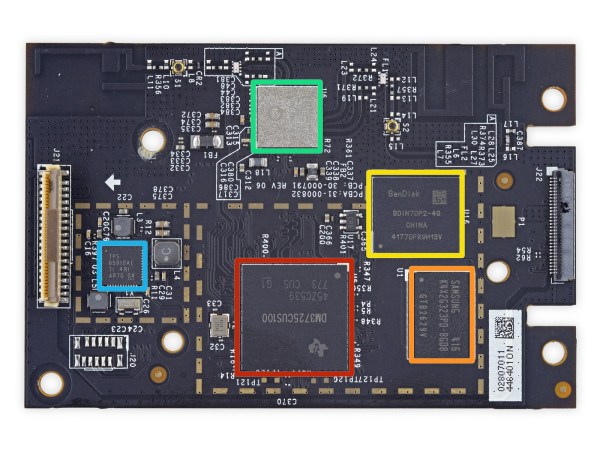
Unless you’ve been living under a case of 1 farad capacitors, you’ve heard of the Amazon Echo. Roughly the size of two cans of beans, the Echo packs quite a punch for such a small package. It’s powered by a Texas Instrument DM3725 processor riding on 256 megs of RAM and 4 gigs of SanDisk iNAND ultra flash memory. Qualcomm Atheros takes care of the WiFi and Bluetooth, and various TI chips take care of the audio codecs and amplifiers.

What’s unique about Echo is its amazing voice recognition. While the “brains” of the Echo exist somewhere on the Internets, the hardware for this circuitry is straight forward. Seven, yes seven microphones are positioned around the top of the device. They feed into four Texas Instrument 92dB SNR low-power stereo ADCs. The hardware and software make for a very capable voice recognition that works from anywhere in the room. For the output sound, two speakers are utilized – a woofer and a tweeter. They’re both powered via a TI 15 watts class D amplifier. Check out this full tear down for more details of the hardware.
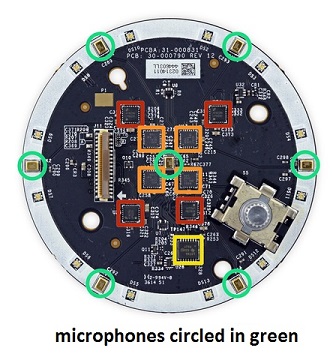
circuit board

Now that we have a good idea of the hardware, we have to accept the bad news that this is a closed source device. While we’ve seen other hacks where people poll the to-do list through the unofficial API, it still leaves a lot to be desired. For instance, the wake word, or the word which signals the Echo to start listening to commands, is either “Alexa” or “Amazon”. There is no other way to change this, even though it should be easily doable in the software. It should be obvious that people will want to call it “Computer” or “Jarvis”. But do not fret my hacker friends, for I have good news!

It appears that Amazon sees (or had seen all along) that home automation is the future of the Echo. They now officially support Philips Hue and Belkin WeMo gadgets. The Belkin WeMo, which is no stranger to the hacker’s workbench, has a good handle on home automation already, making the ability to control things in your house with the Echo tantalizingly close. See the video below where I test it out. Now, if you’re not excited yet, you haven’t heard of the WeMo Maker, a device which they claim will let you “Control nearly any low-voltage electronics device“. While the WeMo Maker is not supported as of yet, it surely will be in the near future.

We know it sucks that all of this is closed source. But it sure is cool! So here’s the question: Is the Echo the future of home automation? Sure, it has its obvious flaws, and one would think home automation is not exactly Amazon’s most direct business model (they just want you to buy stuff). However, it works very well as a home automation core. Possibility better than anything out there right now – both closed and open source.

Do you think Amazon would ever open the door to letting the Echo run open source modules which allow the community to add control of just about any wireless devices? Do you think that doing so would crown Amazon the king of home automation in the years to come?

Continue reading “Ask Hackaday: Is Amazon Echo The Future Of Home Automation?” →

Amazon Echo Becomes A Better Home Automation Appliance

There’s a bright future ahead of us, filled with intelligent computerized assistants that will listen to everything we say and do our bidding. It’ll be like HAL from 2001: A Space Odyssey, but without unverified mission-critical software and a bunch of killing. Until then, we have a few Amazon Echo hacks that tease out a reasonably capable home automation system without a proper API.

This build was inspired by an earlier project that polled the to do list looking for key phrases. Saying, “Alexa, to do, lights on” would turn on an Internet-connected light bulb. Saying, “Alexa, to do, call home” would call a phone number set up with the ‘home’ keyword.

[Glen] has improved that earlier setup somewhat, mostly by getting rid of the requirement to say, ‘to do.’ The Git for the project still shows it’s exploiting the Amazon to do list, but this is a much cleaner build that should end up having a lot more possibilities.

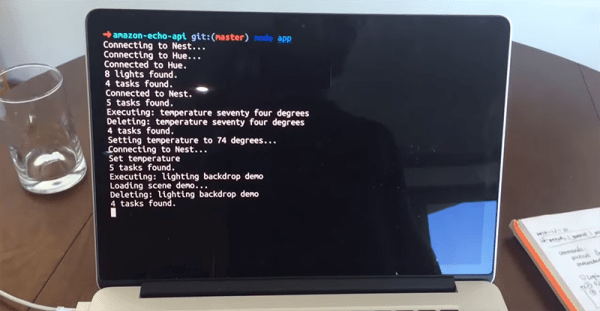
So far, [Glen], or rather, Alexa, can control the temperature of the house through a Nest thermostat, the lighting of a room with a Phillips Hue light bulb, and other random tasks like playing an audio file through the speakers. Not bad, and something that really demonstrates the potential of a smart, connected home.