Antennas That You Install With A Spray-Can

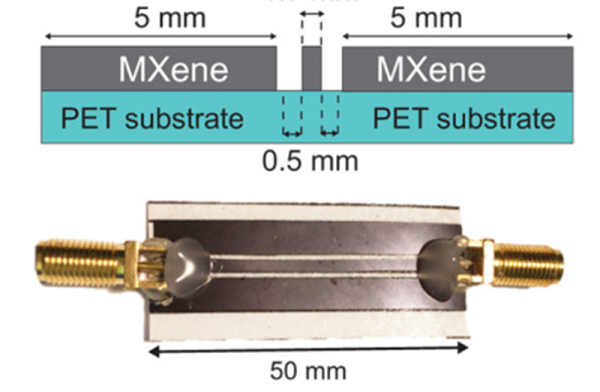
With the explosion in cell phones, WiFi, Bluetooth, and other radio technologies, the demand for antennas is increasing. Everything is getting smaller and even wearable, so traditional antennas are less practical than ever. You’ve probably seen PCB antennas on things like ESP8266s, but Drexel University researchers are now studying using titanium carbide — known as MXene — to build thin, light, and even transparent antennas that outperform copper antennas. Bucking the trend for 3D printing, these antennas are sprayed like ink or paint onto a surface.

A traditional antenna that uses metal carries most of the current at the skin (something we’ve discussed before). For example, at WiFi frequencies, a copper antenna’s skin depth is about 1.33 micrometers. That means that antennas have to be at least thick enough to carry current at that depth from all surfaces –practically 5 micrometers is about the thinnest you can reasonably go. That doesn’t sound like a lot, but when you are trying to make something thin and flexible, it is pretty thick. Using MXene, the researchers made antennas as thin as 100 nanometers thick — that’s 10% of a micrometer and only 2% of a conventional antenna.

Continue reading “Antennas That You Install With A Spray-Can”

Touch Anything And Everything

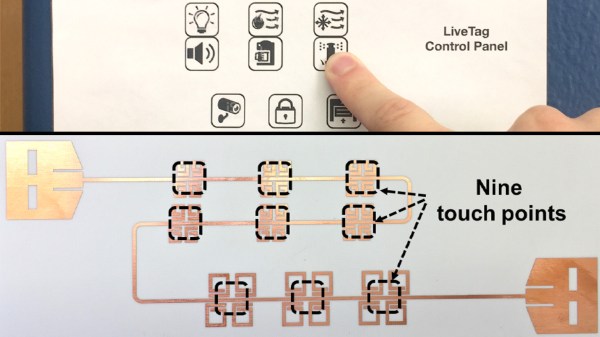
Powering IoT devices is often a question of batteries or mains power, but in rare exceptions to this rule there is no power supply (PDF Warning). At the University of Wisconsin-Madison and the University of California, San Diego, researchers have gone the extra mile to make advanced backscatter devices, and these new tags don’t need the discrete components we have seen in previous versions. They are calling it LiveTag, and it doesn’t need anything aside from a layer of foil printed or etched on a flexible ceramic-PTFE laminate. PTFE is mostly seen in the RF sector as a substrate for circuit boards.

We have seen some of the wild creations with wifi backscatter that range from dials to pushbuttons. RF backscatter works by modulating the RF signals in which we are continuously swimming. Those radio waves power the device and disrupt the ambient signals, which disruption can be detected by a receiver. With a BOM that looks like a statement more than a list, integration with many devices becomes a cost-effective reality. Do not however broadcast important data because you cannot expect great security from backscatter.

[Via IEEE Spectrum]

Radar In Space: The Gemini Rendezvous Radar

In families with three kids, the middle child always seems to get the short end of the stick. The first child gets all the attention for reaching every milestone first, and the third child will forever be the baby of the family, and the middle child gets lost in-between. Something similar happened with the U.S. manned space program in the 60s. The Mercury program got massive attention when America finally got their efforts safely off the ground, and Apollo naturally seized all the attention by making good on President Kennedy’s promise to land a man on the moon.

In between Mercury and Apollo was NASA’s middle child, Project Gemini. Underappreciated at the time and even still today, Gemini was the necessary link between learning to get into orbit and figuring out how to fly to the Moon. Gemini was the program that taught NASA how to work in space, and where vital questions would be answered before the big dance of Apollo.

Chief among these questions were tackling the problems surrounding rendezvous between spacecraft. There were those who thought that flying two spacecraft whizzing around the Earth at 18,000 miles per hour wouldn’t work, and Gemini sought to prove them wrong. To achieve this, Gemini needed something no other spacecraft before had been equipped with: a space radar.

Continue reading “Radar In Space: The Gemini Rendezvous Radar”

Harley-Hardened Wire Helps High-Gain Antenna Hack

What does a Harley-Davidson motorcycle have to do with building antennas? Absolutely nothing, unless you happen to have one and need to work-harden copper wire to build a collinear antenna for LoRa.

We’ll explain. Never being one to settle, [Andreas Spiess] needed a better antenna for his LoRa experiments. Looking for high gain and an omnidirectional pattern, he bought a commercial colinear antenna, which is a wire with precisely spaced loops that acts like a stack of dipoles. Sadly, in a head-to-head test [Andreas] found that the commercial antenna was no better than lower gain antennas in terms of range, and so he decided to roll his own.

Copper wire is a great material for antennas since it can be easily formed without special tools and it solders like a champ. But the stuff you get at the home center is nowhere near stiff enough for a free-standing vertical whip. This is where the Harley came in: [Andreas] used his Hog to stretch out the 1.75-mm diameter (a little bigger than #14 AWG) copper wire. Not only did the work-hardening stiffen the wire, it reduced its diameter to the 1.4 mm needed for the antenna design. His vector network analyzer told him that ground-plane elements and a little fiddling with the loop diameter were needed to get the antenna to resonate at 868 MHz, but in the end it looks like the antenna is on track to deliver 5-dBi of gain.

Of course there are plenty of other ways to stretch out a wire — you could just stretch it out with hanging weights, or even with a go-kart motor-powered winch if you’re ambitious. But if you’ve got a bike like that, why not flaunt it?

Continue reading “Harley-Hardened Wire Helps High-Gain Antenna Hack”

The Biggest Corner Antenna We’ve Ever Seen

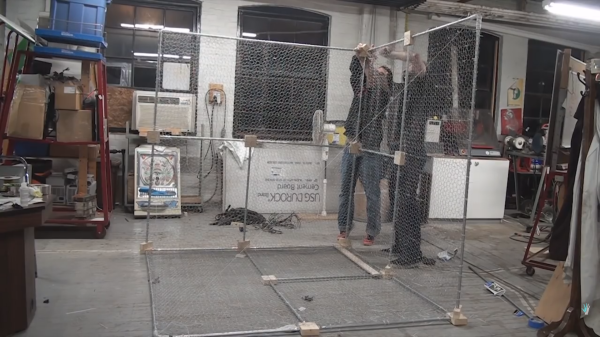
Radio waves are received on antennas, for which when the signal in question comes over a long distance a big reflector is needed. When the reception distance is literally astronomical, the reflector has to be pretty darn big. [The Thought Emporium] wants to pick up signals from distant satellites, the moon, and hopefully a pulsar. On the scale of home-built amateur radio, this will be a monstrous antenna. The video also follows the break.

In hacker fashion, the project is built on a budget, so all the parts are direct from a hardware store, and the tools are already in your toolbox or hackerspace. Electrical conduit, chicken wire, PVC pipes, wood blocks, and screws make up most of the structure so put away your crazy links to Chinese distributors unless you need an SDR. The form of the antenna is the crucial thing, and the shape is three perpendicular panels as seen in the image and video. The construction in the video is just a suggestion, but it doesn’t involve welding, so that opens it to even more amateurs.

Even if you are not trying to receive a pulsar’s signature, we have hacks galore for radios and antennas.

Continue reading “The Biggest Corner Antenna We’ve Ever Seen”

Bandpass Filters From The CNC Mill

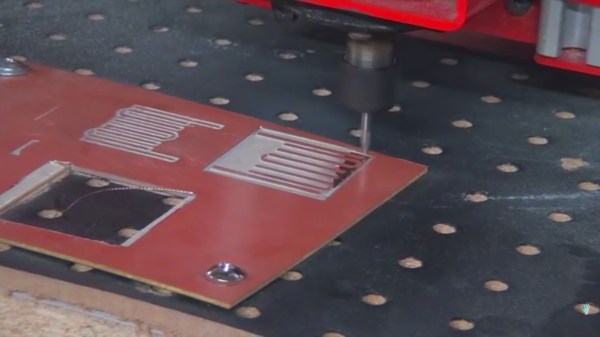
A bandpass allows a certain electrical signal to pass while filtering out undesirable frequencies. In a speaker bandpass, the mid-range speaker doesn’t receive tones meant for the tweeter or woofer. Most of the time, this filtering is done with capacitors to remove low frequencies and inductors to remove high frequencies. In radio, the same concept applies except the frequencies are usually much higher. [The Thought Emporium] is concerned with signals above 300MHz and in this range, a unique type of filter becomes an option. The microstrip filter ignores the typical installation of passive components and uses the copper planes of an unetched circuit board as the elements.

A nice analogy is drawn in the video, which can also be seen after the break, where the copper shapes are compared to the music tuning forks they resemble. The elegance of these filters is their simplicity, repeatability, and reproducability. In the video, they are formed on a CNC mill but any reliable PCB manufacturing process should yield beautiful results. At the size these are made, it would be possible to fit these filters on a business card or a conference badge.

Continue reading “Bandpass Filters From The CNC Mill”

Using AI to see through walls

Using An AI And WiFi To See Through Walls

It’s now possible to not only see people through walls but to see how they’re moving and if they’re walking, to tell who they are. We finally have the body scanner which Schwarzenegger walked behind in the original Total Recall movie.

Seeing through walls: real life, poses, skeletonsThis is the work of a group at the MIT Computer Science and Artificial Intelligence Laboratory (CSAIL). The seeing-through-the-wall part is done using an RF transmitter and receiving antennas, which isn’t very new. Our own [Gregory L. Charvat] built an impressive phased array radar in his garage which clearly showed movement of complex shapes behind a wall. What is new is the use of neural networks to better decipher what’s received on those antennas. The neural networks spit out pose estimations of where people’s heads, shoulders, elbows, and other body parts are, and a little further processing turns that into skeletal figures.

They evaluated its accuracy in a number of ways, all of which are detailed in their paper. The most interesting, or perhaps scariest way was to see if it could tell who the skeletal figures were by using the fact that each person walks with their own style. They first trained another neural network to recognize the styles of different people. They then pass the pose estimation output to this style-recognizing neural network and it correctly guessed the people with 83% accuracy both when they were visible and when they were behind walls. This means they not only have a good idea of what a person is doing, but also of who the person is.

Check out the video below to see some pretty impressive side-by-side comparisons of live action and skeletal versions doing all sorts of things under various conditions. It looks like the science fiction future in Total Recall has gotten one step closer. Now if we could just colonize Mars.

Continue reading “Using An AI And WiFi To See Through Walls”