Desktop Radio Telescope Images The WiFi Universe

It’s been a project filled with fits and starts, and it very nearly ended up as a “Fail of the Week” feature, but we’re happy to report that the [Thought Emporium]’s desktop WiFi radio telescope finally works. And it’s pretty darn cool.

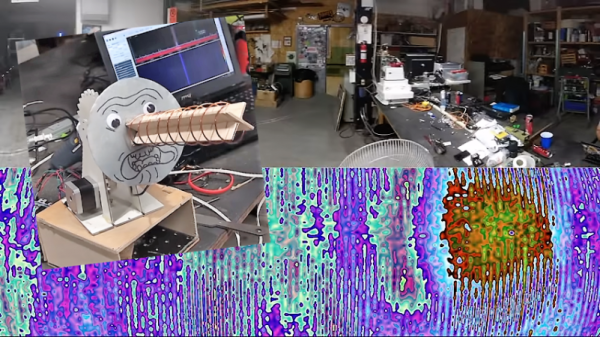
If you’ve been following along with the build like we have, you’ll know that this stems from a previous, much larger radio telescope that [Justin] used to visualize the constellation of geosynchronous digital TV satellites. This time, he set his sights closer to home and built a system to visualize the 2.4-GHz WiFi band. A simple helical antenna rides on the stepper-driven azimuth-elevation scanner. A HackRF SDR and GNU Radio form the receiver, which just captures the received signal strength indicator (RSSI) value for each point as the antenna scans. The data is then massaged into colors representing the intensity of WiFi signals received and laid over an optical image of the scanned area. The first image clearly showed a couple of hotspots, including a previously unknown router. An outdoor scan revealed routers galore, although that took a little more wizardry to pull off.

The videos below recount the whole tale in detail; skip to part three for the payoff if you must, but at the cost of missing some valuable lessons and a few cool tips, like using flattened pieces of Schedule 40 pipe as a construction material. We hope to see more from the project soon, and wonder if this FPV racing drone tracker might offer some helpful hints for expansion.

Continue reading “Desktop Radio Telescope Images The WiFi Universe”

Teardown Locates Fractal Antenna

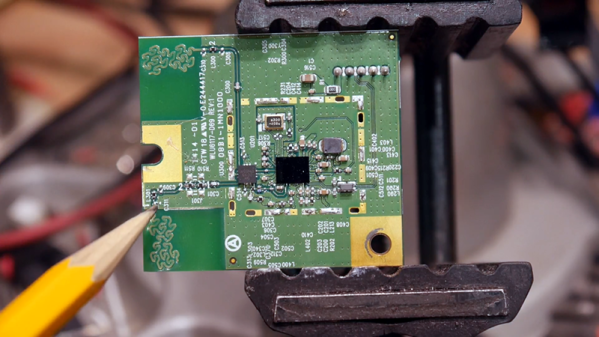
[IMSAI Guy] tore apart a device with a wireless network card and decided to investigate what was under the metal can. You can see the video of his examination below. Overall, it was fairly unremarkable, but one thing that was interesting was its use of an antenna on the PCB that uses a fractal design.

You probably know fractals are “self-similar” in that they are patterns made of smaller identical patterns. The old joke is that the B. in Benoit B. Mandelbrot (the guy who coined the term fractal) stands for Benoit B. Mandelbrot. You can think of it as akin to recursion in software. Antennas made with fractal patterns have some unusual and useful properties.

Continue reading “Teardown Locates Fractal Antenna”

Cloverleaf Satellite Antenna Mounted on a Pole

Tracking CubeSats For $25

CubeSats are tiny satellites which tag along as secondary payloads during launches. They have to weigh in at under 1.33 kg, and are often built at low cost. There’s even open source designs for these little spacecrafts. Over 800 CubeSats have been launched over the last few years, with many more launches scheduled in the near future.

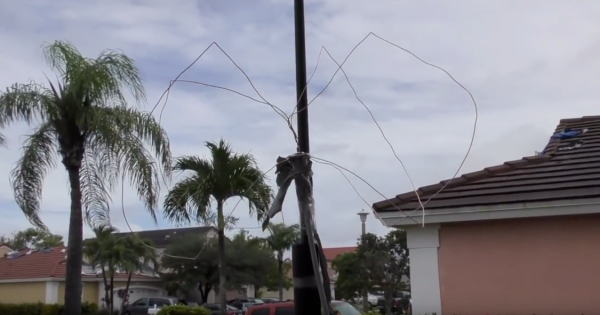
[Thomas Cholakov] coupled a homemade cloverleaf antenna to a software-defined radio to track some of these satellites. The antenna is built out of copper-clad wire cut to the correct length to receive 437 MHz signals. Four loops are connected together and terminated to an RF connector.

This homebrew antenna is connected into a RTL-SDR dongle. The dongle picks up the beacon signals sent by the satellites and provides the data to a PC. Due to the motion of the satellites, their beacons can be easily identified by the Doppler shift of the frequency.

[Thomas] uses SDR Console to receive data from the satellites. While the demo only shows basic receiving, much more information on decoding these satellites can be found on the SDR Satellites website.

This looks like a fun weekend project, and probably the cheapest aerospace related project possible. After the break, watch the full video explaining how to build and set up the antenna and dongle.

Continue reading “Tracking CubeSats For $25”

This Mostly 3D-Printed Discone Antenna Is Ready For Broadband Duty

For hams and other radio enthusiasts, the best part of the hobby is often designing antennas. Part black magic, part hard science, and part engineering, antenna design is an art. And while the expression of that art often ends up boiling down to pieces of wire cut to the correct length, some antennas have a little more going on in the aesthetics department.

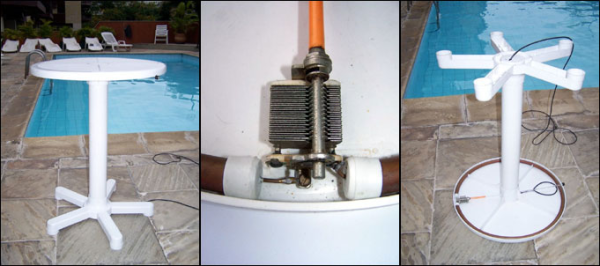
Take the discone antenna, for example. Originally designed as a broadband antenna to sprout from aircraft fuselages, the discone has found a niche with public service radio listeners. But with a disk stuck to the top of a cone, the antennas have been a little hard to homebrew, at least until [ByTechLab] released this mostly 3D-printed discone. A quick look at the finished product, resembling a sweater drying rack more than a disc on top of a cone, reveals that the two shapes can be approximated by individual elements instead of solid surfaces. This is the way most practical discones are built, and [ByTechLab]’s Thingiverse page has the files needed to print the parts needed to properly orient the elements, which are just 6-mm aluminum rods. The printed hub pieces sandwich a copper plate to tie the elements together electrically while providing a feedpoint for the antenna as well as a sturdy place to mount it outdoors. This differs quite a bit from the last 3D-printed discone we featured, which used the solid geometry and was geared more for indoor use.

Interested in other antenna designs? Who can blame you? Check out the theory behind the Yagi-Uda beam antenna, or how to turn junk into a WiFi dish antenna.

[via RTL-SDR.com]

HFT On HF, You Can’t Beat It For Latency

If you are a radio enthusiast of A Certain Age, you may well go misty-eyed from time to time with memories of shortwave listening in decades past. Countries across the world operated their own propaganda radio stations, and you could hear Radio Moscow’s take on world events, the BBC World Service responding, and Radio Tirana proudly announcing that every Albanian village now had a telephone. Many of those shortwave broadcast stations are now long gone, but if you imagine the HF spectrum is dead, think again. An unexpected find in an industrial park near Chicago led to an interesting look at the world of high-frequency trading, or HFT, and how they have moved to using shortwave links when everyone else has abandoned them, because of the unparalleled low latency they offer when communicating across the world.

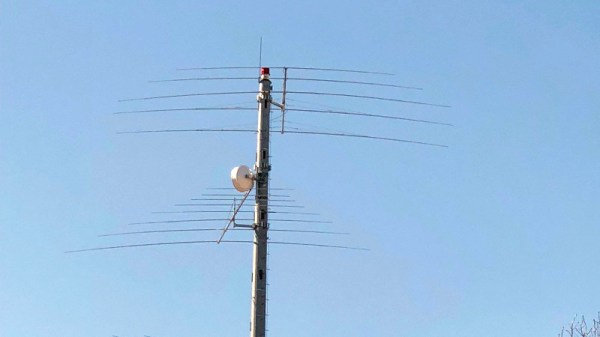
Our intrepid tower-hunter is [KE9YQ], who was out cycling and noticed a particularly unusual structure adorned with a set of HF beams. These are the large directional antennas of the type you might otherwise expect to see on the roof of an embassy or in the backyard of a well-heeled radio amateur, and were particularly unusual in this otherwise unexciting part of America. There followed an interesting process of tracking down the site’s owners via the FCC permits for its operation, leading to the deduction of its purpose. With other antenna-hunters on the lookout for corresponding sites elsewhere in the world, it seems that this unusual global network hiding in plain sight could soon be revealed.

Unsurprisingly we’ve not covered many shortwave HFT stories. There are however other higher-latency ways to cross the world on HF.

Via SWLing Post, and thanks [W6MOQ] for the tip.

Raspberry Pi W Antenna Analysis Reveals Clever Design

The old maxim is that if you pay peanuts, you get a monkey. That’s no longer true, though: devices like the Raspberry Pi W have shown that a $10 device can be remarkably powerful if it is well designed. You might not appreciate how clever this design is sometimes, but this great analysis of the antenna of the Pi W by [Carl Turner, Senior RF Engineer at Laird Technology] might help remind you.

Continue reading “Raspberry Pi W Antenna Analysis Reveals Clever Design”

Build Your Own Antenna For Outdoor Monitoring With LoRa

LoRa and LPWANs (Low Power Wide Area Networks) are all the range (tee-hee!) in wireless these days. LoRa is a sub 1-GHz wireless technology using sophisticated signal processing and modulation techniques to achieve long-range communications.

With that simplified introduction, [Omkar Joglekar] designed his own LoRa node used for outdoor sensor monitoring based on the HopeRF RFM95 LoRa module. It’s housed in an IP68 weatherproof enclosure and features an antenna that was built from scratch using repurposed copper rods. He wrote up the complete build, materials, and description which makes it possible for others to try their hand at putting together their own complete LoRa node for outdoor monitoring applications.

Once it’s built, you can use this simple method to range test your nodes and if you get really good, you might be setting distance records like this.