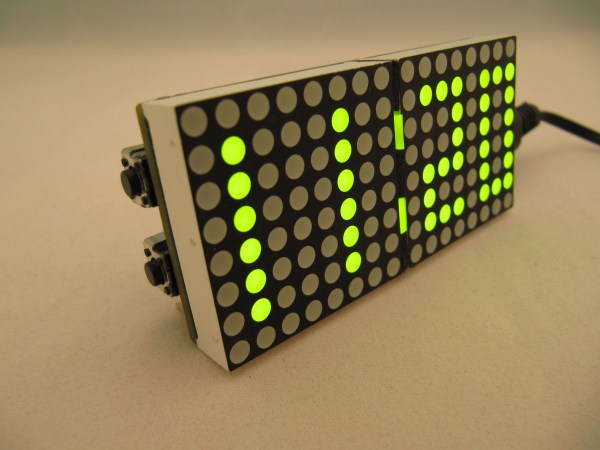
Student Trolls Anti-Arduino Prof With Parasite MCU

Like some of our grouchier readers, [PodeCoet]’s Digital Sub-Systems professor loathes everyone strapping an Arduino onto a project when something less powerful and ten times as complicated will do. One student asked if they could just replace the whole breadboarded “up counter” circuit mess with an Arduino, but, since the class is centered around basic logic gates the prof shot him down. Undeterred, our troll smuggled an MCU into a chip and used it to spell out crude messages.

No Arduino? No problem. It took him 4 tries but [PodeCoet] hollowed out the SN74LS47N display driver from the required circuit and made it the puppet of a PIC16F1503 controller. The PIC emulated the driver chip in every way – as ordered it showed the count up and down – except when left unattended for 15 seconds. Then instead of digits the PIC writes out “HELLO”, followed by three things normally covered by swimsuits and lastly a bodily function.

For such a simple hack it is wonderfully and humorously documented. There are annotated progress/failure pictures and video of the hack working.

It is not as elaborate as the microscopic deception in the infamously impossible 3 LED circuit, but it gets to the point sooner.

Continue reading “Student Trolls Anti-Arduino Prof With Parasite MCU”

Secret Attic Library Door

We have a pretty good guess where [Krizbleen] hides away any seasonal presents for his family: behind his shiny new secret library door. An experienced woodworker, [Krizbleen] was in the process of finishing the attic in his home when he decided to take advantage of the chimney’s otherwise annoying placement in front of his soon-to-be office. He built a false wall in front of the central chimney obstacle and placed a TV in the middle of the wall (directly in front of the chimney) flanked on either side by a bookcase.

If you touch the secret book or knock out the secret sequence, however, the right-side bookcase slides gently out of the way to reveal [Krizbleen’s] home office. Behind the scenes, a heavy duty linear actuator pushes or pulls the door as necessary, onto which [Krizbleen] expertly mounted the bookcase with some 2″ caster wheels. The actuator expects +24V or -24V to send it moving in one of its two directions, so the Arduino Uno needed a couple of relays to handle the voltage difference.

The effort spent here was immense, but the result is seamless. After borrowing a knock-detection script and hooking up a secondary access button concealed in a book, [Krizbleen] had the secret door he’d always wanted: albeit maybe a bit slow to open and close. You can see a video of its operation below.

Continue reading “Secret Attic Library Door”

Capacitive Christmas Organ With Living Lenses Of Slappable Light

We’ve seen capacitive touch organs manifest in pumpkin form. Though they are a neat idea, there’s something about groping a bunch of gourds that stirs a feeling of mild discomfort every time I play one. [mcreed] probably felt the same way and thus created this light-up Jello organ, so he can jiggle-slap Christmas carols, removing any sense of doubt that touching food to play music is weird…

This take on the capacitive tone producing instrument makes clever use of the transparent properties of Jello as well as its trademark wiggling. [mcreed] fills several small mold forms with festively colored strawberry and lime mix. One end of a wire connection is submerged in the liquid of each cup before it has a chance to solidify along with a bright LED. Once chilled and hardened, the gelatinous mass acts as a giant light emitting contact pad. An Arduino is the micro-controller used for the brain, assigning each Jello shape with a corresponding note. By holding onto a grounding wire and completing the acting circuit, one can play songs on the Jello by poking, spanking, or grazing the mounds.

Though I’m not entirely sure if the video is Jello propaganda or not, the idea is applaudable. I prompt anyone to come up with a more absurd item to use for a capacitive organ (zucchinis have already been done).

Continue reading “Capacitive Christmas Organ With Living Lenses Of Slappable Light”

Arduino Plays White Tiles On Your Mobile Touchscreen

Like many mobile gamers, [Daniel] has found himself caught up by the addictive “White Tiles” game. Rather than play the game himself though,  [Daniel] decided to write his own automatic White Tiles player. While this hack has been pulled off before, it’s never been well documented. [Daniel] used knowledge he gleaned on Hackaday and Hackaday.io to achieve his hack.

The basic problem is sensing white vs black tiles and activating the iPad’s capacitive touch screen. On the sensing end, [Daniel] could have used phototransistors, but it turned out that simple CdS cells, or photoresistors, were fast enough in this application. Activating the screen proved to be a bit harder. [Daniel] initially tried copper tape tied to transistors, but found they wouldn’t reliably trigger the screen. He switched over to relays, and that worked perfectly. We’re guessing that changing the wire length causes enough of a capacitance change to cause the screen to detect a touch.

The final result is a huge success, as [Daniel’s] Arduino-based player tears through the classic game in only 3.9 seconds! Nice work [Daniel]!

Click past the break to see [Daniel’s] device at work, and to see a video of him explaining his creation.

Continue reading “Arduino Plays White Tiles On Your Mobile Touchscreen”

thermostat

Arduino Thermostat Includes Vacation Mode

When [William’s] thermostat died, he wanted an upgrade. He found a few off-the-shelf Internet enabled thermostats, but they were all very expensive. He knew he could build his own for a fraction of the cost.

The primary unit synchronizes it’s time using NTP. This automatically keeps things up to date and in sync with daylight savings time. There is also a backup real-time clock chip in case the Internet connection is lost. The unit can be controlled via the physical control panel, or via a web interface. The system includes a nifty “vacation mode” that will set the temperature to a cool 60 degrees Fahrenheit while you are away. It will then automatically adjust the temperature to something more comfortable before you return home.

[William’s] home is split into three heat zones. Each zone has its own control panel including an LCD display and simple controls. The zones can be individually configured from either their own control panel or from the central panel. The panels include a DHT22 temperature and humidity sensor, an LCD display, a keypad, and support electronics. This project was clearly well thought out, and includes a host of other small features to make it easy to use.

Amateur Builds Super Deep Super Cheap Ocean Vehicle

During the summers [Doug] has been building a 75 foot sailing junk to be launched from America’s most inland port. When Oklahoma’s winter hits he heads indoors to work on an ROV that will prowl 3,000 feet below the surface. Originally building a piloted submarine, he grew bored and decided to use the sailboat as a carrier for his fleet of remote submersibles instead.

A consummate amateur, [Doug] is the first to admit how little he knows about anything and how much he enjoys the open source spirit: collaboration, cooperation and learning from others. Determination and hard work fills in everything in between.

Hackaday covered the beginnings of his ROV last winter. In the year since it has progressed from some sketches and a 10″ steel pipe turned into a pressure testing rig to a nearly-complete, 10 foot long,  custom-lathed 4″ aluminum torpedo laying on his shop table. In a bow-to-stern walk-through [Doug] shows how he is building science equipment for less than a penny on the dollar by using largely off-the-shelf imaginatively-repurposed parts or things he could fabricate himself with only a lathe and a 3d printer.

Continue after the break for a breakdown of the tech used.

Continue reading “Amateur Builds Super Deep Super Cheap Ocean Vehicle”

Desk lamp

Sleek Desk Lamp Changes Colors Based On Sun Position

[Connor] was working on a project for his college manufacturing class when he came up with the idea for this sleek desk lamp. As a college student, he’s not fond of having his papers glowing brightly in front of him at night. This lamp takes care of the problem by adjusting the color temperature based on the position of the sun. It also contains a capacitive touch sensor to adjust the brightness without the need for buttons with moving parts.

The base is made from two sheets of aluminum and a bar of aluminum. These were cut and milled to the final shape. [Connor] found a nice DC barrel jack from Jameco that fits nicely with this design. The head of the lamp was made from another piece of aluminum bar stock. All of the aluminum pieces are held together with brass screws.

A slot was milled out of the bottom of the head-piece to make room for an LED strip and a piece of 1/8″ acrylic. This piece of acrylic acts as a light diffuser.  Another piece of acrylic was cut and added to the bottom of the base of the lamp. This makes for a nice glowing outline around the bottom that gives it an almost futuristic look.

The capacitive touch sensor is a pretty simple circuit. [Connor] used the Arduino capacitive touch sensor library to make his life a bit easier. The electronic circuit really only requires a single resistor between two Arduino pins. One of the pins is also attached to the aluminum body of the lamp. Now simply touching the lamp body allows [Connor] to adjust the brightness of the lamp.

[Connor] ended up using an Electric Imp to track the sun. The Imp uses the wunderground API to connect to the weather site and track the sun’s location. In the earlier parts of the day, the LED colors are cooler and have more blues. In the evening when the sun is setting or has already set, the lights turn more red and warm. This is easier on the eyes when you are hunched over your desk studying for your next exam. The end result is not only functional, but also looks like something you might find at that fancy gadget store in your local shopping mall.