IKEA Shelf Becomes Kid Friendly MP3 Player

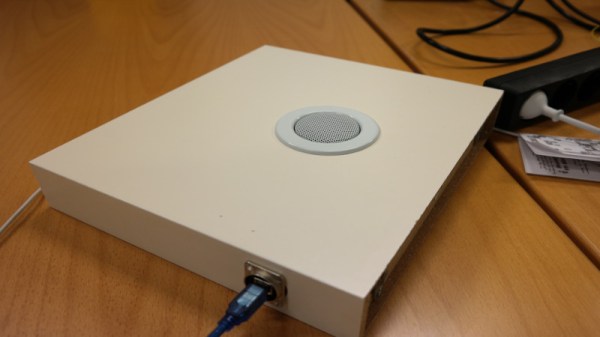
IKEA’s flatpack furniture has long been popular among makers for its modular nature and low cost, making it ideal for whacky experiments and custom builds. [Claus] is one such person, and built a fun MP3 player for his kids out of a basic LACK shelf.

The music is handled by an NodeMCU ESP8266, working in concert with a VS1053 audio board. The VS1053 is a highly capable chip, capable of decoding a variety of raw and compressed audio formats as well as MIDI, but here it’s used to read SD cards and play MP3s. An RC522 is used to read RFID cards to trigger various tracks, allowing kids to choose a song by simply placing a tag on the shelf. A cheap PAM8302 amplifier and speaker are used to output the music. All the hardware is installed neatly inside the LACK shelf, an easy job thanks to the primarily cardboard construction.

RFID cards are more fun than we normally give them credit for, and we’ve seen a few builds along similar lines to this one. Video of [Claus’s] child rocking out after the break.

Continue reading “IKEA Shelf Becomes Kid Friendly MP3 Player”
SOUL Wants To Process Your Audio

Abstraction is the core of nearly all progress in computing. Unless you are fabricating your own semiconductors and drawing wire, we all create with building blocks ranging from components like CPUs, to operating system functions, to specialized libraries. Just as you wouldn’t want to spend your time deblocking disk records or rendering fonts for output devices, you probably shouldn’t have to think too much about audio data. While there are some powerful audio processing libraries out there, a new embeddable language called SOUL (SOUnd Language) is now in version 1.0 and wants to help you create efficient code for processing audio.

The goal of SOUL is to target a runtime that can run on CPUs, but is better on DSPs. The code aims to be secure and real time with no pointers, garbage collection, and other things that typically interfere with audio processing or security.

Continue reading “SOUL Wants To Process Your Audio”

Extensive Modification Of DSLR Includes High Quality Audio

Modern DSLR cameras are incredible pieces of technology that can take excellent high-quality photos as well as record video and audio. However, as they become jacks of all trades they risk being masters of none, and the audio quality in modern DSLRs certainly reflects that old cliche. To get true high-quality audio while recording with a camera like this Canon 80d, you’ll either need a secondary audio recording device or you’ll need to interface one directly into the camera itself.

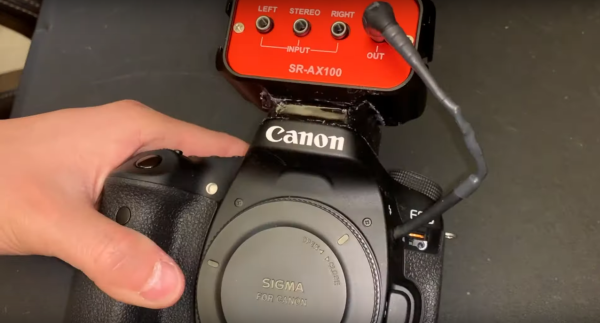
This build from [Tony] aka [Carnivore] goes into the inner workings of the camera to add an audio mixer to the camera’s audio input, allowing for multiple audio streams to be recorded at once. First, he removed the plastic around the microphone port and attached a wire to it that extends out of the camera to a 1/8″ plug. While he had the case open he also wired a second shutter, added a record button to a custom location on the front of the camera, and bypassed a switch which prevents the camera from operating if the battery door isn’t closed.

With those modifications in place, he removed the internal flash from the camera before closing the body. A custom 3D printed mount was placed in the vacant space which now houses the audio mixer, a SR-AX100 from Saramonic. This plugs in to the new microphone wire from earlier in the build, allowing the camera to have an expanded capacity for recording audio.

While [Tony] has a fairly unique use case for all of these modifications to an already $1000 camera, getting into the inner workings of DSLRs isn’t something to shy away from if you need something similar done. We’ve even seen modifications to cameras like these to allow for watercooling during video recording.

Continue reading “Extensive Modification Of DSLR Includes High Quality Audio”

Listening To Long Forgotten Voices: An Optical Audio Decoder For 16 Mm Film

Like many of us, [Emily] found herself on COVID-19 lockdown over the summer. To make the most of her time in isolation, she put together an optical audio decoder for old 16 mm film, built using modern components and a bit of 3D printing.

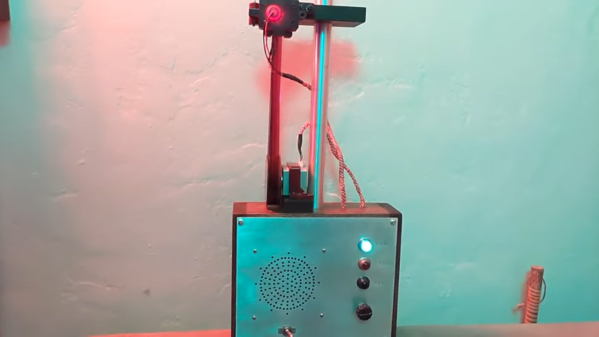
It all started with a broken 16 mm projector that [Emily] got from a friend. After repairing and testing the projector with a roll of film bought at a flea market, she discovered that the film contained an audio track that her projector couldn’t play. The audio track is encoded as a translucent strip with varying width, and when a mask with a narrow slit is placed over the top it modulates the amount of light that can pass through to a light sensor connected to speakers via an amplifier.

[Emily] used a pair of razor blades mounted to a 3D printed bracket to create the mask, and a TI OPT101 light sensor together with a light source to decode the optical signal. She tried to use a photoresistor and a discrete photodiode, but neither had the required sensitivity. She built a frame with adjustable positions for an idler pulley and the optical reader unit, an electronics box on one end for the electronic components, and another pulley attached to a stepper motor to cycle a short loop of the film.

Most of the projects we see involving film these days are for creating digital copies. You can digitize your old 35 mm photo film using a Raspberry Pi, some Lego pieces, and a DSLR camera, or do the same for 8 mm film with a 3D printed rig. Continue reading “Listening To Long Forgotten Voices: An Optical Audio Decoder For 16 Mm Film”

Squeezing Every Bit From An ATMega

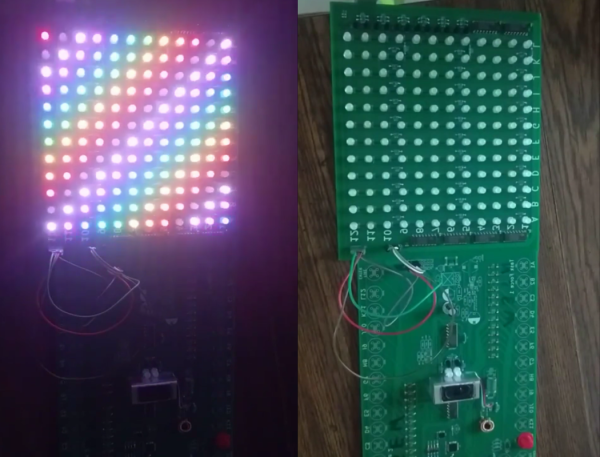
While the ATMega328 is “mega” for a microcontroller, it’s still a fairly limited platform. It has plenty of I/O and working memory for most tasks, but this Battleship game that [thorlancaster328] has put together really stretches the capabilities of this tiny chip. Normally a Battleship game wouldn’t be that complicated, but this one has audio, an LED display, and can also play a fine rendition of Nyan Cat to boot, which really puts the Atmel chip through its paces.

The audio is played through a 512-byte buffer and an interrupt triggers the microcontroller when to fill the buffer while it works on the other processes. The 12×12 LED display is also fed through a shift register triggered by the same interrupt as the audio, and since the build uses so many shift registers the microcontroller can actually output four separate displays (two players, each with a dispaly for shots and one for ships). It will also eventually support a player-vs-computer mode for the battleship game, and also has a mode where it plays Nyan cat just to demonstrate its own capabilities.

We’re pretty impressed with the amount of work this small microcontroller is doing, largely thanks to code optimization from its creator [thorlancaster328]. If there’s enough interest he also says he will provide the source code too. Until then, be sure to check out this other way of pushing a small microcontroller to its limits.

Thanks to [Thinkerer] for the tip!

Building Distributed Mode Loudspeakers With Plywood

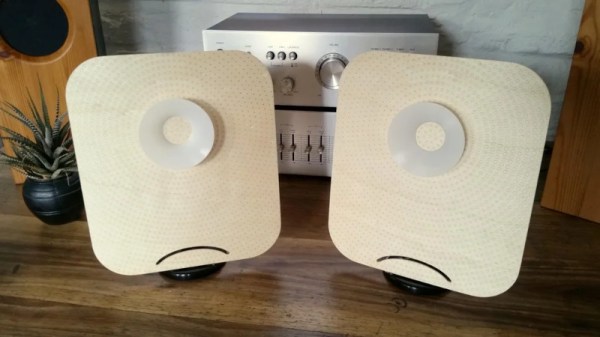
Distributed-mode loudspeakers work rather differently from the typical drivers used in 99% of applications. Instead of using piston-like motion to create sound waves, they instead rely on exciting an entire panel to vibrate and thus produce sound. [JGJMatt] decided to build a pair of bookshelf-sized units, with great results.

The build begins with a pair of 44mm DML exciters, readily available online. These had to be modified to remove their stock metal mounting plates that degraded the sound output in early tests. Instead, 3D printed pieces were used to mount the exciters to the 3mm plywood boards, which were lasercut to act as the main DML panels. Additionally, whizzer cones were fitted to the panels in an effort to further boost the high frequency response of the speakers. The speaker stands are assembled out of more 3D printed pieces and aluminium rods, giving a clean, modern look to the final product.

The performance of the speakers is admirable based on the test video, though [JGJMatt] notes that they should be paired with a subwoofer in use as the DML units do not readily produce frequencies below 100Hz. We’ve seen similar builds before on a larger scale, too. Video after the break.

Continue reading “Building Distributed Mode Loudspeakers With Plywood”

Booting A PC From Vinyl For A Warmer, Richer OS

If you’ve scrolled through the list of boot options offered on any PC’s BIOS, it reads like a history of storage technology. Up top we have the options to boot from disk, often a solid-state drive, then USB disk, optical drive, removable media, and down the bottom there’s usually an option to boot from the network. Practically no BIOS, however, has an option to boot a PC from a vinyl record — at least until now.

Clearly a project from the “Because why not?” school of hacking, [Jozef Bogin] came up with the twist to the normal booting process for an IBM-PC. As in the IBM-PC — a model 5150, with the putty-colored case, dual 5-1/4″ floppies, and one of those amazing monochrome displays with the green slow-decay phosphors. To pull off the trick, [Jozef] leverages the rarely used and little known cassette tape interface that PCs had back in the early days. This required building a new bootloader and burning it to ROM to make the PC listen to audio signals with its 8255 programmable peripheral interface chip.

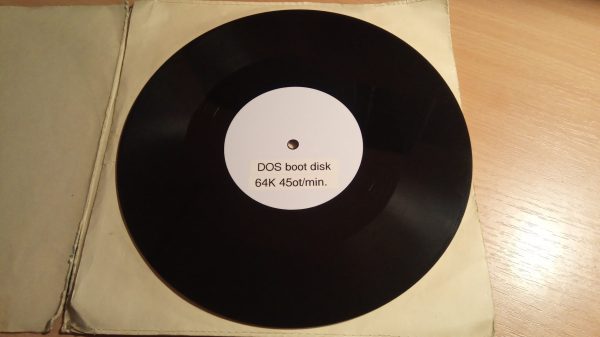
Once the PC had the right bootloader, a 64k FreeDOS bootable disk image was recorded on vinyl. [Jozef] provides infuriatingly little detail about the process other than to mention that the audio was sent directly to the vinyl lathe; we’d have loved to learn more about that. Nonetheless, the resulting 10″ record, played back at 45 RPM with some equalization tweaks to adapt for the RIAA equalization curve of the preamp, boots the PC into FreeDOS just fine, probably in no more time than it would have taken to boot from floppy.

It’s may not be the first time we’ve seen software on vinyl, but it’s still a pretty cool hack. Want to try it yourself but lack a record-cutting lathe? Maybe laser-cutting your boot disc will work.

Continue reading “Booting A PC From Vinyl For A Warmer, Richer OS”