Build Your Own Class AB Audio Amplifier

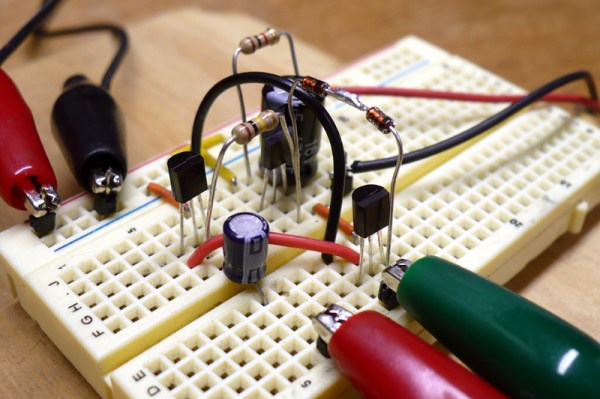
[Dino Segovis] wrote in to tell us about his “hack”, making an AB Audio Amplifier. The advantage of this particular amp is that the transistors never turn off, which would cause distortion. A full schematic is given in the article as well as a parts list. A complete “bill of materials” makes any circuit building project easier, especially for the beginner.

Although this is by no means a new circuit design, (a similar setup is used in car audio equipment) [Dino] does a great job of explaining how things work in the article itself and in the video after the break. He also gives some great tips about transferring your drawn circuit to a breadboard in a neat and organized way at around 5:00 in the video. Continue reading “Build Your Own Class AB Audio Amplifier”

Using An LED Cube As An Audio Visualizer

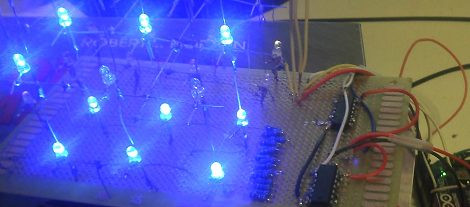
[Isaac] sent in his mashup build of a LED cube combined with a graphic EQ meter. The build is fairly simple and from the video we can tell that his build would be a great installation in a dubstep venue. While it’s not the 9x9x9 cube possible with some judicious coding we think it’s a very fitting display for the intended purpose.

Continue reading “Using An LED Cube As An Audio Visualizer”

Experimental Music IPad Dock

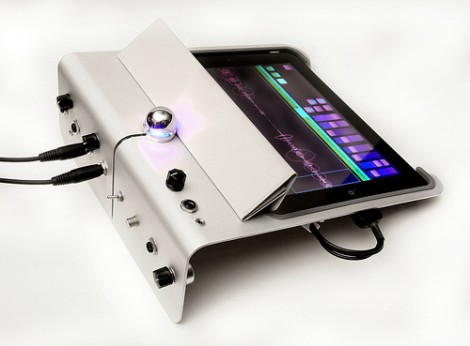
You can buy nice audio breakout equipment for your iPod if you don’t mind breaking the bank. This is partly because the demand is not incredibly high so commercial breakout hardware doesn’t benefit from volume discounts. But it’s also because Apple charges licensing fees for third-party accessories (often referred to as the “Apple Tax”). [Reed Ghazala] decided to side-step the whole situation by building his own accessory which he calls the iPad Audio Desk.

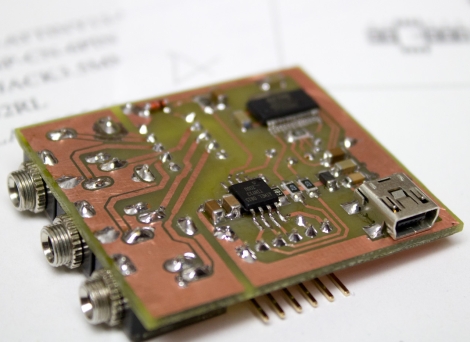
It all starts with a breakout board. The PodBreakout Mini provides an easy to solder interface for the iPad, and ensures that the repetitive act of plugging and unplugging the connection doesn’t break a solder connection. From there [Reed’s] enclosure finishing skills take over. The shape and curve of the aluminum sheet give the look befitting an expensive tablet device. Along the back you can see the jacks for line-in, line-out, video, mic/guitar, and headphones that make the dock useful. It wouldn’t be hard to make one… but it might be hard to make one look this great. See for yourself after the break.

Continue reading “Experimental Music IPad Dock”

ChipKIT Sketch: Mini Polyphonic Sampling Synth

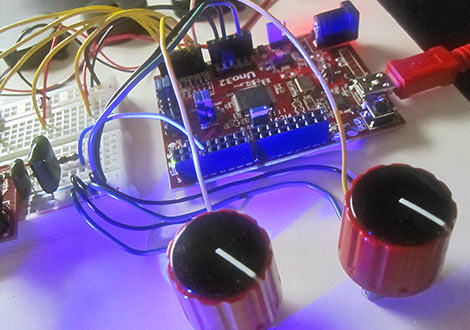
In our hands-on review of the Digilent chipKIT Uno32, we posed the question of what the lasting appeal might be for a 32-bit Arduino work-alike. We felt it needed some novel applications exploiting its special features…not just the same old Arduino sketches with MOAR BITS. After the fractal demo, we’ve hit upon something unique and fun…

Continue reading “ChipKIT Sketch: Mini Polyphonic Sampling Synth”

Music Tank Puts The Boom In Boombox

music_tank

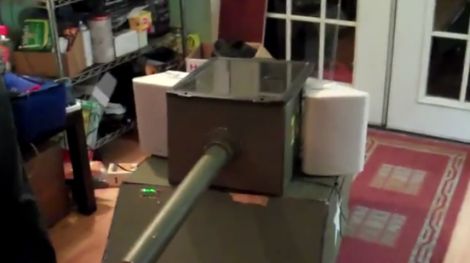
When you think of Memorial Day weekend, what comes to mind? Well around here, all we can think about is this tank cum boombox that Instructable user [Elian_gonzalez] put together.

This build is actually the third version of his Music Tank, and it comes with all sorts of improvements over previous models. The tank is primarily constructed out of plywood, with cavernous compartments for holding all of its goodies. In its capacious body, the tank sports a 60 Watt stereo system that powers a pair of external speakers mounted on either side of the turret. The turret itself contains an air-powered cannon built from PVC tubing, which we imagine can be used to shoot a multitude of different projectiles.

While the concept itself is pretty cool, the tank happens to be nearly self-sustaining as well. The tank has a pretty deep battery well and uses a 50w home made solar panel to help keep things topped off while in use. [Elian] does not specify a total running time, but we imagine that it can go for hours on a nice, sunny day.

Keep reading to see a long video walkthrough of the Music Tank MK3 in action. Continue reading “Music Tank Puts The Boom In Boombox”

Doorbell Hack Makes Coworkers Less Annoying

doorbell_wav_player

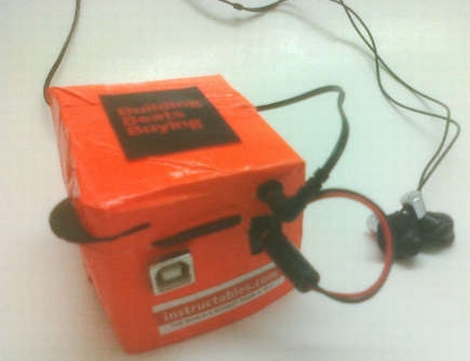
Hackaday reader [Sprite_tm] works in an office building that used to house several businesses, and as a remnant of the previous configuration, a doorbell sits in the hallway just outside his office. Several of his coworkers get a kick out of ringing the doorbell each time they enter the office. While not annoyed at the practice, he was getting tired of the same old “ding-dong” and decided to shake things up a bit.

He wanted to modify the doorbell to play random sounds when triggered, but he was pressed for time as it was March 31st, and he wanted to get it installed for April Fools’ Day. Without any real plan or bill of materials in mind, he pieced things together with whatever he happened to have sitting around.

He used a design borrowed from Elm-chan in order to play wav files from an SD card with an ATTiny85, and used an L293 H-Driver as an improvised sound amplifier. After sorting out some power-related problems, and configuring the circuit to be as stingy with its battery as he could, he declared the project complete. He originally aimed to deadbug everything on the metal sleeve of the SD card socket (which is awesome), but considering the size of the speaker and the battery he selected for the project, he ended up stuffing everything into a cardboard box.

We don’t care too much about how he packaged it, we just wanted to know what his co-workers thought of his doorbell augmentation. In the end, they loved it, but we imagine this doesn’t do anything to discourage any of them from hitting the doorbell multiple times a day.

Stick around to see a quick video of his doorbell hack in action.

Continue reading “Doorbell Hack Makes Coworkers Less Annoying”

Micro Audio Player Can Hide Behind A Postage Stamp

The original iPod shuffle was a pretty small device, there’s no doubt about that. However, in the world of miniature audio players, [Chan] is no slouch either.

A few years ago, he set out to construct a micro audio player that used little more than a small microcontroller and a microSD memory card. He chose an ATinyX5 series microcontroller to run the show, utilizing its pair of PWM output pins to directly drive the speakers. Since there is no built-in amplifier, the audio volume is not loud, but it does sound reasonable if you use a set of high efficiency desktop speakers. He does mention that the sound can easily be amplified after passing the signal through a filter, so there is hope for those of you who like your music turned up to 11.

The only downside we can see is that the audio player can only process Wave files, but it’s hard to expect more from a DIY audio player smaller than a postage stamp. It would be great to see what sort of micro-handiwork [Chan] could perform if he were to update his design and build a full-functioning MP3 player based upon this project.