DIY AVR USB RGB LED Notifier

LED_notifier_in_place

Giving us a chance to break out the TLAs, [Blair] sent in his latest hack where he embedded an RGB LED into his EeePC to display twitter, pidgin, and email notifications. It is based around the ATtiny45, and requires very few additional parts. He based the project on a foundation of work laid by [Dennis Schulze] on notifications and the work of [Dave Hillier] that used V-USB, a library for implementing USB on AVRs. The entire circuit was done freehand and crammed inside the netbook. He says that it is a lot easier to see notifications, even when the laptop is shut.

Related: Email notification via RGB LED

C64 USB Keyboard

breadboard

[Maarten] told us about a C64 USB keyboard that was modified to be used as a standard input device. An interesting aspect of the project is the use of V-USB (formerly known as AVR-USB). V-USB is a software only approach to slow speed USB HID. In essence this is a two fold mod, The C64 keyboard is patched to a PC, and an off the shelf AVR is software-hacked to bit bang the USB communications. The author notes an initial problem with multiple key presses that was later corrected in the application. For the other side of the spectrum, we had covered the C64 twittering client, and a commodore 64 laptop.

World Smallest TV-B-Gone

uTVBG

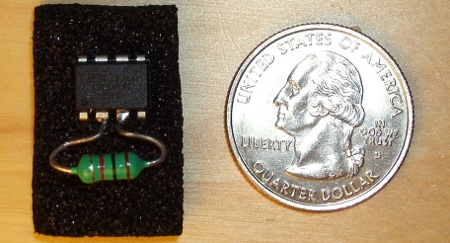
The TV-B-Gone has proven to be a dangerous and versatile gadget. At Interactive Matter, they created an even smaller version with more sneaking potential. Called the µTVBG, it packs an entire TV-B-Gone in a 1.4 x 2.5 cm footprint and even has room for a programming header. He found some high-powered surface-mount IR LEDs that would match the original TV-B-Gone’s power. To drive the board, they used a CR1220 button battery on the bottom of the board. The whole thing is smaller than your thumb and should be easier to hide next time you wreak havoc.

SparkFun Open-sources Latest Kits

09205-5

SparkFun has started to release some of their kits as open-source hardware. Projects such as ClockIt, a simple alarm clock, have their schematics, board designs, and source code released under the CC-by-sa license. Although most of their widgets and projects already had example code and schematics available, they are now using an open-source license. They are joining adafruit and EMSL and others in pushing OSH, but it is interesting to see an established company turn to this. Normally, startups do this to encourage early adoption.

[via adafruit]

Motors And Microcontrollers 101

[youtube=http://www.youtube.com/watch?v=WnWJki-zwsE]

[Humberto] from NerdKits sends in the newest addition to their excellent collection of videos. This video goes over the basics of DC motor control with microcontrollers. They begin by showing nine experiments and observations that can be done by the average hacker with a multimeter, motor, LED, and jumperwire. Using the results from these they show how to model and calculate the properties of a motor. Lastly, it shows how to control a motor using PWM. They have supplemental text and demonstration code for an ATmega168 on their website.

AVR RFID Tag

[pc486] sent in his hack that uses an ATtiny85 to act like an EM4102, a chip used for RFID tags. Minimally, all that is needed is the AVR and a coil, but he recommends some filtering capacitors. Depending on the size of the coil, different frequencies and ranges can be achieved. This project actually includes several hacks, such as using the coil for not only power, but a clock signal. The coil is actually able to power the chip without being connected to the power pins due to clamping diodes on the connected pins. The firmware is short but available on subversion.

Related: Scratch-built RFID tags

64 Synchronizing Fireflies

screenshot_007

[Alex] of tinkerlog created a set of 64 RGB fireflies that synchronize to blink all at once. We covered the kit earlier, but he has assembled a set of 64. Each firefly is independently controlled by an ATtiny13 that reads a phototransistor and lights up an RGB LED. The fireflies are programmed to blink a certain rate, but blink faster if they detect other blinks. After a few cycles, the fireflies begin to blink in unison. When the fireflies are arranged in different configurations, different patterns emerge. He is selling kits and has instructions for building your own. Videos of the fireflies after the jump.

Continue reading “64 Synchronizing Fireflies”