Keychain GPS Finder

gps keychain navigation

With a user interface consisting of two buttons and a three digit display, the GPS finder guides the user back to a saved location. Nine locations can be saved for navigation recall. Press a button to save location and press another button to recall. Each switch has a secondary function, for management purposes such as memory indexes and power features. An AarLogic GPS 3A module and AVR microcontroller make up the guts. With the popularity of Geocaching, this would make an impressive trinket; Leading the hunter to an undocumented treasure.

Arduino Nixie Shield

AN_Board_FirstBuild2

Reader [Bradley] sent in his ArduiNIX project, an Arduino shield designed for driving nixie tubes. The shield allows the Arduino to drive and multiplex nixie tubes without any additional hardware. These antique-looking displays are commonly hacked into clocks. It takes 9 volts from a wall wart and steps it up to over 200V in order to drive the displays. The shield is capable of multiplexing up to 80 individual elements. He has example code for driving a 6-digit display and a clock on his site. He is selling kits and completed shields too.

Related: Victorian nixie tube clock

[thanks Bradley!]

USB Reader For SNES Game Carts

[youtube=http://www.youtube.com/watch?v=Pwq6vRM8U7k]

Reader, [Matthias_H], sent in a video about his USB adapter for SNES game carts. All you have to do is plug in the SNES game cartridge and USB cable, then a ROM file of the game shows up as an external storage device on your computer. After that, you can play the ROM with your choice of emulator. We emailed [Matthias] asking for more information, and he quickly replied with a very nice writeup about the hack that is pasted below.

Update: [Matthias] launched a site for the “snega2usb” with updates on the development of the board and a FAQ.

Continue reading “USB Reader For SNES Game Carts”

Meat Thermometer Using Predictive Filtering

meatthermoafteradjustment

The guys over at NerdKits put together a really informative video on a meat thermometer using predictive filtering which is viewable below. The video, supplemental text, and code is available on their website. The thermometer is constructed of a LM34 temperature sensor attached to a piece of 12 gauge solid copper wire. The thermometer signal is processed on an ATmega168 microcontroller and visualized using the pygame library for python. The real gem in this project is their excellent explanation of predictive filtering, which could easily be utilized for a large number of projects.

Continue reading “Meat Thermometer Using Predictive Filtering”

Controllable Bristlebot

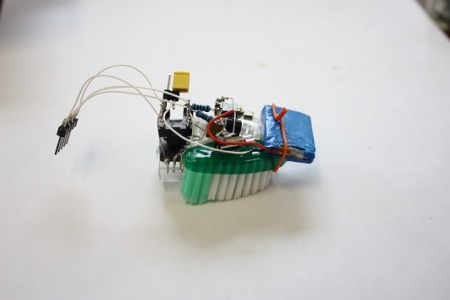
[sprite_tm], whose projects we have covered in the past, took the popular bristlebot to an extreme and created a controllable version. A bristlebot consists of a small vibrating motor mounted with a battery on the head of a toothbrush. These micro-robots buzz around randomly, and he attempted to tame them. He used a platform of twin bristlebots and added an optical sensor from a laser mouse and an ATtiny13. The optical sensor is used to determine the relative motion of the robot, so that the motors can be adjusted accordingly. He also has a video of the bot using the sensor to find a mark on the floor and stay within bounds. Although it isn’t as accurate, it acts like a traditional line-following robot.

Continue reading “Controllable Bristlebot”

RGBike POV

rgbike_pov

[Hazard] wanted a full color POV display for his bike wheel. Adafruit’s SpokePOV is single color and Monkeylectric’s original version didn’t display images. He also balked at the cost and decided to manufacture his own version. It uses 16 RGB LEDs on a single layer board he manufactured himself. It’s an entirely through-hole design to make assembly easy. It uses a hall effect sensor to synchronize the image display. The two main components are an ATmega328p microcontroller, which should make it Arduino compatible, and a TLC5940 PWM LED driver. It’s a very well documented build and certainly a good looking effect.

[via adafruit]