Low-Power Wi-Fi Includes E-Paper Display

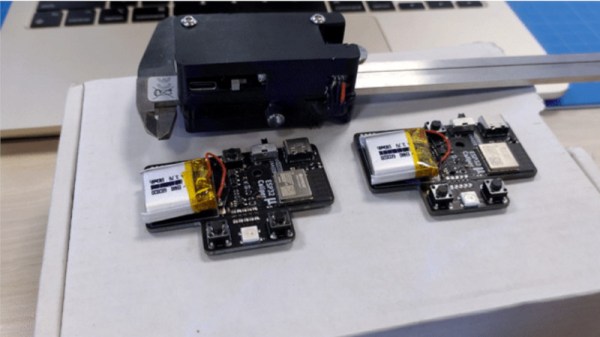
Designing devices that can operate in remote environments on battery power is often challenging, especially if the devices need to last a long time between charges or battery swaps. Thankfully there are some things available that make these tasks a little easier, such as e-ink or e-paper displays which only use power when making changes to the display. That doesn’t solve all of the challenges of low-power devices, but [Albertas] shows us a few other tricks with this development board.

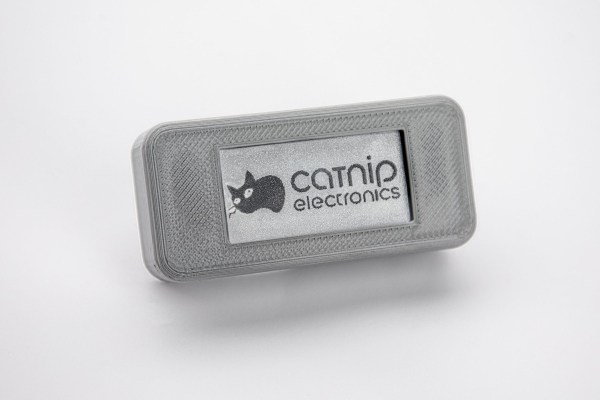
The platform is designed around an e-paper display and is meant to be used in places where something like sensor data needs to not only be collected, but also displayed. It also uses the ESP32C3 microcontroller as a platform which is well-known for its low power capabilities, and additionally has an on-board temperature and humidity sensor. With Bluetooth included as well, the tiny device can connect to plenty of wireless networks while consuming a remarkably low 34 µA in standby.

With a platform like this that can use extremely low power when not taking measurements, a battery charge can last a surprisingly long time. And, since it is based on common components, adding even a slightly larger battery would not be too difficult and could greatly extend this capability as well. But, we have seen similar builds running on nothing more than a coin cell, so doing so might only be necessary in the most extreme of situations.

Stadia Controller’s Two Extra Buttons Get Seen With WebHID

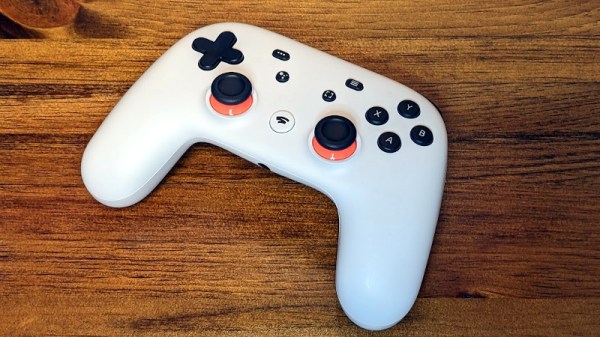
The Google Stadia game streaming service relied on a proprietary controller. It was a pretty neat piece of hardware that unfortunately looked destined for landfills when Google announced that Stadia would discontinue. Thankfully it’s possible to use them as normal gamepads, and related to that, [Thomas Steiner] has a developer blog post about how to talk to the Stadia controller via WebHID. Continue reading “Stadia Controller’s Two Extra Buttons Get Seen With WebHID”

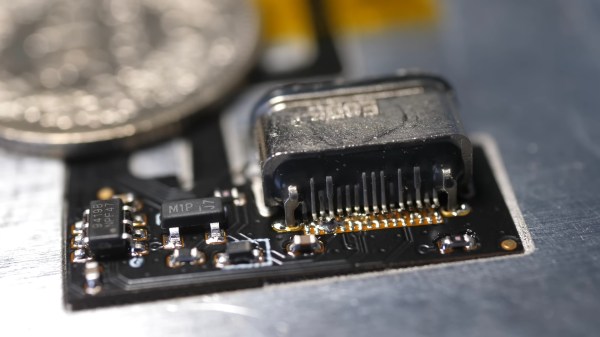
A closeup of a black flexible PCB with an out-of-focus quarter in the background, approximately the same size as the end of the PCB we're looking at. One the right is a USB C connector and to its left are two SMD components with visible pins. Several smaller SMD components (resistors or caps?) are soldered to other parts of the board.

Making The AirPods Pro Case Repairable

Apple is often lauded for its design chops, but function is often sacrificed at the altar of form, particularly when repair is involved. [Ken Pillonel] has made it easier for everyone to replace the batteries or lightning port in the AirPods Pro case. (YouTube)

With such notable hacks as adding USB C to the iPhone already under his belt, [Pillonel] has turned his attention to fixing the notoriously poor repairability of AirPods and AirPods Pro, starting with the cases. While the batteries for these devices are available, replacement Lightning ports are not, and taking the housing apart for the case is an exercise in patience where the results can’t be guaranteed.

He designed a USB C replacement port for broken Lightning ports that is a perfect fit if you happen to get the case apart in one piece. If you’re less successful, he has you covered there too with a 3D printable enclosure replacement.

We sure miss the days of schematic proliferation here at Hackaday, but we know you don’t let glued enclosures or unobtainium parts stand in the way of repairs.

Continue reading “Making The AirPods Pro Case Repairable”

Playing Music On A Custom Flyback Transformer

We’ve seen a number of people create plasma speakers over the years here at Hackaday, so at first blush, the latest Plasma Channel video from [Jay Bowles] might seem like more of the same. Even his overview of the assembly of the 555 timer circuit at the heart of the setup, as detailed as it may be, is something we’ve seen before.

But the back half of the video, where [Jay] talks about the flyback transformer used in this plasma speaker, really got our attention. You see, frustrated by the limited options on the market for AC flybacks, he set out to put together a custom transformer utilizing a 3D printed secondary former of his own design.

Winding an early version of the secondary with a drill.

Armed with a spare core, [Jay] spent some time in CAD coming up with his secondary. Despite never having built a flyback before, his first attempt managed to produce some impressive sparks — that is, until it arced through the printed plastic and released the critical Magic Smoke. Inspired by this early success, he went back to the digital drawing board and cranked his way through several different iterations until he came up with one that didn’t self-destruct.

Continue reading “Playing Music On A Custom Flyback Transformer”

Electronic Shoe Explores Alleged Chess Misbehavior

A few months ago, a scandal erupted in the chess world which led to some pretty wild speculation around a specific chess player. We won’t go into any of the details except to say that there is virtually no physical evidence of any method this player allegedly used to cheat in a specific in-person chess match. But [Teddy Warner] and partner [Jack Hollingsworth] were interested in at least providing a proof-of-concept for how this cheating could have been done, though, and came up with this device which signals a chess player through a shoe.

The compact device is small enough to fit in the sole of one of the player’s shoes, and is powered by an ATtiny412 microcontroller paired with a HC-06 Bluetooth module. The electronics are fitted into a 3D printed case along with a small battery which can then be placed into the sole of a shoe, allowing the wearer to feel the vibrations from a small offset-weight motor. With a second person behind a laptop and armed with a chess engine, the opponent’s moves can be fed into the computer and the appropriate response telegraphed through the shoe to the player.

While [Teddy] and [Jack] considers the prototype a success in demonstrating the ease at which a device like this could be used, and have made everything related to this build open source, this iteration did have a number of issues including that the motor buzzing was noticeable during play, and that his chess engine made some bizarre choices in the end game. It also requires the complicity of a second person, which is something this other chess cheating machine does away with. They also note that it’s unlikely that any chess players at the highest levels use devices like these, and that other chess experts have found no evidence of any wrongdoing in this specific scandal.

Continue reading “Electronic Shoe Explores Alleged Chess Misbehavior”

A MiniDisc Walkman, a MiniDisc and a pair of BlueTooth earphones

Wireless MiniDisc Walkman Has Bluetooth Inside

For most people, MiniDisc is just one of countless media formats that became obsolete when music went online. Not so for MiniDisc enthusiasts, many of whom still use a MiniDisc deck at home and a MiniDisc Walkman on the go. Unfortunately, high-end headphones these days often come with Bluetooth connectivity only, necessitating the use of clunky signal converters that ruin the tidy compactness of those portable players. [Daniel Rojas] cleverly solved this problem by directly adding Bluetooth functionality to a Sony MZ-R500 MiniDisc Walkman.

MiniDisc Walkmen are famously compact devices, so adding a full circuit board to one wasn’t easy. [Daniel] managed to squeeze the PCB from a Schosche wireless audio transmitter inside the front of the Walkman, next to the control buttons. He connected the audio signal to the transmitter’s input and rewired the little-used “End Search” button to become the “Pair” button. Sadly, the recording head and some associated hardware had to be removed in order to make space for the new component, turning the Walkman into a playback-only device.

A MiniDisc Walkman, opened up and showing a BlueTooth module inside
Lots of flying wires and Kapton tape, but it all fits.

The project’s GitHub page contains a detailed walk-through of the modification process that should enable anyone to reproduce the end result. [Daniel] didn’t arrive at the optimal solution in one go however, and he describes the three major revisions of his project in separate sections. In the first iteration for example, the Bluetooth module caused interference on the audio signal, which [Daniel] solved by adding isolation transformers in version two. He also includes a page full of technical information he collected during his project, which will come in handy if you ever want to perform other modifications on your MiniDisc Walkman.

We’ve seen several impressive projects where Bluetooth interfaces were added to pre-Bluetooth gadgets, ranging from tube radios to 8-track players. Some, like the iPod Nano, are even more space-constrained than a MiniDisc Walkman. Continue reading “Wireless MiniDisc Walkman Has Bluetooth Inside”

Spray-On Keyboard Is As Light As It Gets

We’ve all seen those ‘nothing’ keyboards, where the keys themselves are not much more than projected lasers, and users are asked to ritually beat their poor fingertips into the table — which has little give and even less clack. Well, a team at the Korea Advanced Institute of Science and Technology have come up with a way to eschew the keyboard altogether.

Essentially, the user wears a thin, breathable mesh of silver nanowires coated in gold, which is then embedded in a polyurethane coating. The mesh is sprayed onto their forearms and hands on the spot, and the mesh terminates in a small enclosure that is also worn on the skin. This contains a small Bluetooth unit that beams data back to a computer, a machine, or potentially another user wearing the same type of unit.

As the skin stretches and contorts, the mesh senses small electrical changes within. These changes become meaningful with applied AI, which maps the changes to specific gestures and manual tasks. To do this, the team started with teaching it to distinguish between patterns from tasks like typing on a phone, typing on a regular keyboard, and then holding and interacting with six differently-shaped simple objects.

The team isn’t stopping there — they plan to try capturing a larger range of motion by using the nanomesh on multiple fingers. In addition to facilitating communication between humans and machines, this could leave a huge fingerprint on gaming and VR.