We’ve seen a number of people create plasma speakers over the years here at Hackaday, so at first blush, the latest Plasma Channel video from [Jay Bowles] might seem like more of the same. Even his overview of the assembly of the 555 timer circuit at the heart of the setup, as detailed as it may be, is something we’ve seen before.
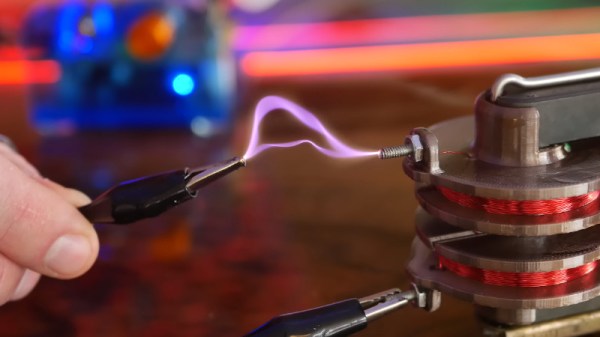
But the back half of the video, where [Jay] talks about the flyback transformer used in this plasma speaker, really got our attention. You see, frustrated by the limited options on the market for AC flybacks, he set out to put together a custom transformer utilizing a 3D printed secondary former of his own design.
Winding an early version of the secondary with a drill.
Armed with a spare core, [Jay] spent some time in CAD coming up with his secondary. Despite never having built a flyback before, his first attempt managed to produce some impressive sparks — that is, until it arced through the printed plastic and released the critical Magic Smoke. Inspired by this early success, he went back to the digital drawing board and cranked his way through several different iterations until he came up with one that didn’t self-destruct.
A few months ago, a scandal erupted in the chess world which led to some pretty wild speculation around a specific chess player. We won’t go into any of the details except to say that there is virtually no physical evidence of any method this player allegedly used to cheat in a specific in-person chess match. But [Teddy Warner] and partner [Jack Hollingsworth] were interested in at least providing a proof-of-concept for how this cheating could have been done, though, and came up with this device which signals a chess player through a shoe.
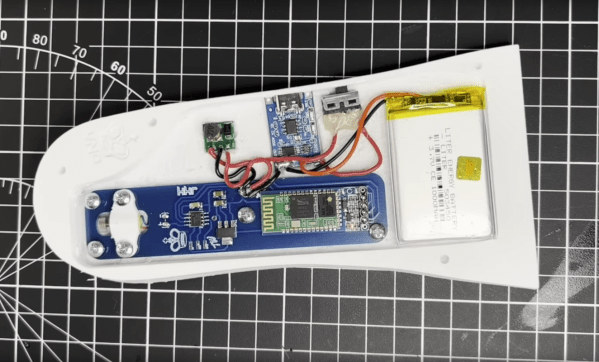
The compact device is small enough to fit in the sole of one of the player’s shoes, and is powered by an ATtiny412 microcontroller paired with a HC-06 Bluetooth module. The electronics are fitted into a 3D printed case along with a small battery which can then be placed into the sole of a shoe, allowing the wearer to feel the vibrations from a small offset-weight motor. With a second person behind a laptop and armed with a chess engine, the opponent’s moves can be fed into the computer and the appropriate response telegraphed through the shoe to the player.
While [Teddy] and [Jack] considers the prototype a success in demonstrating the ease at which a device like this could be used, and have made everything related to this build open source, this iteration did have a number of issues including that the motor buzzing was noticeable during play, and that his chess engine made some bizarre choices in the end game. It also requires the complicity of a second person, which is something this other chess cheating machine does away with. They also note that it’s unlikely that any chess players at the highest levels use devices like these, and that other chess experts have found no evidence of any wrongdoing in this specific scandal.
For most people, MiniDisc is just one of countless media formats that became obsolete when music went online. Not so for MiniDisc enthusiasts, many of whom still use a MiniDisc deck at home and a MiniDisc Walkman on the go. Unfortunately, high-end headphones these days often come with Bluetooth connectivity only, necessitating the use of clunky signal converters that ruin the tidy compactness of those portable players. [Daniel Rojas] cleverly solved this problem by directly adding Bluetooth functionality to a Sony MZ-R500 MiniDisc Walkman.
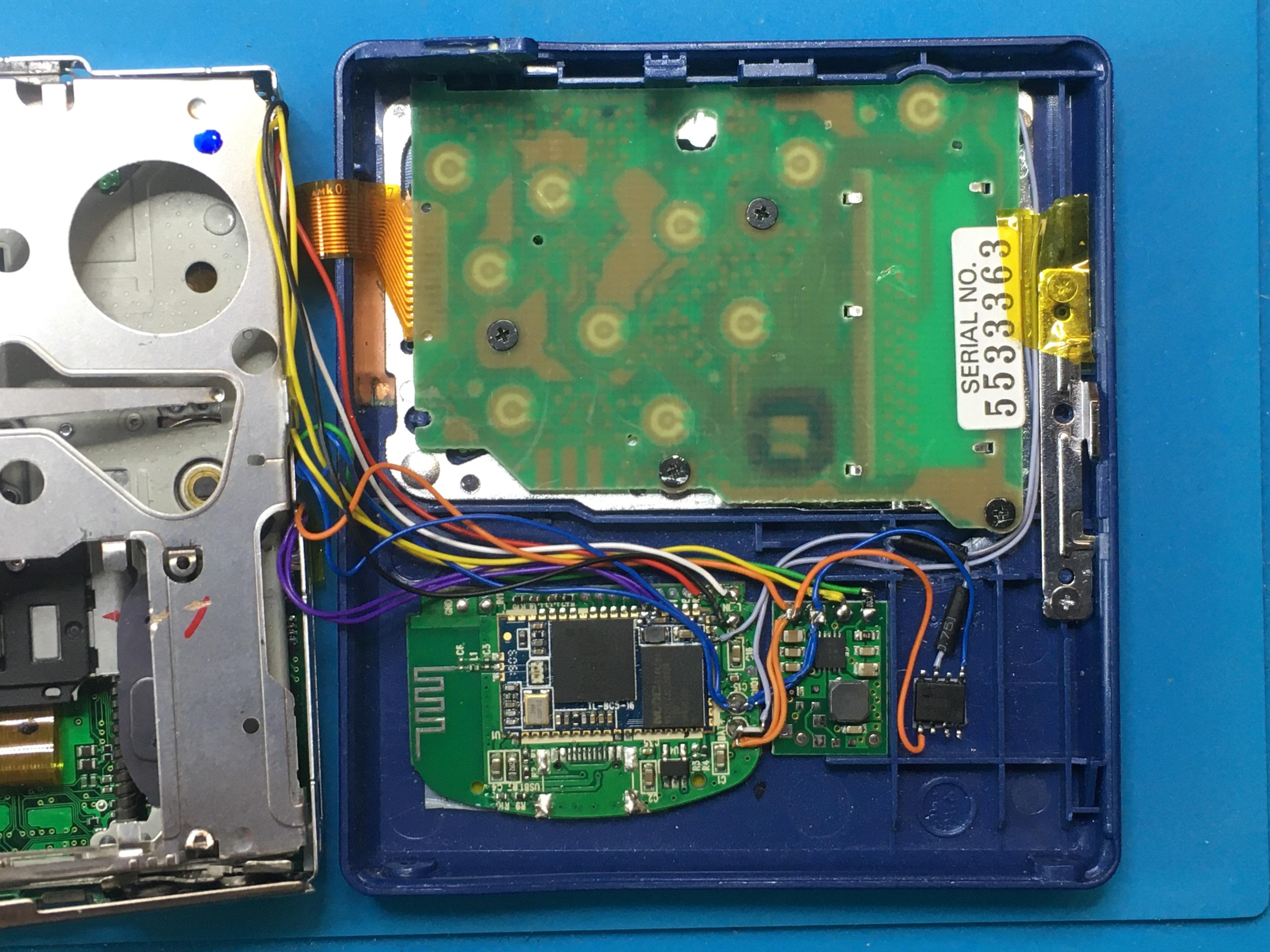
MiniDisc Walkmen are famously compact devices, so adding a full circuit board to one wasn’t easy. [Daniel] managed to squeeze the PCB from a Schosche wireless audio transmitter inside the front of the Walkman, next to the control buttons. He connected the audio signal to the transmitter’s input and rewired the little-used “End Search” button to become the “Pair” button. Sadly, the recording head and some associated hardware had to be removed in order to make space for the new component, turning the Walkman into a playback-only device.
Lots of flying wires and Kapton tape, but it all fits.
The project’s GitHub page contains a detailed walk-through of the modification process that should enable anyone to reproduce the end result. [Daniel] didn’t arrive at the optimal solution in one go however, and he describes the three major revisions of his project in separate sections. In the first iteration for example, the Bluetooth module caused interference on the audio signal, which [Daniel] solved by adding isolation transformers in version two. He also includes a page full of technical information he collected during his project, which will come in handy if you ever want to perform other modifications on your MiniDisc Walkman.
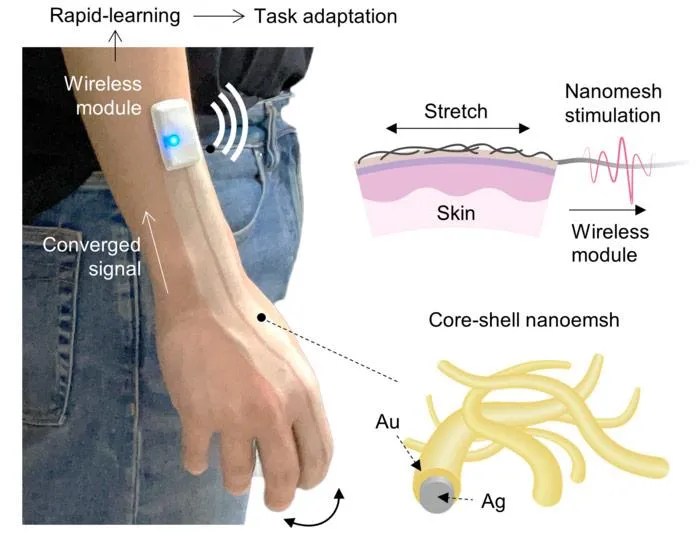
We’ve all seen those ‘nothing’ keyboards, where the keys themselves are not much more than projected lasers, and users are asked to ritually beat their poor fingertips into the table — which has little give and even less clack. Well, a team at the Korea Advanced Institute of Science and Technology have come up with a way to eschew the keyboard altogether.
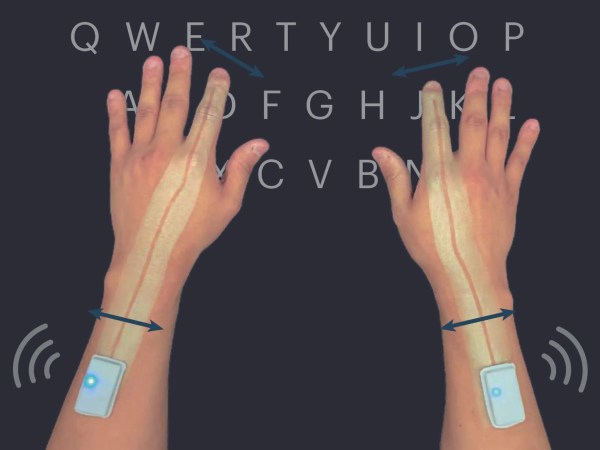
Essentially, the user wears a thin, breathable mesh of silver nanowires coated in gold, which is then embedded in a polyurethane coating. The mesh is sprayed onto their forearms and hands on the spot, and the mesh terminates in a small enclosure that is also worn on the skin. This contains a small Bluetooth unit that beams data back to a computer, a machine, or potentially another user wearing the same type of unit.
As the skin stretches and contorts, the mesh senses small electrical changes within. These changes become meaningful with applied AI, which maps the changes to specific gestures and manual tasks. To do this, the team started with teaching it to distinguish between patterns from tasks like typing on a phone, typing on a regular keyboard, and then holding and interacting with six differently-shaped simple objects.
The team isn’t stopping there — they plan to try capturing a larger range of motion by using the nanomesh on multiple fingers. In addition to facilitating communication between humans and machines, this could leave a huge fingerprint on gaming and VR.
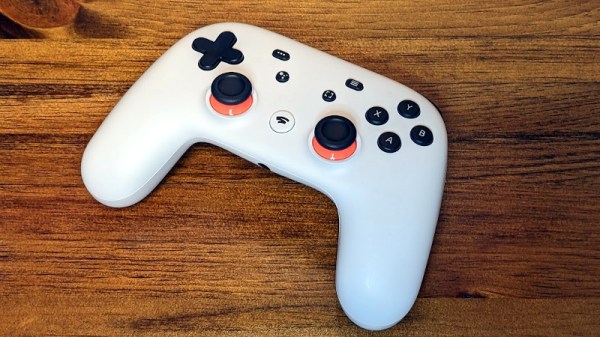
In just a few days time, Google’s Stadia game streaming service will finally shut down for good. But not for any technical reason, mind you. Microsoft has managed to demonstrate that streaming modern games over home and even mobile Internet connections is viable with their immensely popular Game Pass Ultimate service, and NVIDIA is making similar inroads with GeForce Now. No, like so many of Google’s failed experiments, they’ve simply decided they don’t want to play anymore and are taking their proverbial ball home back with them.
But not all is lost for those who shelled out money for Stadia’s wares. Not only will Google be refunding any money players spent on games, but a company representative has also announced they will be releasing a tool to unlock the latent Bluetooth capabilities of the service’s custom controller — hopefully stemming a surge of e-waste before it starts.
Thanks for playing, chumps.
In a forum thread titled “A Gift from the Stadia Team”, Community Manager [DanFromGoogle] explains that information on how you can enable Bluetooth on the controller will be coming next week. In the meantime, he also announced the immediate release of “Worm Game”, a tech demo that staffers apparently used to test out capabilities of the streaming service before its public release.
That this ridiculously simple game, which looks all the world like something a kid would crank out during an after-school programming class, will be the final title to officially release on Stadia is a stunningly insulting epitaph for the fledgling service. But then, Google seems to have developed a special affinity for mistreating their most loyal cattle users over these last few years.
Enabling Bluetooth on a game controller might not seem like such a big deal, but in this case, it will potentially give the piece of hardware a second chance at life. The Stadia controller is unique in that it uses WiFi to communicate directly over the Internet to Google’s streaming service, so once those servers stop responding, the orphaned device will end up being little more than a curiosity. Although it does technically work over USB, being able to use it wirelessly will not only provide a more modern experience, but help justify its internal batteries.
The last time we mentioned the Stadia controller, it was to document one user’s attempt to rid it of an internal microphone they didn’t feel comfortable with. Now that the service is being put to pasture, we wonder if we’ll start to see more hacks involving the admittedly interesting peripheral. We’ll certainly be keeping an eye out for them, but if you see anything we miss, you know where to send it.
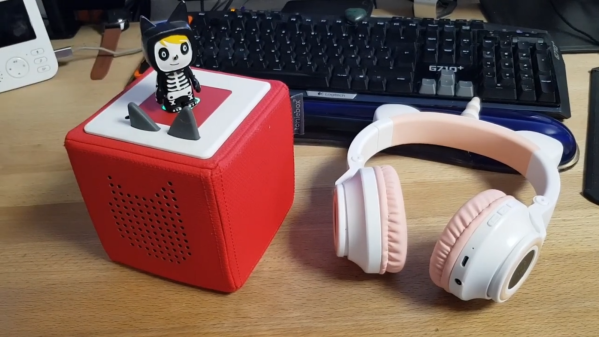
The Toniebox is a toy that plays stories and songs for kids to listen to. Audio content can be changed by placing different NFC enabled characters that magnetically attach to the top of the toy. It can play audio via its built-in speaker or through a wired headphone connected to the 3.5 mm stereo jack. Using the built in speaker could sometimes be quite an irritant, especially if the parents are in “work from home” mode. And wired headphones are not a robust alternative, specially if the kid likes to wander around or dance while listening to the toy. We guess the manufacturers didn’t get the memo that toddlers and cables don’t mix well together. Surprisingly, the toy does not support Bluetooth output, so [g3gg0] hacked his kids Toniebox to add Bluetooth audio output.
[g3gg0] first played with the idea of transmitting audio via an ESP32 connected to the I²S interface, running a readily available A2DP library. While elegant, it is a slightly complex and time consuming solution. Using the ESP32 would also have affected the battery life, given the ESP32’s power hungry nature. Continue reading “CUTTING CABLES CURES TANGLED CORD CHAOS”→
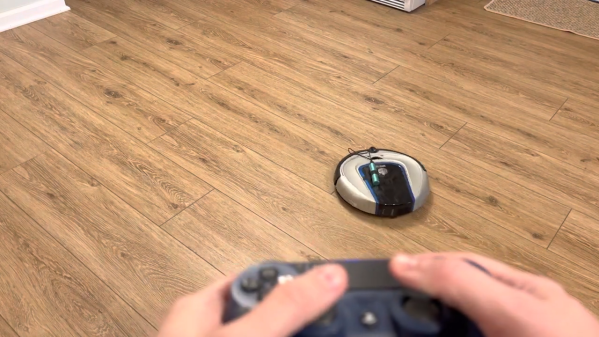
To our way of thinking, the whole purpose behind robotic vacuum cleaners is their autonomy. They’re not particularly good at vacuuming, but they are persistent about it, and eventually get the job done with as little human intervention as possible. So why in the world would you want to convert a robotic vacuum to radio control?
For [Lucas], the answer was simple: it was a $20 yard sale find, so why not? Plus, he’s got some secret evil plan to repurpose the suckbot for autonomous room mapping, which sounds like a cool project that would benefit from a thorough knowledge of this little fellow’s anatomy and physiology. The bot in question is a Hoover Quest. Like [Lucas] we didn’t know that Hoover made robotic vacuums (Narrator: they probably don’t) but despite generally negative online reviews by users, he found it to be a sturdily built and very modular and repairable unit.
After an initial valiant attempt at reverse engineering the bot’s main board — a project we encourage [Lucas] to return to eventually — he settled for just characterizing the bot’s motors and sensors and building his own controller. The Raspberry Pi Zero he chose may seem like overkill, but he already had it set up to talk to a PS4 game controller, so it made sense — right up until he released the Magic Smoke within it. A backup Pi took the sting out of that, and as the brief video below shows, he was finally able to get the bot under his command.
[Lucas] has more plans for his new little buddy, including integrating the original sensors and adding new ones. Given its intended mission, we’d say a lidar sensor would be a good addition, but that’s just a guess. Whatever he’s got in store for this, we’re keen to hear what happens.