Open Source Electric Vehicle Charging

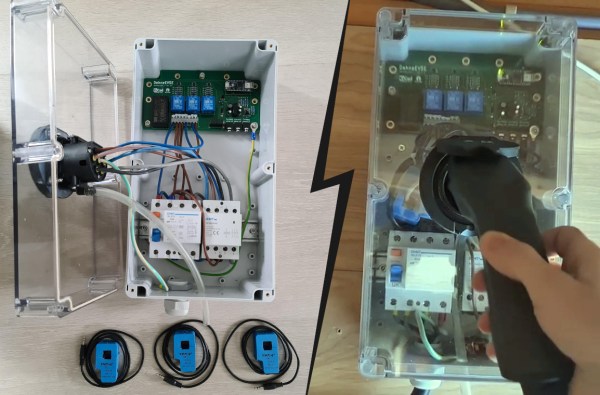
Electric vehicles are becoming more and more common on the road, but when they’re parked in the driveway or garage there are still some kinks to work out when getting them charged up. Sure, there are plenty of charging stations on the market, but they all have different features, capabilities, and even ports, so to really make sure that full control is maintained over charging a car’s batteries it might be necessary to reach into the parts bin and pull out a trusty Arduino.

This project comes to us from [Sebastian] who needed this level of control over charging his Leaf, and who also has the skills to implement it from the large high voltage switching contactors to the software running its network connectivity and web app. This charging station has every available feature, too. It can tell the car to charge at different rates, and can restrict it to charging at different times (if energy is cheaper at night, for example). It is able to monitor the car’s charge state and other information over the communications bus to the vehicle, and even has a front-end web app for monitoring and controlling the device.

The project is based around an Arduino Nano 33 IoT with all of the code available on the project’s GitHub page. While we would advise using extreme caution when dealing with mains voltage and when interfacing with a high-ticket item like an EV, at first blush the build looks like it has crossed all its Ts and might even make a good prototype for a production unit in the future. If you don’t need all of the features that this charging station has, though, you can always hack the car itself to add some more advanced charging features.

Continue reading “Open Source Electric Vehicle Charging” →

The Difference Between 4WD And AWD

Car manufacturers will often tout a vehicle’s features to appeal to the market, and this often leads to advertisements featuring a cacophony of acronyms and buzzwords to dazzle and confuse the prospective buyer. This can be particularly obvious when looking at drivelines. The terms four-wheel drive, all-wheel drive, and full-time and part-time are bandied about, but what do they actually mean? Are they all the same, meaning all wheels are driven or is there more to it? Let’s dive into the technology and find out.

Part-Time 4WD

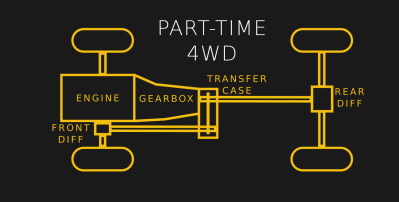
Part-time four-wheel drive is the simplest system, most commonly found on older off-road vehicles like Jeeps, Land Cruisers and Land Rovers up to the early 1990s, as well as pickup trucks and other heavy duty applications. In these vehicles, the engine sends its power to a transfer case, which sends an equal amount of torque to the front and rear differentials, and essentially ties their input shafts together. This is good for slippery off-road situations, as some torque is provided to both axles at all times. However, this system has the drawback that it can’t be driven in four-wheel drive mode at all times. With the front and rear differentials rotating together, any difference in rotational speed between the front and rear wheels — such as from turning a corner or uneven tyre wear — would cause a problem. The drive shaft going to one differential would want to turn further than the other, a problem known as wind-up.

Continue reading “The Difference Between 4WD And AWD” →

The Rise And Fall Of The Fan Car

The advent of aerodynamic wings in motorsport was one of the most dramatic changes in the mid-20th century. Suddenly, it was possible to generate more grip at speed outside of altering suspension setups and fitting grippier tyres. However, it was just the beginning, and engineers began to look at more advanced ways of generating downforce without the drag penalty incurred by fitting wings to a racecar.

Perhaps the ultimate expression of this was the fan car. Mechanically complex and arguably dangerous, the technology offered huge downforce with minimal drag. However, the fan car’s time in the spotlight was vanishingly brief, despite the promise inherent in the idea. Let’s take a look at the basic theory behind the fan car, how they worked in practice, and why we don’t see them on racetracks today. Continue reading “The Rise And Fall Of The Fan Car” →

Custom Ignition For A Citroën Mehari

The 20th century saw a great many cheap, utilitarian vehicles enter the marketplace. Cars like the Mini and the original Jeep offered low-cost, no-frills motoring. However, they were also decidedly low-tech, and not as reliable as modern cars by a long shot. The Citroën Mehari fits into this category neatly, and when [FVFILIPPETTI] grew tired of the unreliable points ignition system, he decided to build a more modern replacement.

The system is based around at ATmega328, the venerable chip many are familiar with from its starring role in the Arduino Uno. The chip tracks engine position with a magnet mounted on the flywheel combined with a hall-effect sensor, passed through an optocoupler to avoid nasty high-voltage spikes from the spark system interfering with the microcontroller. The chip then charges the ignition coil and fires it at the necessary time to ignite the air fuel mixture.

Old-school mechanical ignition systems were, if we’re honest, terrible compared to more modern solutions. This build has rewarded [FVFILIPPETTI] with a far more reliable ride, which we’re sure is very satisfying. If all this hacking has you thirsty for an automotive project of your own, dive into our primer on how to get into cars!

Sony’s Electric Car Now Road Testing In Austria

The Consumer Electronics Show was not typically a place for concept cars, and Sony aren’t known as a major automaker. However, times change, and the electric transport revolution has changed much. At the famous trade show, Sony shocked many by revealing its Vision-S concept — a running, driving, prototype electric car.

Far from a simple mockup to show off in-car entertainment or new fancy cameras, Sony’s entry into the automotive world is surprisingly complete. Recently, the Japanese tech giant has been spotted testing the vehicle on the road in Austria, raising questions about the future of the project. Let’s dive in to what Sony has shown off, and what it means for the potential of the Vision-S.

Continue reading “Sony’s Electric Car Now Road Testing In Austria” →

How To Get Into Cars: Drifting Mods

Drifting is a hugely popular motorsport unlike any other, focusing on style and getting sideways rather than the pursuit of the fastest time between two points. It’s a challenge that places great demands on car and driver, and proper attention to setup to truly succeed. Here’s a guide to get your first drift build coming together.

Getting Sideways (And Back Again)

Drift cars are specialised beasts, and like any motorsport discipline, the demands of the sport shape the vehicle to suit. If you’re looking to drift, you’ll want to choose a project car with a front-engined, rear-wheel drive layout. While it’s somewhat possible to drift with other layouts, the act of kicking out the tail and holding a slide at speed is best achieved with the handling characteristics of such a vehicle. It all comes down to weight transfer and breaking traction at will. Of course, over the years, certain cars have become expensive on the second-hand market due to their drift prowess, so you may have to get creative if your first choice isn’t available at your budget. It pays to talk to the drifters down at your local track to get an idea of which cars in your area are the best bet for a drift build. Once you’ve got yourself a car, you can get down to installing mods!

Continue reading “How To Get Into Cars: Drifting Mods” →

Road Pollution Doesn’t Just Come From Exhaust

Alumni from Innovation Design Engineering at Imperial College London and the Royal College of Art want to raise awareness of a road pollution source we rarely consider: tire wear. If you think about it, it is obvious. Our tires wear out, and that has to go somewhere, but what surprises us is how fast it happens. Single-use plastic is the most significant source of oceanic pollution, but tire microplastics are next on the naughty list. The team calls themselves The Tyre Collective, and they’re working on a device to collect tire particles at the source.

Continue reading “Road Pollution Doesn’t Just Come From Exhaust” →