Two Factor Authentication With The ESP8266

Google Authenticator is a particularly popular smartphone application that can be used as a token for many two factor authentication (2FA) systems by generating a time-based one time password (referred to as TOTP). With Google Authenticator, the combination of your user name and password along with the single-use code generated by the application allows you to securely authenticate yourself in a way that would be difficult for an attacker to replicate.

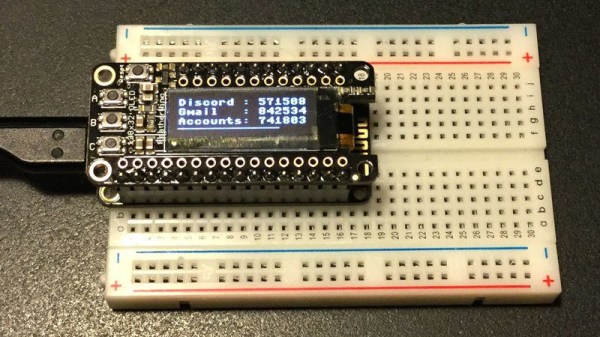
That sounds great, but what if you don’t have a smartphone? That’s the situation that [Lady Ada] recently found herself in, and rather than going the easy route and buying a hardware 2FA token that’s compatible with Google Authenticator, she decided to build one herself based on the ESP8266. With the hardware and source documented on her site, the makings of an open source Google Authenticator hardware token are available for anyone who’s interested.

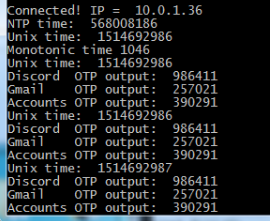
Generated codes can also be viewed via serial.

For the hardware, all you need is the ESP8266 and a display. Naturally [Lady Ada] uses her own particular spin on both devices which you can purchase if you want to create an identical device, but the concept will work the same on the generic hardware you’ve probably already got in the parts bin. Software wise, the code is written in CircuitPython, a derivative of MicroPython, which aims to make microcontroller development easier. If you haven’t tried MicroPython before, grab an ESP and give this a roll.

Conceptually, TOTP is relatively simple. You just need to know what time it is, and run an SHA1 hash. The time part is simple enough, as the ESP8266 can connect to the network and get the current time from NTP. The calculation of the TOTP is handled by the Python code once you’ve provided it with the “secret” pulled from the Google Authenticator application. It’s worth noting here that this means your 2FA secrets will be held in clear-text on the ESP8266’s flash, so try not to use this to secure any nuclear launch systems or anything, OK? Then again, if you ever lose it the beauty of 2-factor is you can invalidate the secret and generate a new one.

We’ve covered the ins and outs of 2FA applications before here at Hackaday if you’d like to know more about the concept, in addition to previous efforts to develop a hardware token for Google Authenticator.

Bodging On More Flash Memory

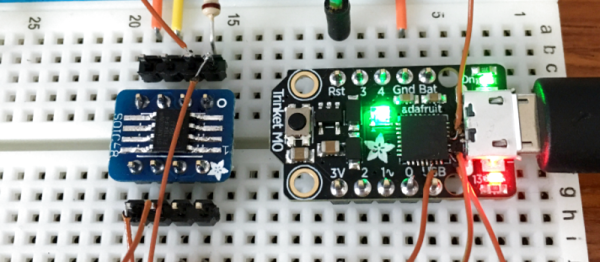
[Curmudegeoclast] found himself running out of flash memory on a Trinket M0 board, so he decided to epoxy and fly-wire a whopping 2 MB of extra flash on top of the original CPU.

We’ll just get our “kids these days” rant out of the way up front: the stock SAMD21 ARM chip has 256 kB (!) of flash to begin with, and is on a breakout board with only five GPIO pins, for a 51 kB / pin ratio! And now he’s adding 2 MB more? That’s madness. The stated reason for [Curmudegeoclast]’s exercise is MicroPython, which takes up a big chunk of flash just for the base language. We suspect that there’s also a fair amount of “wouldn’t it be neat?” in the mix as well. Whatever.

The hack is a classic. It starts off with sketchy wires soldered to pins and breadboarded up with a SOIC expander board. Following that proof of concept, some degree of structural integrity is brought to the proceedings by gluing the flash chip, dead-bug, on top of the microcontroller. We love the (0805?) SPI pullup resistor that was also point-to-point soldered into place. We would not be able to resist the temptation to entomb the whole thing in hot glue for “long-term” stability, but there are better options out there, too.

This hack takes a minimalist board, and super-sizes it, and for that, kudos. What would you stuff into 2 MB of free flash on a tiny little microcontroller? Any of you out there using MicroPython or CircuitPython care to comment on the flash memory demands? 256 kB should be enough for anyone.

These Five Hackaday.io Members Just Won Fancy New CircuitPython Boards

Just a few hours ago, we had a HackChat over on Hackaday.io with Adafruit discussing CircuitPython, their new extension to the MicroPython codebase. During the chat, the folks at Adafruit took questions and asked participants in the chat what they’d like to build with some cool new hardware. These CircuitPlayground M0 Express boards are brand new, unreleased hardware. Really cool stuff.

The winners of these unreleased boards, and the projects they’ll be using them for are: [RaidDude8] for a light painting system, [gelatinousslime] for a ‘magic wand’ for his daughter that reacts to gestures, [Neon22] for a multiuser game using Neopixels, [turbinenreiter] for a gravity demonstrator using Neopixels and the accelerometer, and [todbot] for a Powermate knob USB HID clone.

During the chat, The folks at Adafruit talked about their additions to MicroPython. It’s a rework of the API, provides better support for more platforms, and extends the entire thing to microcontrollers.  If you like Python and want to get into microcontrollers, this one is for you.

If you missed the chat, you can still check out Adafruit’s live stream right here, or the transcript right here. Below, you can check out Lady Ada awarding the new boards after the break.

We have a few more HackChats coming up in the next few weeks, one with [Sprite_TM], inevitably discussing why he won’t do a crowdfunding campaign for his tiny, tiny Game Boy, an RF talk with [Jenny List], and a chat with Sparkfun. You can check out the upcoming HackChats here. Want to get in on the action? Request to join the HackChat and you’re in.

Continue reading “These Five Hackaday.io Members Just Won Fancy New CircuitPython Boards”

Friday Hack Chat: CircuitPython With Adafruit Engineers

What the heck is CircuitPython? Get that question answered along with many more during this Friday’s Hack Chat. Three engineers from Adafruit join us as [Ladyada], [Tony DiCola], and [Scott Shawcoft] lead a CircuitPython discussion at Noon PST on 1/27/17.

CircuitPython is Adafruit’s new extension on the MicroPython codebase. It adds support for SAMD21 processors in MicroPython and reworks the API for better support across platforms and better documentation. Does this still sound like jibberish? The Python programming language has been extended to microcontrollers. CircuitPython is furthering that work and this Hack Chat is the perfect opportunity to talk with the people who are doing that work. They will also be doing a giveaway of five CircuitPlayground m0 Express boards (brand new, not yet released hardware).

Don’t miss this Hack Chat! Here’s a handy web tool to help convert Friday, January 27 at noon PST to your local time.

Here’s How to Take Part:

join-project-team-message-buttons
Buttons to join the project and enter Hack Chat

Hack Chats are live community events that take place in the Hackaday.io Hack Chat group messaging. Visit that page (make sure you are logged in) and look for the “Join this Project Button” in the upper right. Once you are part of the project, that button will change to “Team Messaging” which takes you to the Hack Chat.

You don’t have to wait for Friday, join Hack Chat whenever you like and see what the community is currently talking about.