Binary Clock Uses DS3232 RTC

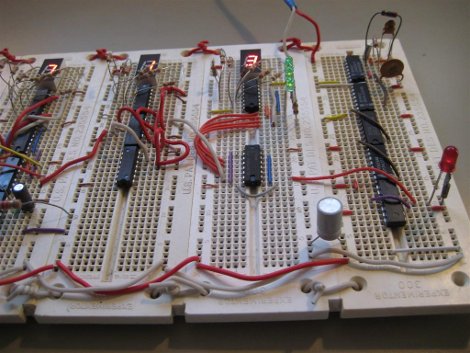
[Kenneth Finnegan] quenches our clock-a-day compulsion with his Arduino based binary timepiece. The clock uses a 5×7 LED matrix as a display and shows month, day, and time. He sourced a DS3232 real-time clock which automatically compensates for temperature to achieve very accurate time keeping. We like the super-cap circuit he added to keep the RTC running if the power is cut.

Is an Arduino overkill here? Well, the code is certainly not filling the 16k available on the ATmega168. At $4.32, the $1-2 you could save by using a lower-grade chip is not worth having to rewrite the code developed during prototyping. [Kenneth] also mentions that these projects usually only hang around for a few weeks before they’re re-purposed for the next endeavor.

Take a look at [Kenneth’s] superb hardware walk through in the video after the break.  If you’re a fan of clean breadboarding, he’s also made a time-lapse of the circuit building process.

Continue reading “Binary Clock Uses DS3232 RTC”

Hybrid Analog/binary Clock, The MK2

[Kieran] let us know about his hybrid analog/binary clock. The circuitry behind the clock is nothing too new. An Arduino combined with a Chronodot to produce an accurate clock. What we really enjoyed however was the creative implementation of an old British Telecom Linesman’s Multimeter as the case. The analog meter acts as the seconds hand, while a another display made of LEDs diffused with stripboard is the binary clock. The end product is nothing short of ingenuitive.

Hackaday Links: Sunday January 24

Everyone Remembers Free day right? [The Ideanator’s] Bus Pirate came in such a nice red box – he decided to make it his permanent case.

[Chico] is in the middle of making a CNC, but decided to make some music with the steppers in the mean time.

What looks like an old wooden box is actually [Ludvig’s] super sweet retro arcade cabinet. Complete with a giant emergency stop red button.

Who says Legos are dead? [Carl] used them to create a simple and cheap diffraction grating projector. Including video!

[Torchris] used an Ethernet shield exactly as it was designed, sending data over Ethernet. Still a nice hack for those needing help working with Ethernet shields and Arduino.

Finally [Robert] let us know about a friends Arduino Binary Clock. But we think his elegant use of tape and a sand blaster to engrave glass is cooler.

Ideas Based On Photo Frame Clock

[Mahto] bought a digital picture frame but the image quality turned out to be terrible. He decided to turn it into a clock in a unique way. He loaded up 720 images, one for each minute in a twelve hour period. He then used an Arduino to simulate a button once a minute, cycling to the next image.

This is a simple solution and it works. Visions of hardcore hacks danced through our head when we first looked at this. We’re wondering if there is a way to inject image data into the frame’s memory? How about rewriting the SD card location where the image file that’s currently being displayed is stored, then having the frame reload the picture? Those are projects for a snowy weekend, but we’re sure that [Mahto] finished this hack long before we would have because he kept it simple.

Sooner or later we’re going to need a category for all of these clock hacks.

[Thanks Drone]

The Most Complicated, And Simplest Binary Clocks.

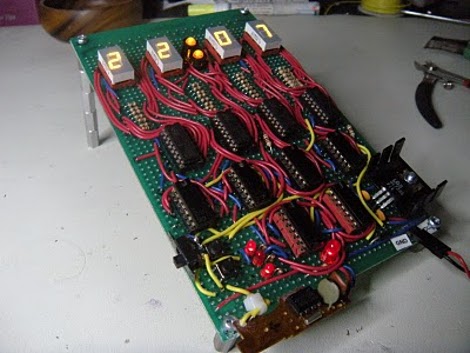
We were going to take a break from posting clocks. Really we were. This one came in the tip line today though, and we just couldn’t pass it up. [Alex] has built, what might be the most complicated clock we’ve seen. At least, it would appear that way initially. This Binary clock shows Hours, Minutes, Seconds, Days, and Months. He started with a picaxe, but eventually settled on an Mbed. Yes, he knows it is overkill, but it worked out pretty well.

As for the simplest, that came into our tip line as well. [Toby] sent this in, and agrees with us that it is hardly worthy of being called a hack. However, in light of the complicated one above, we didn’t see any harm in posting its opposite. Check it out after the break.

Continue reading “The Most Complicated, And Simplest Binary Clocks.”

Wine Glass Time Keeper

We’ve seen a glut of time-keeping projects lately. We guess time was the original motivator for technology so we’re okay with it (but we’re not calling ourselves Clockaday quite yet). This clock, or more appropriately this timer, is a homemade hourglass that [Andrei] put together. The finished look is simple but he put some real time into its production.

The glass portion is a combination of two wine glasses. He removed the stems, ground the bottoms flat, then drilled holes to allow the sand to pass. He used plumbers putty around the top of the upturned reservoir to create a temporary bowl of water which cooled the glass during drilling. This prevented cracking by keeping the friction generated heat at bay. Working with the glass took a total of around five hours.

To assemble, he epoxied the two wine glasses together, routed out a ring in the wood bases for the lips, and used dowels to connect the two ends. [Andrei] concluded that the gentle slope at the bottom of the wine glasses is not the ideal shape as some sand can get stuck in them. Perhaps champagne flutes for his next build? At any rate, we think it’s a unique, non-automated hourglass build.

Volt Meter Clock

The Volt meter clock continues our recent slew of interesting clock projects. Though considerably easier to read than the resistor clock, it is in the same frame of mind. Set up to look like the face of an analog volt meter, it almost looks like something official or scientific. Since [Jon] couldn’t simply drop a clock mechanism in, he used a PIC microcontroller. The circuit is pretty simple, but he deserves some credit just for the unique layout.