Cyberdeck

This End Times Cyberdeck Is Apocalypse-Ready

In the cyberdeck world, some designs are meant to evoke a cyberpunk vibe, an aesthetic that’s more lighthearted than serious. Some cyberdecks, though, are a little more serious about hardening their designs against adverse conditions. That’s where something like the ARK-io SurvivalDeck comes into play.

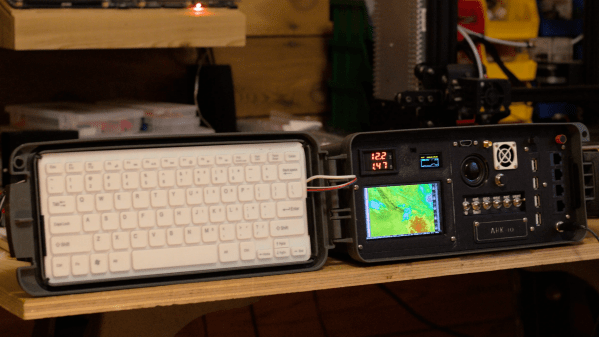
Granted, there does seem to be at least a little lightheartedness at play with the aptly named [techno-recluse]’s design. It’s intended to be an “Apocalypse Repository of Knowledge”, which may be stretching the point a bit. But it does contain an impressive amount of tech —  wide-band software defined radio (SDR) covering HF to UHF, GPS module, a sensor for air pressure, temperature, and humidity, and a Raspberry Pi 3B running Kali Linux. Everything is housed in a waterproof ammo can; a 3D printed bezel holds an LCD touchscreen and a satisfying array of controls, displays and ports. The lid of the ammo can holds a keyboard, which was either custom-made to precisely fit the lid or was an incredibly lucky find.

There’s a lot to like about this build, but our favorite part is the external dipole for receiving NOAA weather satellite imagery. The ability to monitor everything from the ham bands to local public service channels is a nice touch too. And we have no complaints about the aesthetics or build quality either. This reminds us of an earlier cyberdeck with a similar vibe, but with a more civilian flavor.

Thanks to [Kate] for the tip.

[via Tom’s Hardware]

A Tidy Cyberdeck That You Could Take Anywhere.

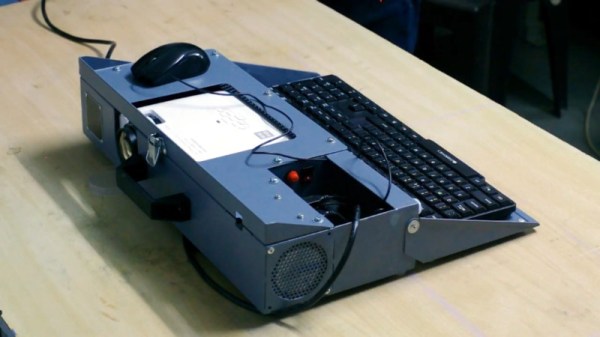
The cyberdeck trend has evolved to a relatively straightforward formula: take a desktop computer and strip it to its barest essentials of screen, PCB, and input device, before clothing it in a suitably post-apocalyptic or industrial exterior. Sometimes these can result in a stylish prop straight from a movie set, and happily for [Patrick De Angelis] his Raspberry Pi based cyberdeck (Italian, Google Translate link) fits this description, taking the well-worn path of putting a Raspberry Pi and screen into a ruggedised flight case. Its very unremarkability is the key to its success, using a carefully-selected wired keyboard and trackpad combo neatly dodges the usual slightly messy arrangements of microcontroller boards.

If this cyberdeck has a special feature it’s in the extra wireless interfaces and the stack of antennas on its right-hand side. The Pi touchscreen is a little small for the case and perhaps we’d have mounted it centrally, but otherwise this is a box we could imagine opening somewhere in the abandoned ruins of a once-proud Radio Shack store for a little post-apocalyptic Hackaday editing. After all, your favourite online tech news resource doesn’t stop because the power’s gone out!

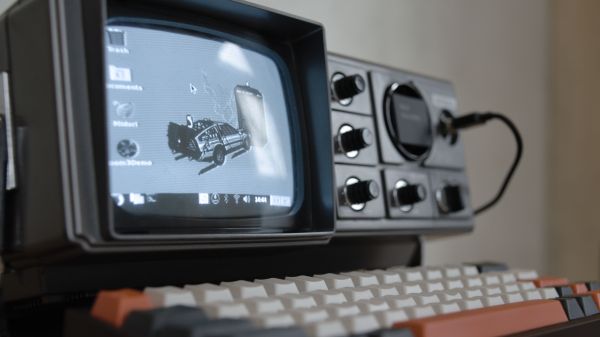
We’d Like, Totally Carry This Retro Boombox Cyberdeck On Our Shoulder

Cyberdeck. For those of a certain age, the ‘deck’ part conjures visions of tape decks, be they cassette, 8-track, or quarter-inch, and we seriously have to wonder why haven’t seen this type of build before. But here we are, thanks to [bongoplayingmonkey]’s Sanyo Cyberdeck, a truly retro machine built into a cool old boombox.

According to [bongoplayingmonkey], this was a unicorn of a build wherein everything more or less came together, soup to nuts. Right now, [bongoplayingmonkey] is cracking the nuts of a few remaining issues, like calibrating the analog VU meter that inspired the build in the first place. The plan is to use that to indicate various analog things such as battery power and the WiFi signal.

Luckily, everything survived the teardown, parts-wise. That huge knob has a new life has a rotary encoder for scrolling and middle click. And the VU meter made it too, thank Zod. This baby has full mouse controls thanks to a PS/2 joystick and a pair of vintage momentary buttons are likely chrome and bakelite to round out the look.

So apparently [bongoplayingmonkey]’s personal jury is still out on whether this is a blasphemous build or a divine ‘deck, but we say one thing is for sure: this is definitely art.

Unfortunately, the cassette deck didn’t survive. Otherwise, we might have to question its categorization — is it still a boombox if the tape deck works? This, however, is definitely a laptop that grew up to be a cyberdeck.

Thanks for the tip, [Blasto]!

A musical cyberdeck

Musical Cyberdeck Is Part Synth, Part MIDI Controller, And All Cool

When a new project type starts to get a lot of exposure, it’s typically not long before we see people forking the basic concept and striking out in a new direction. It happened with POV displays, it happened with Nixie clocks, and now, it seems to be happening with cyberdecks. And that’s something we can get behind, especially with cyberdecks built to suit a specialized task, like this musical cyberdeck/synth.

Like many musicians, [Benjamin Caccia] felt like he needed a tool to help while performing with his band “Big Time Kill.” He mainly needed to trigger track playbacks on the fly, but also wanted something to act as a mega-effects pedal and standalone synth. And while most of that could be done with an iPad, it wouldn’t look as cool as a cyberdeck. The build centers around a Raspberry Pi 4 and a 7″ LCD display. Those sit on top of a 25-key USB MIDI keyboard and a small mixer. Alongside the keyboard is a USB keypad, which has custom mappings to allow fast access to buried menu functions in the cyberdeck’s Patchbox OS. Everythign was tied together on a 3D-printed frame; the video below shows it in action, and that it sounds as good as it looks.

We think [Benjamin]’s cyberdeck came out great. Need to see some other specialized cyberdecks? Why not take a look at this battle-ready cyberdeck, one that aims to be distraction-free, or a cyberdeck for patrolling the radioactive wastelands.

Continue reading “Musical Cyberdeck Is Part Synth, Part MIDI Controller, And All Cool”

Hands-On: MNT Reforms The Laptop

When we met our contact from MNT in the coffee shop, he was quietly working away on his laptop. Jet black and standing thick it was like an encyclopedia that didn’t quite blend in with the sea of silver MacBook lookalikes on the surrounding tables. After going through all the speeds and feeds we eagerly got our 64 piece driver kit out to open it up and see what made this marvel tick, but when the laptop was turned over it became clear that no tools were needed. The entire bottom of the machine was a single rectangle of transparent acrylic revealing everything from sharp white status LEDs on the bare mainboard to individual 18650 LiFePO4 battery cells in a tidy row. In a sense that’s the summary of the entire product: it’s a real laptop you can use to get work done, and every element of it from design to fabrication is completely transparent.

a view of the inside of a MNT Reform laptop, showing screen and keyboard
The MNT Reform

The device pictured here is called the Reform and is designed and manufactured by MNT, a company in Berlin, Germany (note MNT stands for MNT, it’s not an acronym). The Reform is a fully open source laptop which is shipping today and available via distribution through Crowd Supply. If the aesthetic doesn’t make it clear the Reform is an opinionated product designed from the ground up to optimize for free-as-in-freedom: from it’s solid metal chassis to the blob-free GNU/Linux distribution running inside.

We’re here to tell you that we’ve held one, it’s real, and it’s very well built.

Continue reading “Hands-On: MNT Reforms The Laptop”

Is It A Cyberdeck Or A Vintage Toshiba?

Cyberdecks, the portable computers notable for a freely expressed form factor, owe much to post-apocalyptic sci-fi. But they are not always the most practical devices. There’s a reason that all laptops share a very similar form factor: it’s a convenient and functional way to make a computer to take anywhere. So for the ideal compromise, why not make a cyberdeck from a vintage laptop? That’s exactly what [Valrum] has done with a non-functioning Toshiba 3100/20, upgrading the display and slipping in a Raspberry Pi 4, along with a handy removable USB e-ink supplementary screen (The red/black rectangle to the right of the main screen).

These older machines were so bulky that once their original hardware is removed there is plenty of space for upgrades. Even the screen enclosure is big enough to hide the LCD driver board behind a modern panel.  It follows a well-worn path for Raspberry Pi builds of using a Teensy as a USB keyboard controller, but unexpectedly the stock keyboard has been entirely replaced with a hand-wired one, which is nicely executed to appear superficially as though it was original. In an amusing twist this machine has no battery, not because it wouldn’t be possible but because the original Toshiba didn’t have one either. The USB ports are brought out to the space where the floppy would once have been.

With a plentiful supply of unexceptional or non functional older laptops to be had it’s clear that there’s a rich vein to be mined in this type of build. It’s something we’ve seen done before, in a more famous Toshiba laptop.

Paper Pi Is An Ergonomic Cyberdeck Meant For Thumbs

What’s the fastest way to master console stuff like screen or emacs? Force yourself to use it exclusively, of course. But maybe you’d be tempted to cheat with a desktop. We know we would be. In that case, you ought to build a console-only cyberdeck like this sweet little thing by [a8skh4].

This cyberdeck serves another purpose as well — the keyboard layout is Miryoku, so [a8ksh4] can get more practice with that at the same time. Fortunately, the layout is built for emacs.

Inside is a Raspberry Pi 4 and what looks to be an Arduino handling the keyboard input. The Paper Pi spotlights a 4.2″ e-ink screen between a split thumb keyboard that’s made of soft, silent, tactile switches.

Since they’re SMD, [a8ksh4] made clever use of header pins to get them to work with protoboard. As much as we love the keyboard, it would be awesome to see a few switches on the shoulders or even the back that make use of the rest of the fingers. Check out more build pictures in the gallery.

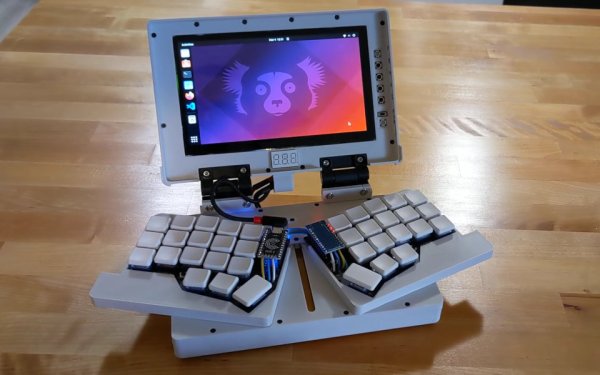
We love to see cyberdecks with split keyboards, because you shouldn’t have to sacrifice ergonomics in a portable computer. Here’s one that comes in three pieces, making it easy to get the spacing between the halves just right.

Via r/cyberdeck