Hacking An IButton

breadboard1

Maxim’s iButtons, which are small ICs in button-sized disks, are starting to show up in more and more places. They have a range of uses, from temperature loggers to identification, and all use the 1-wire protocol to communicate. Over a furrtek, they hacked an iButton used for buying things from vending machines and created an infinite money cheat. They built a small rig based on the ATmega8 to read and write data to the chip. The data was encrypted, so it wasn’t feasible to put an arbitrary amount on the card. Instead, they used a similar technique to the Boston subway hack and restored a previous state to the iButton after something was bought. They also created a hand-held device to backup and restore the contents of a button for portable hacking.

[Thanks furrtek]
Intel 8008 Clock

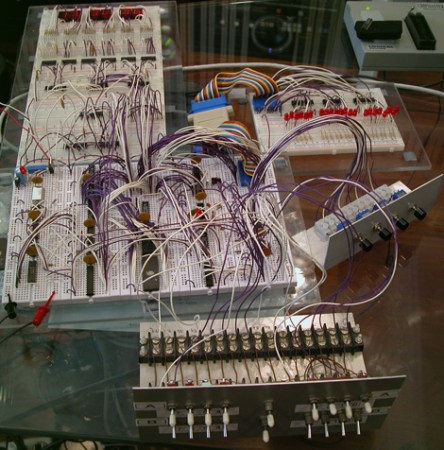
Every year [Len Bales] designs and builds a new clock. His 2006 clock runs on the classic Intel 8008 microprocessor. The design is definitely not for the faint of heart, but he includes all code, diagrams and a good description on his site. The project is an interesting look into the not-so-distant past of computing. While the function of the project is a clock, it is actually a fully programmable 8008 computer running at 500khz with 16k of memory space and 4io ports. [Len] also links a lot of useful 8008 resources for anyone wanting to tackle a project of their own.

DIY AVR USB RGB LED Notifier

LED_notifier_in_place

Giving us a chance to break out the TLAs, [Blair] sent in his latest hack where he embedded an RGB LED into his EeePC to display twitter, pidgin, and email notifications. It is based around the ATtiny45, and requires very few additional parts. He based the project on a foundation of work laid by [Dennis Schulze] on notifications and the work of [Dave Hillier] that used V-USB, a library for implementing USB on AVRs. The entire circuit was done freehand and crammed inside the netbook. He says that it is a lot easier to see notifications, even when the laptop is shut.

Related: Email notification via RGB LED

Capacitive Discharge Cutting

capacitive discharge cutting

Capacitive discharge cutting provides more control than linear transformer versions. A very large capacitor is charged to a precise voltage and then discharged through the material to produce a controlled cut. The same device can also be used for spot and tab welding. A video of copper roof flashing being cut is embedded below. An example of a linear transformer can be found in our our How-to: build your own spot welder.

Continue reading “Capacitive Discharge Cutting”

Firework Ignitors And Controllers Roundup

fireworks ignitor

With the 4th of July around the corner, we thought it would be a good idea to give a controller wrap up and show you how to make some ignitors. Last year we covered a microcontroller based fireworks launcher. If you like the idea of a controller but don’t want to run all the wire, we have the wireless fireworks controller. Adding a little twist to the wireless scene are cell phone triggered fireworks. Maybe controllers are not your cup of tea, you could try to microwave your fireworks. After the break we show you how to make ignitors from a diode and a match.

Continue reading “Firework Ignitors And Controllers Roundup”

AVR RFID Tag

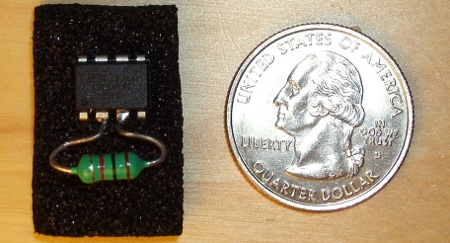
[pc486] sent in his hack that uses an ATtiny85 to act like an EM4102, a chip used for RFID tags. Minimally, all that is needed is the AVR and a coil, but he recommends some filtering capacitors. Depending on the size of the coil, different frequencies and ranges can be achieved. This project actually includes several hacks, such as using the coil for not only power, but a clock signal. The coil is actually able to power the chip without being connected to the power pins due to clamping diodes on the connected pins. The firmware is short but available on subversion.

Related: Scratch-built RFID tags

Home Made Solder Pot

solder pot

Our reader [Damir] built a home made soldering pot. It can be used to solder and desolder components. To remove a through hole component, the solder side is placed in the bath. Then the component is removed with pliers. It is also possible to solder components, by placing the leads in the molten solder; similar to wave soldering. Another common use is tinning self stripping wire. The insulation of the wire is designed to burn off, allowing the strip and tin phase to be single step. This solder pot would be a nice addition to the hacker’s soldering station we had covered in 2008. For more pictures, check out the photo gallery. In the video embedded below, a transformer is easily removed from a modem.

Continue reading “Home Made Solder Pot”