How-To: Web Server On A Business Card (Part 1)

For years, Microchip PIC microcontrollers dominated; PIC16F84 hacks and projects are everywhere. The 8-bit 16F and 18F lines are supported by several coding environments and easy-to-build serial port programmers. Microchip’s 16-bit PIC24F is cheaper, faster, and easier to work with, but largely absent from hacks and projects.

We recently used a Microchip PIC24F microcontroller in a mini web server project, but didn’t find many introductory references to link to. In this article we’ll cover some PIC 24F basics: support circuitry and programming options. We’ll also talk about our favorite features, and how we figured them out. Our next article will outline a web server on a business card based on the PIC 24F.

Continue reading “How-To: Web Server On A Business Card (Part 1)”

Mister Jalopy On NPR


[Mister Jalopy] is an outspoken recycler. He believes it is wrong that we live in a “throw away culture” and we here at Hackaday tend to agree. There is so much potential left in products, long after they may have given up their original purpose. He has been pushing to get companies to work with the public, to encourage re purposing and hacking. The belief is that it can only improve a company’s relationship with their customers.

[Mister Jalopy] appeared on National Public Radio today. They discussed the benefits of making your own stuff, as well as the legalities involved with modifying off the shelf products.

We covered his open house last October. Tons of fascinating stuff there.

[via Hoopty Rides]

12 Channel LiFe Battery Management System


With fuel prices rising, EVs are becoming more an more stylish. This bit of floor tile wrapped hardware is actually a 12 channel battery management system designed to handle Lithium Iron battery packs. It’s designed to take power from a standard lead acid charger and supply the batteries with their maximum charge current. The cost and complexity of the BMS has been a major stumbling block in the past, so it’s interesting to see these come around. If you need more than 12 cells, multiple boards can be used.

ThingamaKIT: Make Your Own Thingamagoop


Bleep Labs’ Thingamagoop is a small synthesizer packed with wacky controls for generating unique sounds; you can now build an expanded version yourself with the ThingamaKit. Made “because there are not nearly enough beeping, zapping, bixxerfouping, anthropomorphic synthesizer monsters in the world,” it generates sounds of different pitches depending on the type and intensity of light hitting a photocell on the front panel. It’s most unique feature, is its LEDacle, which is something like a tentacle with an LED on the end. This can be pointed towards the photocell to modulate the sound. Output is through a 1/4″ audio jack.

Bleep Labs sells fully assembled Thingamagoops for $100, but the new DIY kit is available for half price. The kit version of the Thingamagoop has more controls, two photosensors, and two LEDacles. You can buy it with or without the case, and it doesn’t require any complex wiring. Look after the break for video of some Thingamagoops in action.

Continue reading “ThingamaKIT: Make Your Own Thingamagoop”

Wide Angle Lens For The ATC2K Video Camera


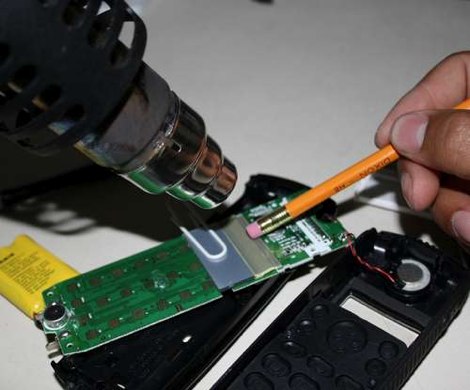
We just ordered up a new ATC3K video camera from Oregon Scientific for some, uh projects. (No, not our new porn site.) If you’ve got one of the older ATC2K cams, you can mod it a bit to avoid dropping another C-note on the new model. [Carlos] wrote up his mod to remove and replace the original narrow lens with a wide angle fisheye lens. The install requires some significant effort and some case modding – probably not a good idea if the waterproof feature is dear to you.

Lamination For PC Board Etching


If you’ve ever tried ironing laser printed paper to transfer the toner, you know that it can be slightly frustrating. [Dave] sent in an interesting twist on this method. The laser printer is used to print onto paper from a magazine and then the board and paper are both run through a laminating machine six or seven times. From the writeup, it looks like this technique works great. (You’ll probably need a printer with a manual feed tray to get it to print on the magazine paper)