The Final Days Of The Fire Lookouts

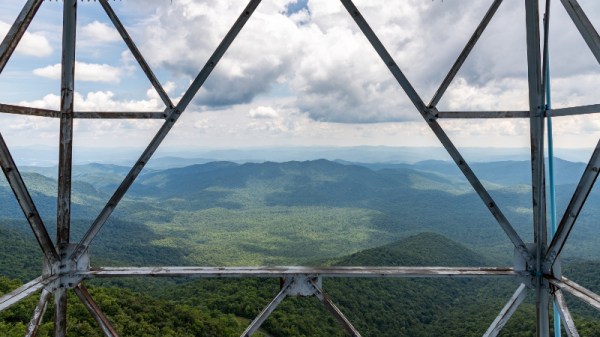
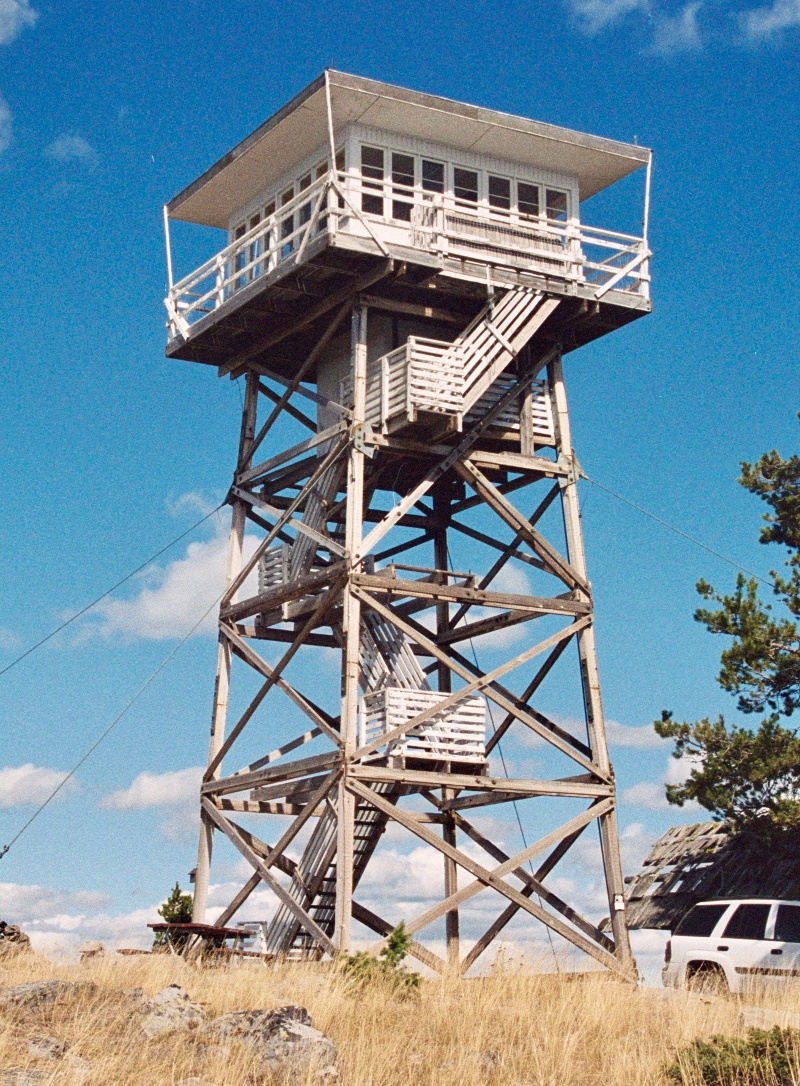
For more than a century, the United States Forest Service has employed men and women to monitor vast swaths of wilderness from isolated lookout towers. Armed with little more than a pair of binoculars and a map, these lookouts served as an early warning system for combating wildfires. Eventually the towers would be equipped with radios, and later still a cellular or satellite connection to the Internet, but beyond that the job of fire lookout has changed little since the 1900s.

Like the lighthouse keepers of old, there’s a certain romance surrounding the fire lookouts. Sitting alone in their tower, the majority of their time is spent looking at a horizon they’ve memorized over years or even decades, carefully watching for the slightest whiff of smoke. The isolation has been a prison for some, and a paradise for others. Author Jack Kerouac spent the summer of 1956 in a lookout tower on Desolation Peak in Washington state, an experience which he wrote about in several works including Desolation Angels.

But slowly, in a change completely imperceptible to the public, the era of the fire lookouts has been drawing to a close. As technology improves, the idea of perching a human on top of a tall tower for months on end seems increasingly archaic. Many are staunchly opposed to the idea of automation replacing human workers, but in the case of the fire lookouts, it’s difficult to argue against it. Computer vision offers an unwavering eye that can detect even the smallest column of smoke amongst acres of woodland, while drones equipped with GPS can pinpoint its location and make on-site assessments without risk to human life.

At one point, the United States Forest Service operated more than 5,000 permanent fire lookout towers, but today that number has dwindled into the hundreds. As this niche job fades even farther into obscurity, let’s take a look at the fire lookout’s most famous tool, and the modern technology poised to replace it.

Continue reading “The Final Days Of The Fire Lookouts”

Military Gliders Are Making A Comeback, This Time In Unmanned Form

Sun Tzu said, “The line between disorder and order lies in logistics.” This is as true in the modern world as it was 2500 years ago, and logistics have helped win and lose many wars and battles over the centuries. To this end, Logistical Gliders Inc. is developing one-time use, unmanned delivery gliders, for the US Military.

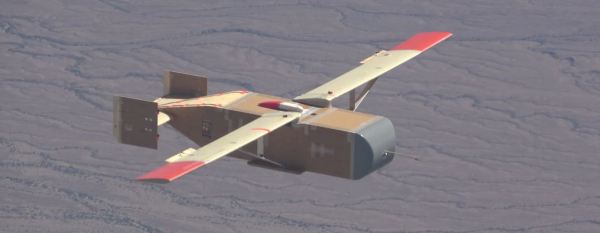
Reminiscent of the military gliders used in WW2, the gliders are designed to be dropped from a variety of aircraft, glide for up to 70 miles and deliver supplies to troops in the field. Specifically intended to be cheap enough to be abandoned after use, the gliders are constructed from plywood, a few aluminum parts for reinforcement and injection molded wing panels. There are two versions of the glider, both with huge payloads. The LG-1K, with a payload capacity of 700 lbs/320 kg and the larger LG-2K, with a payload capacity of 1,600 lbs/725 kg. Wings are folded parallel to the fuselage during transport and then open after release with the help of gas springs. The glider can either do a belly landing in an open area or deploy a parachute from the tail at low altitude to land on the crushable nose.

Gliders like these could be used to deliver supplies after natural disasters, or to remote locations where road travel is difficult or impossible while reducing the flight time required for conventional aircraft. Powered UAVs could even be used to carry/tow a glider to the required release point and then return much lighter and smaller, reducing the required fuel or batteries.

Drones are already used to deliver medical supplies in Rwanda and Ghana, and it’s possible to build your own autonomous unmanned glider. Check out the video after the break to see the big boys in action. Continue reading “Military Gliders Are Making A Comeback, This Time In Unmanned Form”

Flying Batteries For Drones

Power is the bane of drone pilots. You’d like to fly longer which means a bigger battery. But a bigger battery will weigh more which leads to less flight time. You have to strike a balance and for most consumer drones that balance is about 20 minutes of flight time, more or less. Researchers at Berkeley have a different idea: don’t use a bigger battery, but simply replace the battery in flight.

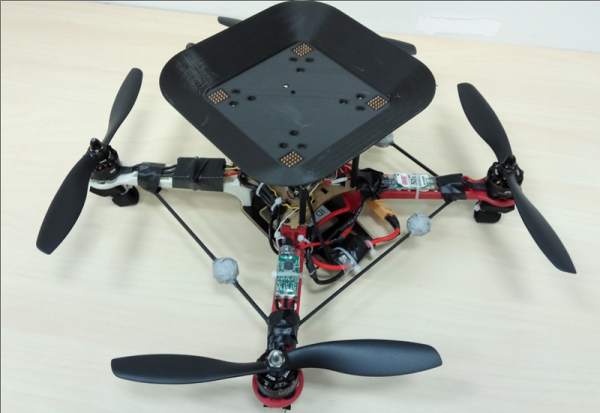
The idea isn’t completely new. After all, many planes refuel in flight — a technically sophisticated operation, but it occurs every day. The scheme here is to have a primary battery and a secondary battery. When the secondary battery is low, the drone ejects it while running on the primary battery. Another secondary battery flies to the drone and docks with it becoming the new main power source.

Continue reading “Flying Batteries For Drones”

Use Jedi Mind Tricks To Control Your Next Drone Swarm

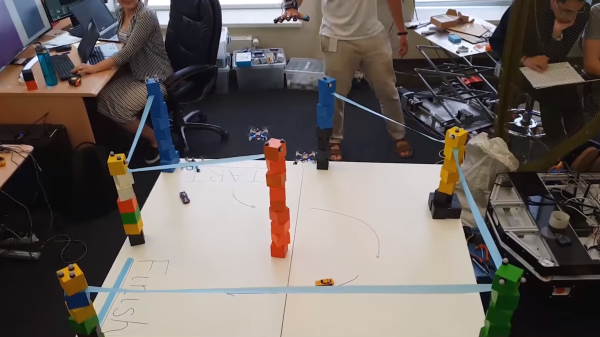
Controlling a single drone takes up a considerable amount of concentration and normally involves wearing silly goggles. It only gets harder if you want to control a swarm. Researchers at Skolkovo Institute of Technology decided Jedi mind tricks were the best way, and set up swarm control using hand gestures. 

We’ve seen something similar at the Intel Booth of the 2016 Makerfaire. In that demo, a single drone was controlled by hand gesture using a hacked Nintendo Power Glove. The Skoltech approach has a lot of innovation building on that concept. For one, haptics in the finger tips of the glove provide feedback from the current behavior of the drones. Through their research they found that most operators quickly learned to interpret the vibrations subconsciously.

It also increased the safety of the swarm, which is a prime factor in making these technologies usable outside of the lab. Most of us have at one point frantically typed commands into a terminal or pulled cords to keep a project from destroying itself or behaving dangerously. Having an intuitive control means that an operator can react quickly to changes in the swarm behavior.

The biggest advantage, which can be seen in the video after the break, is that the hand control eliminates much of the preprogramming of paths that is currently common in swarm robotics. With tech like this we can imagine a person quickly being trained on drone swarms and then using them to do things like construction surveys with ease. As an added bonus the researchers were nice enough to pre-submit their paper to arxiv if any readers would like to get into the specifics.

Continue reading “Use Jedi Mind Tricks To Control Your Next Drone Swarm”

Gatwick Drone Incident: Police Still Clueless

Quietly released and speedily buried by Parliamentary wrangles over Brexit is the news that Sussex Police have exhausted all lines of inquiry  into the widely publicised drone sighting reports that caused London’s Gatwick Airport to be closed for several days last December. The county’s rozzers have ruled out 96 ‘people of interest’ and combed through 129 separate reports of drone activity, but admit that they are no closer to feeling any miscreant collars. There is no mention of either their claims at the time to have found drone wreckage, their earlier admissions that sightings might have been of police drones, or even that there might have been no drone involved at all.

Regular readers will know that we have reported extensively the sorry saga of official reactions to drone incidents, because we believe that major failings in reporting and investigation will accumulate to have an adverse effect on those many people in our community who fly multi-rotors. In today’s BBC report for example there is the assertion that 109 of the drone sightings came from “‘credible witnesses’ including a pilot and airport police” which while it sounds reassuring is we believe a dangerous route to follow because it implies that the quality of evidence is less important than its source. It is crucial to understand that multi-rotors are still a technology with which the vast majority of the population are still unfamiliar, and simply because a witness is a police officer or a pilot does not make them a drone expert whose evidence is above scrutiny.

Whichever stand you take on the drone sightings at Gatwick and in other places it is clear that Sussex Police do not emerge from this smelling of roses and that their investigation has been chaotic and inept from the start. We believe that there should be a public inquiry into the whole mess, so that those embarrassing parts of it which they and other agencies are so anxious to quietly forget can be subjected to scrutiny. We do not however expect this to happen any time soon.

Keystone Kops header image: Mack Sennett Studios [Public domain].

ESPcopter: A Fully Customizable Drone

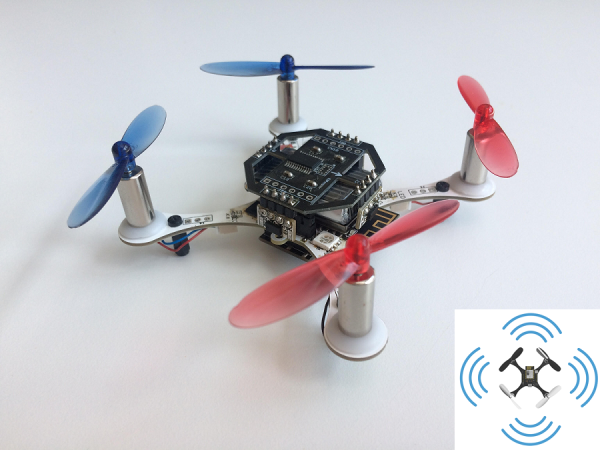
With so many capabilities for obstacle avoidance, the only natural progression for drones would be for them to be hand-controlled. For Turkish inventor [metehanemlik], even this wasn’t enough of a challenge, as he decided to create the ESP8266-Powered Mini Drone: ESPcopter, a programmable Arduino-compatible modular drone that is open to modding through expansion shields. Not only can DIY enthusiasts modify the algorithms used for obstacle avoidance, but the drone can be sized to whatever dimensions fit their needs.

The drone is almost entirely built from expansion shields, including the multi-ranger shield with four VL53L0x laser-ranging sensors on the forward, backward, right, and left directions of the drone. The website for the ESPcopter comes with an SDK that lets users easily modify the software running on the drone’s MCU as well as pinouts to better understand its hardware functionality. Impressively, it was fully funded through a 60-day crowdfunding campaign, and will be undergoing a second launch shortly, with some new and improved features.

Power comes from a 26 0mAh LiPo battery that allows for up to six minutes of flight time; includes a 3-axis gyroscope, accelerometer, and magnetometer; runs on an ESP8266-12S 32-bit MCU; fully charges within 45 minutes through a USB connection; weighs around 35 g; and is about 90 mm from motor to motor. Continue reading “ESPcopter: A Fully Customizable Drone”

Aussies Find The True Meaning Of Drone Flight

Ah, stereotypes. Once they’ve solidified it’s surprisingly hard to shake them. When non-Australians think of a generic Aussie then, the chances are that a Crocodile Dundee type of character will spring to mind — a ‘Strine-speaking outdoorsman with a beer in hand. This group of Aussies aren’t helping the case, with a video posted by Australian drone retailer UAVme and featured by ABC News where a large multirotor lifts a guy in a lawn chair, beer in hand, over a lake to do some fishing.

Antics aside, having enough capacity to lift a person is pretty impressive. The drone in question appears to be a large hexacopter frame with rotors both below and above the boom, achieving an unusual dodecacopter configuration.

Of course we’re entertained by the sight, who wouldn’t envy them a spin under a drone in the relative safety of an environment where an unscheduled landing merely means getting wet? It seems Austrailia’s Civil Aviation Safety Authority isn’t quite so happy though, as ABC reports the usual chorus of condemnation. Entertainingly though it’s unclear whether or not our plucky adventurer — named as [Sam Foreman] — has in fact broken any laws given that he’s not flown in restricted airspace, over people or habitation, or above the legal altitude.

This isn’t the first such story we’ve brought you from Down Under, back in 2016 an Aussie landed in hot water for picking up a Bunnings sausage in a bun with his drone.

Continue reading “Aussies Find The True Meaning Of Drone Flight”