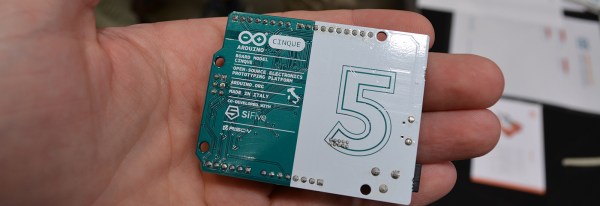
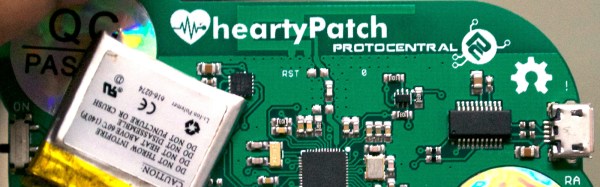
Look What Showed Up For Bring-A-Hack At OSH Park

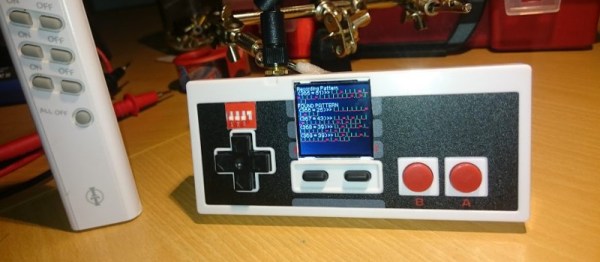
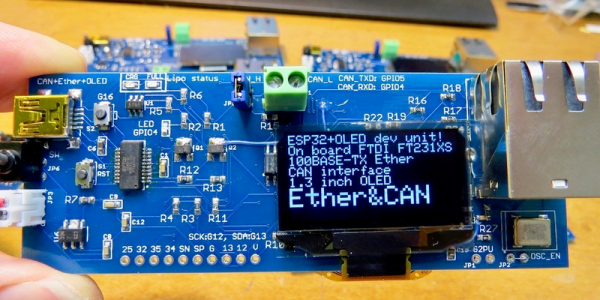
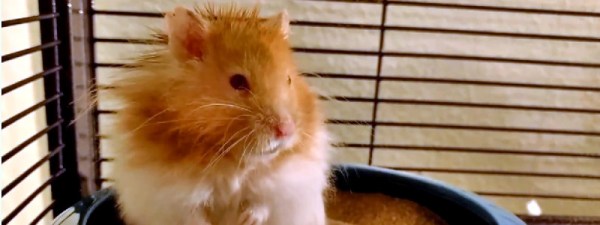
Hackaday was in Portland last weekend for the Open Hardware Summit. I did a brief recap earlier this week but this post has been on my mind the entire time. The night before the summit, OSH Park (the Purveyors of Perfect Purple PCBs which we all know and love) hosted a Bring-A-Hack at their headquarters. [Laen] knows how to throw a party — with a catered spread and open bar which all enjoyed. The place was packed with awesome hackers, and everyone had something amazing to show off.

In fact, there were far too many people showing off hardware for me to capture all in one evening. But join me after the jump for six or seven examples that really stuck out.

Continue reading “Look What Showed Up For Bring-A-Hack At OSH Park”

Porting NES To The ESP32

There’s an elephant in the room when it comes to the Raspberry Pi Zero. The Pi Zero is an immensely popular single board computer, but out of stock issues for the first year may be due to one simple fact: you can run a Nintendo emulator on it. Instead of cool projects like clusters, CNC controllers, and Linux-based throwies, all the potential for the Pi Zero was initially wasted on rescuing the princess.

Espressif has a new chip coming out, the ESP32, and it’s a miraculous Internet of Things thing. It’s cheap, exceptionally powerful, and although we expect the stock issues to be fixed faster than the Pi Zero, there’s still a danger: if the ESP32 can emulate an NES, it may be too popular. This was the hypothetical supply issue I posited in this week’s Hackaday Links post just twenty-four hours ago.

Hackaday fellow, Hackaday Supercon speaker, Espressif employee, and generally awesome dude [Sprite_tm] just ported an NES emulator to the ESP32. It seems Espressif really knows how to sell chips: just give one of your engineers a YouTube channel.

This build began when [Sprite] walked into his office yesterday and found a new board waiting for him to test. This board features the ESP-WROOM-32 module and breaks out a few of the pins to a microSD card, an FT2232 USB/UART module, JTAG support, a bunch of GPIOs, and a 320×240 LCD on the back. [Sprite]’s job for the day was to test this board, but he reads Hackaday with a cup of coffee every morning (like any civilized hacker) and took the links post as a challenge. The result is porting an NES emulator to the ESP32.

The ESP-32-NESEMU is built on the Nofrendo emulator, and when it comes to emulation, the ESP32 is more than capable of keeping the frame rate up. According to [Sprite], the display is the bottleneck; the SPI-powered display doesn’t quite update fast enough. [Sprite] didn’t have enough time to work on the sound, either, but the source for the project is available, even if this dev board isn’t.

Right now, you can order an ESP32; mine are stuck on a container ship a few miles from the port of Long Beach. Supply is still an issue, and now [Sprite] has ensured the ESP32 will be the most popular embedded development platform in recent memory. All of this happened in the space of 24 hours. This is awesome.

Continue reading “Porting NES To The ESP32”

Hackaday Links Column Banner

Hackaday Links: October 9, 2016

Atari is back! That’s what some dude says. There are no real details in that post, other than ‘Atari is Back!’

The ESP32 is coming, and it’s going to be awesome. Espressif has just released an Arduino core for the ESP32 WiFi chip. The digitalRead, digitalWrite, SPI, Serial, Wire, and WiFi “should” work. If you’re looking for ESP32 hardware, they’re infrequently available and frequently out of stock. Thankfully, stock levels won’t be the Raspberry Pi Zero all over again until someone figures out how to run an NES emulator on the ESP32.

Tiny, cheap ARM boards would make for great home servers if they had SATA or multiple network interfaces. Here’s a Kickstarter for a board with both. It’s based on an ARM A53 with multiple Ethernets, mini PCIe, enough RAM, and SATA. It’s a board for niche use cases, but those uses could be really cool.

You’re not cool or ‘with it’ until you have a PCB ruler. That’s what all the hip kids are doing. For wizards and dark mages out there, a simple PCB ruler isn’t enough. These rare beasts demand RF rulers. There’s some weird stuff on these rulers, like Archemedian spiral antennas and spark gaps. Black magic stuff, here.

Some dude with a camera in the woods did something. Primitive Technology, the best example of experimental archaeology you’ve ever seen, built a spear thrower. You can throw a ball faster with a lacrosse stick than you can with just your hands, and this is the idea behind this device, commonly referred to as an atlatl. You can hunt with an atlatl in some states, but I have yet to see a video of anyone taking down a deer with one of these.

Think we’re done spamming the Hackaday Superconference yet? YOU’RE WRONG. The Hackaday Superconference is the greatest hardware conference of all time until we do this whole thing again next year. Get your tickets, look at the incredible list of speakers, book your flights, and be in Pasadena November 5-6.

How To Get Started With The ESP32

ESP32 is the hottest new wireless chip out there, offering both WiFi and Bluetooth Low Energy radios rolled up with a dual-core 32-bit processor and packed with peripherals of every kind. We got some review sample dev boards, Adafruit and Seeed Studio had them in stock for a while, and AI-Thinker — the company that makes the most popular ESP8266 modules — is starting up full-scale production on October 1st. This means that some of you have the new hotness in your hands right now, and the rest of you aren’t going to have to wait more than a few more weeks.

As we said in our first-look review of the new chip, many things are in a state of flux on the software side, but the basic process of writing, compiling, and flashing code to the chip is going to remain stable. It’s time to start up some tutorials!

Continue reading “How To Get Started With The ESP32”

Hackaday Links: September 18, 2016

No Star Trek until May, 2017, at which time you’ll have to pay $5/month to watch it with ads. In the meantime, this is phenomenal and was shut down by Paramount and CBS last year ostensibly because Star Trek: Discovery will be based around the same events.

Tempest in a teacup. That’s how you cleverly introduce the world’s smallest MAME cabinet. This project on Adafruit features a Pi Zero, a 96×64 pixel color OLED display, a few buttons, a tiny joystick, and a frame made out of protoboard. It’s tiny — the height of this cabinet just under two wavelengths of the radiation corresponding to the transition between the two hyperfine levels of the ground state of the cesium 133 atom. Being based on the Pi Zero, it’s a capable arcade cabinet, although we would struggle to find a continuous rotation pot small enough to play Tempest the way it should be played. Check out the video.

[Graham] sent an interesting observation in on the tip line. It’s an election year in the US, and that can mean only one thing. It’s coroplast season. Coroplast is that strange material used for political signage, famous for its light weight, being waterproof, and reasonably strong, depending on how you bend it. There is a severe lack of coroplast builds, but if you have some be sure to send them in.

The ESP32, the followup to the hugely popular ESP8266 , is shipping. [Elliot] got his hands on one and found it to be a very promising chip, but the ESP3212 modules I bought from Seeed haven’t arrived yet. That hasn’t stopped [Ptwdd] from making a breakout board for the ESP3212, though. We don’t know if it works, but it’s just a breakout board, anyway.

The usual arguments for drones involve remote sensing, inspection, and generally flying around for a very long time. Quadcopters don’t do this, but fixed wings can. Over on DIYDrones, [moglos] just flew 425km on a single charge. The airframe is a 3 meter Vigilant C1 V tail, using the stock 300kV motor. The battery is a bunch of Panasonic 18650 cells arranged in 6S 9P configuration for 30600mAh. The all-up weight is 5.7kg. This is significant, and we’re seeing the first glimmer of useful tasks like pipeline monitoring, search and rescue, and mapping being done with drones. It is, however, less than half the range a C172 can fly, but batteries are always getting better. Gas goes further because it gets lighter as you fly.

ESP32 Hands-On: Awesome Promise

The ESP32 is looking like an amazing chip, not the least for its price point. It combines WiFi and Bluetooth wireless capabilities with two CPU cores and a decent hardware peripheral set. There were modules in the wild for just under seven US dollars before they sold out, and they’re not going to get more expensive over time. Given the crazy success that Espressif had with the ESP8266, expectations are high.

And although they were just formally released ten days ago, we’ve had a couple in our hands for just about that long. It’s good to know hackers in high places — Hackaday Superfriend [Sprite_tm] works at Espressif and managed to get us a few modules, and has been great about answering our questions.

We’ve read all of the public documentation that’s out there, and spent a week writing our own “hello world” examples to confirm that things are working as they should, and root out the bugs wherever things aren’t. There’s a lot to love about these chips, but there are also many unknowns on the firmware front which is changing day-to-day. Read on for the full review.

Continue reading “ESP32 Hands-On: Awesome Promise”

Hackaday Links Column Banner

Hackaday Links: September 11, 2016

You know about the Hackaday Superconference, right? It’s the greatest hardware con ever, and it’s happening on November 5+6. Details incoming shortly.

The Hackaday Retro Edition exists. It’s the Hackaday blog, HTML-1-izized for weird and old computers? Why did I do this? Because Google is the quickest page to load on a Powerbook 180. There’s a new Retro Success, this time coming from @LeSpocky and his Nokia 3109c phone from 2008.

This is your official notice. The Open Hardware Summit is less than a month away. It’s going down in Portland, OR. Why Portland? The Vaporwavescene, of course. Hackaday, Tindie, and the rest of the crew will be out in Portland next month getting the latest news on the state of Open Hardware. We won’t be sitting in church pews this year, but then again there is no lady made out of soap.

Speaking of OHS, [Dave] just solved all their problems. The ‘problem’ with Open Hardware, if you can call it that, is that people use it as a bullet point on a sales deck. That neat gear logo can be marketing wank, without any of the sources, schematics, or anything else that makes a project Open Hardware. Last year, OSHWA announced they would be creating a certification process, with a trademarked logo, so they can sue people who don’t post schematics and mechanical designs (slightly inaccurate, but that’s the jist of the program). [Dave] is suggesting keeping the cool gear logo, but adding letters the teeth of the gear to designate what makes something Open Hardware. Add an S for schematic, add a B for a BOM, sort of like the creative commons logo/license. Is it a good idea? If OSHWA keeps using the gear logo for the ‘official’ Open Hardware logo/designation, there’s no recourse for when people misuse it. I’m of several minds.

[Colin Furze] is famous for his zany builds. His latest Youtube is anything but. It’s a shed. Of course, it’s the entry for his underground bunker, but this is a quality shed with a concrete pad, a few bits to keep it off the ground, and insulation. The roof is slate (because why not?), but if your design decisions are based on the phrase, ‘you only live once,’ copper may be a better choice.

The ESP32 has been released. The ESP32 is the follow-on to the very popular ESP8266. The ’32 features WiFi and Bluetooth, dual core processors, and a few undisclosed things that will make it very interesting. You can buy ESP32 modules right now, but no one has them on their workbench quite yet. To get you started when they finally arrive, [Adam] created an ESP32 KiCad Library for the ESP32 chip, and the ESP32-WROOM and ESP3212 modules.