Anti-Hack: Free Automated SSL Certificates

You want to put your credit card number into a web site. You know to look for a secure web site. But what does that really prove? And now that so many electronic projects have Web servers (ok, I’ll say it… the Internet of Things), do you need to secure your web server?

There was a time when getting a secure certificate (at least one that was meaningful) cost a pretty penny. However, a new initiative backed by some major players (like Cisco, Google, Mozilla, and many others) wants to give you a free SSL certificate. One reason they can afford to do this is they have automated the verification process so the cost to provide a certificate is very low.

Continue reading “Anti-Hack: Free Automated SSL Certificates”

One Man’s Quest To Spend Less TIme In The Basement

[Lars] has a second floor apartment, and the washing machines and clothes dryers are in the basement. This means [Lars] has spent too much time walking down to the basement to collect his laundry, only to find out there is 15 minutes left in on the cycle. There are a few solutions to this: leave your load in the washer like an inconsiderate animal, buy a new, fancy washer and dryer with proprietary Internet of Things™ software, or hack together a washer and dryer monitoring solution. We all know what option [Lars] chose.

Connecting a Pi to the Internet and serving up a few bits of data is a solved problem. The hard part is deciding which bits to serve. Washers and dryers all have a few things in common: they both use power, they both move and shake, they make noise, and their interfaces change during the wash cycle. [Lars] wanted a device that could be used with washers and dryers, and could be used with other machines in the future. He first experimented with a microphone, capturing the low rumble of a washer sloshing about and a dryer tumbling a load of laundry. It turns out an accelerometer works just as well, and with a sensor securely fastened to a washer or dryer, [Lars] can get a pretty good idea if it’s running or not.

With a reliable way to tell if a washer or dryer is still running, [Lars] only had to put this information on his smartphone. He ended up using PushBullet, and quickly had an app on his phone that told him if his laundry was done.


Raspberry_Pi_LogoSmall

The Raspberry Pi Zero contest is presented by Hackaday and Adafruit. Prizes include Raspberry Pi Zeros from Adafruit and gift cards to The Hackaday Store!
See All the Entries || Enter Your Project Now!

Samsung ARTIK Dev Boards Start To Ship

Another week’s news, another single board computer aimed at Internet of Things applications is launched. This time it’s Samsung’s Artik 5, a platform they’ve been talking about for a while now but which you can now buy as a dev board from Digi-Key for $99.99. For that you get Wi-Fi, Bluetooth and Zigbee connectivity, a dual-core ARM Cortex A7 running at 1GHz, 512MB of memory, and 4GB of eMMC storage. There are the usual plethora of interfaces: GPIO, I2C, SPI, UART, SDIO, USB 2.0, JTAG, and analogue.

The single board computer marketplace is starting to look rather crowded, and with so many competitors to choose from at more reasonable prices you might ask yourself why the ARTIK could be of interest to a maker. And given that Samsung are positioning it in their literature on its increased security for use in commercial  applications such as IoT hubs, IP cameras and industrial and commercial lighting systems, you’d probably be on to something. If you were to make a very rough analogy with the Raspberry Pi range this has more in common with the Compute Module when it comes to intended marketplace than it does with the Pi Zero.

One answer to that question though could be that it is one of the first devices to support the Thread networking protocol for IoT devices. Thread is a collaboration between Google and a range of other interested parties that has been designed to deliver reliable and secure mesh networking for IoT devices in connected homes. As with all new connectivity protocols only time will tell whether Thread is the Next Big Thing, but it is interesting to note in this board nevertheless.

The ARTIK hasn’t made many waves as yet, though we covered the story when it was announced last year. It is worth mentioning that the ARTIK 5 is only the first of three platforms, the ARTIK 1 will be a tiny board with Bluetooth LE aimed at portable and wearable applications while the ARTIK 10 will be an octo-core powerhouse aimed at mulitmedia processing and network storage applications.


Augmented Reality Becomes Useful, Real

The state of augmented reality is terrible. Despite everyone having handheld, portable computers with high-resolution cameras, no one has yet built ‘Minecraft with digital blocks in real life’, and the most exciting upcoming use for augmented reality is 3D Dungeons and Dragons. There are plenty of interesting things that can be done with augmented reality, the problem is someone needs to figure out what those things are. Lucky for us, the MIT Media Lab knocked it out of the park with the ability to program anything through augmented reality.

The Reality Editor is a simple idea, but one that is extraordinarily interesting. Objects all around you are marked with a design that can be easily read by a smartphone running a computer vision application. In augmented reality, these objects have buttons and dials that can be used to turn on a lamp, open a car’s window, or any other function that can be controlled over the Internet. It’s augmented reality buttons for everything.

This basic idea is simple, but by combining it by another oft-forgotten technology from the 90s, we get something really, really cool. The buttons on each of the objects can be connected together with a sort of graphical programming language. Scan a button, connect the button to a lamp, and you’re able to program the lamp with augmented reality.

The Reality Editor is already available on the Apple app store, and there are a number of examples available for people to start tinkering with this weird yet interesting means of interacting with the world. If you’ve ever wondered how we’re going to interact with the Internet of Things, there you have it. Video below.

Continue reading “Augmented Reality Becomes Useful, Real”

Shmoocon 2016: Z-Wave Protocol Hacked With SDR

The first talk at 2016 Shmoocon was a great one. Joseph Hall and Ben Ramsey presented their work hacking Z-Wave, a network that has been gaining a huge market share in both consumer and industrial connected devices. EZ-Wave uses commodity Software Defined Radio to exploit Z-Wave networks. This is not limited to sniffing, but also used for control with the potential for mayhem.

Continue reading “Shmoocon 2016: Z-Wave Protocol Hacked With SDR”

Internet Of Things In Five Minutes

If you’re looking for the quickest way to go from zero to voice-controlled home automation system, you should spend five minutes checking out [Hari Wiguna]’s project on Hackaday.io where he connects up IoT gadgets and services into a functioning lightswitch. (Video below the break.)

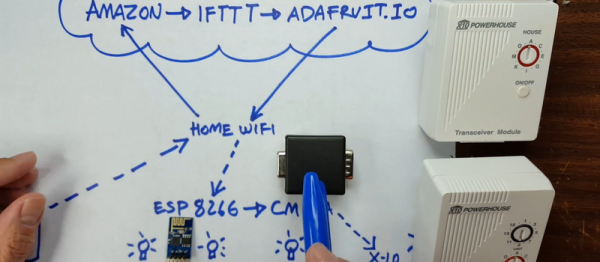
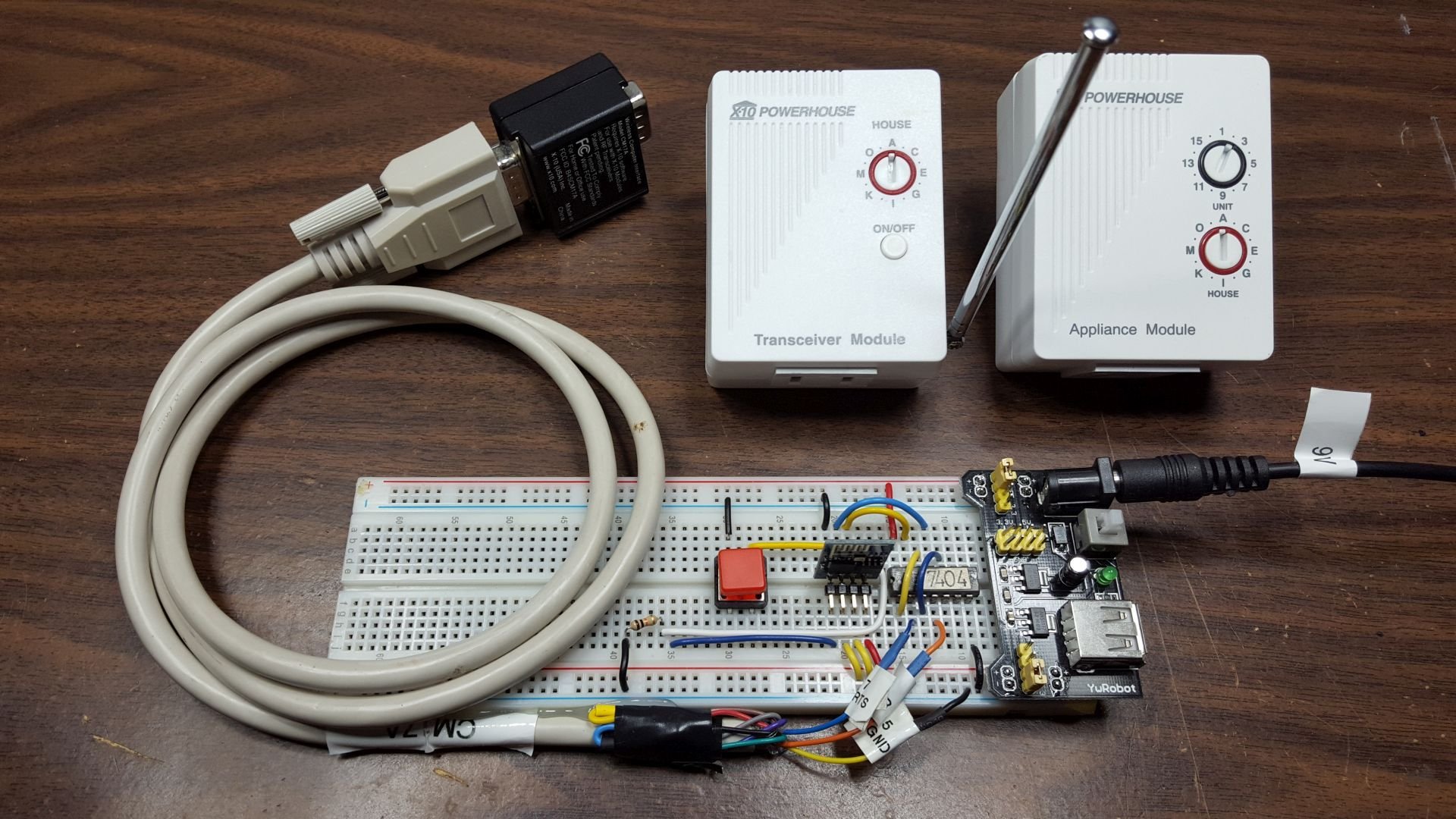
6166971452133983621[Hari] demonstrates how to set up a complex chain: Amazon Echo to IFTTT to Adafruit.io as a data broker, which is then polled by an ESP8266 unit in his home that controls his X10 setup. (Pshwew.) But each step along the way is designed to be nearly plug-and-play, so it’s really a lot like clicking Lego blocks together. [Hari]’s video is a nice overview.

There’s only one catch if you’re going to replicate this yourself: the X10 system that’s used for the last mile. Unless you have one of these setups already, you’re on your own for controlling the outlets that turn the lights on and off. For price and hackability, we suggest the common 433MHz wireless outlet switches and pairing them with cheap 433MHz transmitters, available at eBay for around $1. We’ve seen a lot of hacks of these systems — they’re quite common both in the US and Europe.

We’ve also covered [Hari]’s projects before: both his self-learning TV remote and a sweet Halloween hack. His video production skills are excellent. We’re in awe of how much info he crams into his YouTube videos.

Weightless IoT Hardware Virtually Unavailable

It has been over 2 years since we last mentioned the Weightless SIG and their claims of an IoT open standard chip with a 10 year battery life and 10km wireless range, all at a jaw dropping price of $2 per chip. There was a planned production run of the 3rd gen chips which I would suspect went to beta testers or didn’t make it into production since we didn’t hear anything else, for years.

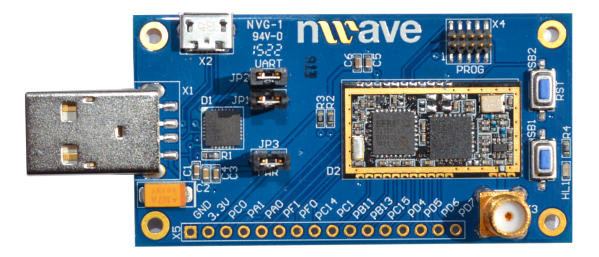
Recently, a company called nwave began producing dev-kits using the Weightless Technology which you can see in the banner image up top. Although the hardware exists it is a very small run and only available to members of the development team. If you happen to have been on the Weightless mailing list when the Weightless-N SDK was announced there was an offer to get a “free” development board to the first 100 development members. I use bunny ears on free because in order to become a member of the developer team you have to pay a yearly fee of £900. Don’t abrasively “pffffft” just yet, if you happened to be one first 100 there was an offer for developers that came up with a product and submitted it back for certification to get their £900 refunded to them. It’s not the best deal going, but the incentive to follow through with a product is an interesting take.

Continue reading “Weightless IoT Hardware Virtually Unavailable”