CBS To Advertise Using Video-in-Print Technology

[youtube=http://www.youtube.com/watch?v=fgJ6DA50thw]
In what seems like another move to blur the line between digital and print media, CBS has announced that they will be introducing something called Video-in-Print technology in next month’s issue of Entertainment Weekly. Video-in-Print, or ViP, technology consists of a small LCD screen and circuit board that can be inserted into print media and play video and audio content. CBS is using the ViP technology to promote their fall prime-time television lineup. Video-in-Print technology is the brainchild of Americhip, a company that claims to specialize in multisensory marketing. The ViP player in next month’s issue of Entertainment Weekly incorporates a 320×240 resolution TFT LCD screen and a rechargeable battery lasting 50-60 hours. The battery can be recharged via the player’s on-board mini USB port. While this isn’t the first time that we’ve seen a magazine do something like this, as far as we know this is the first time that anyone has put a video player into a magazine. That being said, there seems to be no indication whether or not CBS will make it easy for us to modify the ViP player’s software like Esquire did with their e-ink display. We’re not entirely sure what we’re going to do with the ViP player, but the fact that it has a mini USB port gives us some interesting ideas. Juicebox, anyone?

Parts: 4×20 VFD Character Display (NA204SD02)

futuba-serial

Futaba makes vacuum florescent character displays that can be used as a drop-in replacement for common character LCDs. VFDs have a wider viewing angle, and generally look cooler.

Futaba’s character displays can be interfaced using the standard 8-bit or 4-bit parallel LCD interface, or a simple two-wire protocol. The protocol type is set by resistors on the back of the display, so it’s not particularly easy to change without a hot-air rework station. Today we’ll demonstrate a serially-interfaced VFD using the Bus Pirate.

Continue reading “Parts: 4×20 VFD Character Display (NA204SD02)”

IDisplay, Webcam Multitouch

[youtube http://www.youtube.com/watch?v=mlLY0zic7u0%5D

Embedded above is an interesting multitouch demo by [Lahiru]. The goal of the project was to find an easy way to retrofit current LCDs for multitouch. Instead of using infrared or capacitive recognition, it uses a standard webcam mounted overhead. To calibrate, you draw polygon around the desktop screen as the webcam sees it. The camera can identify the location of markers placed on the screen and their color. iDisplay can also recognize hands making the pinch motion and sends these as touch events via TUIO, so it works with existing touch software. It’s written in C++ using OpenCV for image processing with openFrameworks as the application framework.

[via NUI Group]

Repair A Malfunctioning LCD

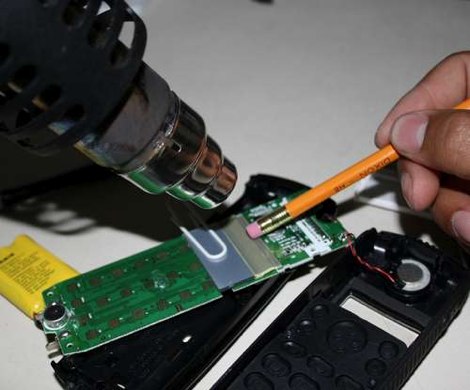
When most people encounter dead pixels on an LCD text display, they figure that the display is dead and they decide to scrap it. However when the LCD display on one of [Joe]’s cordless phones started to show dead rows and columns of pixels, [Joe] decided that he could fix it. With only a pencil eraser, a hot air gun, and a screwdriver (for disassembly), [Joe] was able to fix his phone’s screen in just under 10 minutes. His process involves heating the glue holding the LCD’s ribbon cable to the phones PCB with a hot air gun and using a pencil eraser to reattach segments of the ribbon cable to the PCB. If anyone here has a problem similar to [Joe]’s, be sure to check out his detailed how-to complete with step-by-step pictures.

LCD Multitouch

[youtube=http://www.youtube.com/watch?v=wLztKzljMc0&feature=player_embedded]

[Jacob] wrote us to show off his latest project. He built his multitouch interface out of an LCD monitor. We’ve seen plenty of multitouch projects here, but usually they are projection style. This project uses the panel out of an LCD, with the diffusers and backlighting removed. The panel itself is fairly transparent, so a webcam with IR filter can see the light pens right through it. It does seem a bit dim in the video, we’re wondering if it is better in real life.

Custom Motorcycle Display

motorcycle_display

[fibra] has been slowly building a custom controller for his motorcycle. It’s an automated chain oiling system that varies application based on RPM. The LCD can show wheel RPM, voltage, time, date, air, and engine temperature. A separate driver board has a MOSFET for controlling the oiling valve. The real gold here is the attention to detail. He built a one off circuit board. The case is laser cut acrylic that he then shaped. The box is molded smoothly into the original instrument cluster using epoxy. It’s excellent work that could be mistaken for a commercial product.

Weather Monitoring

weather

This weather monitor can track pressure, temperature, and humidity and last several months on a pack of AA batteries. It has a PIC18f452 to control all the bits, as well as some fancy power management to get the most out of the batteries as possible. The screen displays the highest and lowest temperatures of the last 42 hours as well as having options to display all other sensor input, updated every minute or so. You can get the full schematic and parts list on the project site.

[via YourITronics]