Spin Peggy, Get 3D POV

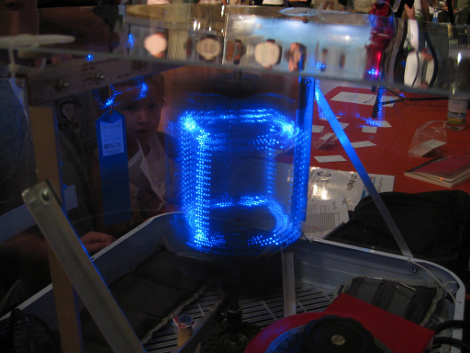
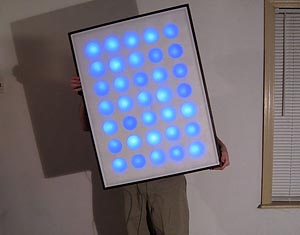
We put a temporary ban on posting POV projects after receiving several LED spheres back in May. But we had to lift the injunction after seeing this superb Volumetric 3D POV display by [Wes Faler] and [Don Smith].

Their creative use of several readily available components adds to the alluring setup; the central elements being just a box fan and Peggy kit from EMSL. The video after the jump doesn’t really do the project justice, but if you missed it at Maker Fair Detroit and can’t make your own it’s the best you’re going to get.

Continue reading “Spin Peggy, Get 3D POV”

Save A Baby, Nursery Temperature Monitor

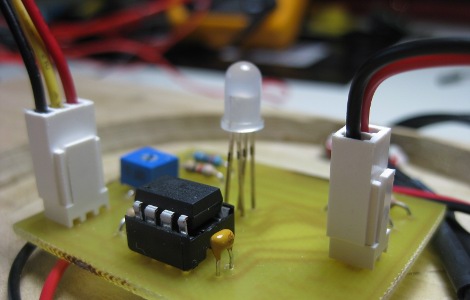
Yes, you could argue this Nursery Room Temperature Monitor is simply an LED and an Arduino with a temperature sensor, but [Jay] really did put more thought into the process. For instance he stuck with AVR, built a wooden base and sanded globe, and even included schematics and source code. Plus, SIDS is no laughing matter and the more you know, the more it can be prevented. Back on point, one thing we would add is PWM for a more gradual change in color. What would you add?

Continue reading “Save A Baby, Nursery Temperature Monitor”

Chess Table: Physical Interface For Internet Games

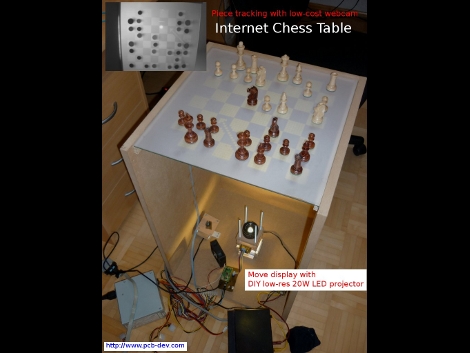
Wanting to get back to playing with actual pieces, [Thomas Pototschnig] built a chess table that interfaces with the Internet. The table uses an custom setup to project the board on the frosted surface of the table. Chess moves from your internet opponent are displayed as arrows on the board so you can move the pieces. Your moves are detected by a webcam below the surface as this table actually functions as a multitouch display. From the description, it sounds like the projector was made from a 128×64 graphic LCD display. A 64×64 pixel area is used, with an LED below and a lens above. This works remarkably well. See for yourself after the break.

Want some other options for your chess setup? You can play against a robot arm, or if you’ve got 144 square feet of extra space you can build a really big board for the occasional game.

Continue reading “Chess Table: Physical Interface For Internet Games”

Decatron Stand-in

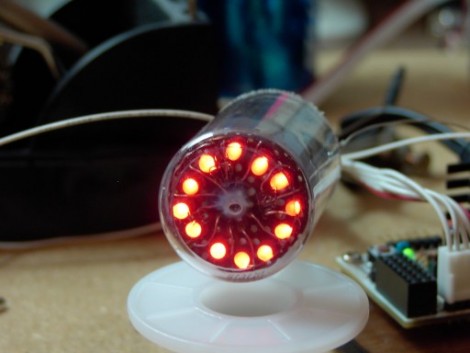
Think the swirling glow of a Decatron is cool but don’t want to deal with the voltage issues? [Osgeld] sidestepped the problem by developing a fake Decatron. Admiral Nelson (Captain Morgan’s cheaper cousin) provided the enclosure in the form of an airplane sized liquor bottle. The LEDs are common-something (not sure if it’s anode or cathode) so they end up being individually addressable through the mess of wires coming out the end. This will greatly simplify that kitchen timer we’ve been meaning to build. See the blinking lights go around and around after the break.

Continue reading “Decatron Stand-in”

Physical Tone Matrix

[Andrew Jenner] pulled off something amazing with this Physical Tone Matrix. He wanted to build a physical version of a flash applet he had seen. Two layers make up the main user interface. The top layer is a sheet of acrylic that acts as a touch interface and below there’s an LED matrix. [Andrew’s] touch interface uses wires running throughout the acrylic as contacts which are polled via transistor pairs. As you can see in the video after the break it works well and we like the fact that there’s a tactile component (due to the bumpy wires) you don’t get when working with a touchscreen.

The 16×16 grid of LEDs on the bottom layer correspond to each ‘button’ on the touch matrix hand have some extra functions such as playing Conway’s Game of Life. This fantastic build still has a couple of kinks to work out, most notably the interference in the audio circuit, but we’re quite impressed at what he’s achieved quickly. Plus, this is more economical than a monome and larger than some of the monome clones we’ve seen.

Continue reading “Physical Tone Matrix”

Giant LED Matrix

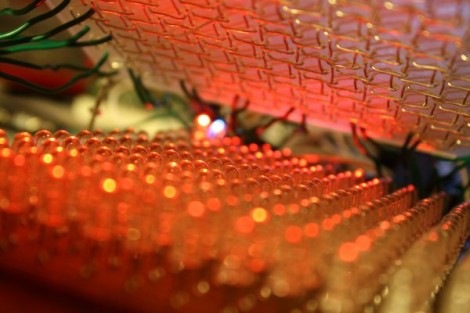
We all love blinky lights. What we love even more than blinky lights is a very detailed tutorial with great photos. [Richard Kline] has written this fantastic tutorial on how to build a large 5×7 LED matrix and control it with a PIC processor.  The bulk of the body is a foam insulation board, covered with a diffuser. Source code and schematics are available for download from the site. If you’ve ever thought about getting into PIC processors, this would be a great beginner project.

[via MakeZine]

Printed Circuit Board Minus The Printed Traces

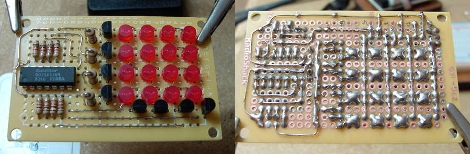
Reader [Osgeld] is a board-layout ninja. He populated this 4×4 LED matrix board without having a layout plan to start with. Watch it develop in slideshow format to see the art work he performs. The display is driven by a shift-register and he’s included all the proper parts like resistors and transistors, yet he makes everything fit. Why is this amazing? He’s using uninsulated wire and not a single one of them crosses another wire. He’s physically designing a printed circuit board, routing the traces as he solders away. He’s built this to use with an Arduino shift register tutorial and our only question is where is the header to hook this board to a microcontroller?