CN Tower Synced With Techno

[youtube=http://www.youtube.com/watch?v=idC8lyuBVHQ]

As part of Nuit Blanche, Toronto’s annual community art event, the CN Tower’s lighting system got put to some creative use. Installed 2 years ago, the RGB LED-based system is composed of 1330 individually addressable lights lining the glass elevator shafts. It costs just under $1000 to run almost every evening for a month. Named ‘Bright Lights Big City’ (not to be confused with the book, movie, or song of the same name), this project was coordinated by [Ryan Stec]. The lights on the tallest freestanding structure in North America were animated to CIUT 89.5 FM for the entire night. This innovative solution allowed one to appreciate the light show from almost anywhere in the city with access to a radio.

Pickle Lighting For Fun And Profit

2oct09_mitpickle (Custom)

The fantastic people at MIT have taken it upon themselves to explain how an OLED works. Their visual aide in this explanation is an electrocuted pickle. This helps describe how OLEDs are actually constructed from organic material.  Many of you probably already know how they work, but for those who don’t this video will clear up any questions you might have. Even if you do know how OLEDs work, you may learn something too. We hadn’t realized how amazingly thin the displays are.

[via Engadget]

SMD LED Matrix

3573544803_03000843fc

Everyone loves a good LED matrix hack, and we’ve seen our fair share, but never a 16 by 24 hand soldered SMD one. [bear24rw] and his team needed a project reflecting the interests of one of his classes, being an EE major, an LED matrix was just the ticket. Based on this instructable, he was able to cobble together a driver board; the code however was unacceptable, and he came up with a double buffer array solution. You can grab the eagle file and source code here, while you’re at it check out a quick video after the break.

Continue reading “SMD LED Matrix”

Open Source Weapon Makes You Puke

[Limor] of Adafruit Industries and the Ice Tube Clock has made her own open source non-lethal weapon: The Bedazzler. After attending a conference by the DHS where she saw the big-budget Dazzler, she decided to make her own. Thirty-six LEDs, six switching FETs, a Boarduino, and a former flashlight later, the Bedazzler makes a better rave toy than a weapon. It doesn’t work as-is, but we figure it will only be a matter of time before someone hacks this to make people… umm hack.  See the video after the break.

Continue reading “Open Source Weapon Makes You Puke”

Word Clock: Tell The Time With Words

wordclock

[drj113]  posts his cool word clock. After seeing a similar clock on an industrial design website, he set out to make his own version. He made custom pcbs with the toner-etch method. The front is a solid piece of copper clad board and the light shines through the etched areas. It’s powered by a PIC microcontroller and uses approximately 120 ultra bright LEDs. [drj113] has all of the circuit board diagrams, silkscreens, etch negatives, and code on the intructable so you can build your own.

Defocusing LED Clock

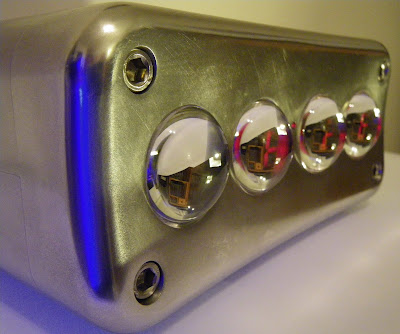
[Dennis] has created a well-documented and very beautiful clock in his latest project. This clock stands out from the other clock projects we have covered with its unique display. The seven segment LED displays mounted on a sled that moves them back and forth behind an array of fiber optic lenses, effectively taking the display out of focus at certain points. Currently, a Dorkboard controls the sled, moving it at random intervals. The case is machined and polished aluminium, the top buttons are ball bearings.

BlokClok – Abstract Time Display

blokclok_abstract_time_display

Clocks made from blinking LEDs always make for fun projects. [Earthshine] built a clock that displays time abstractly using an 8×8 RGB LED matrix. The video embedded after the break illustrates how to read the time but here’s the gist of it: One LED is illuminated in the outside box of LEDs and moved in a clockwise motion to approximate seconds. Inside of this, there are four quadrants; upper left indicates hour-tens digit, upper right hour-ones, lower left minute-tens, and lower right minute-ones. This certainly makes for an interesting conversation piece!

There is no schematic and no code available but it’s really the concept that we’re interested in. If you must know, [Earthshine] bases this build around an Arduino. A DS1307 real time clock keeps the time, while four 74HC595 shift registers are utilized to control the three LED colors and the multiplexing.

Continue reading “BlokClok – Abstract Time Display”