MIDI Mouse Makes Marvelous Music

It’s an old misconception that digital musicians just use a mouse and keyboard for their art. This is often far from the truth, as many computer music artists have a wide variety of keyboards/synths, MIDI controllers, and “analog” instruments that all get used in their creative process. But what if one of those instruments was just a mouse?

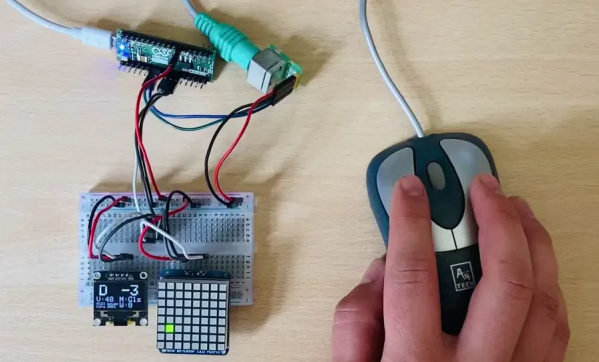
Well, that must have been what was going through [kzra]’s mind when he turned an old ps/2 roller ball mouse into an electronic instrument. Born out of a love for music and a hate for waste, the mouse is a fully functional MIDI controller. Note pitch is mapped to the x-coordinate of the pointer, and volume (known as velocity, in MIDI-speak) is mapped to the y-coordinate. The scroll wheel can be used as a mod wheel, user-configurable but most often used to vary the note’s pitch. The mouse buttons are used to play notes, and can behave slightly differently depending on the mode the instrument is set to.

Not satisfied with simply outputting MIDI notes, [kzra] also designed an intuitive user interface to go along with the mouse. A nice little OLED displays the mode, volume, note, and mouse coordinates, and an 8×8 LED matrix also indicates the note and volume. It’s a fantastic and versatile little instrument, and you’ve gotta check out the video after the break to see it for yourself. We’ve seen some awesome retro-tech MIDI controllers before, and this fits right in.

Continue reading “MIDI Mouse Makes Marvelous Music”

Turning GameCube & N64 Pads Into MIDI Controllers

It’s fair to say that the Nintendo 64 and GameCube both had the most unique controllers of their respective console generations. The latter’s gamepads are still in high demand today as the Smash Bros. community continues to favor its traditional control scheme. However, both controllers can easily be repurposed for musical means, thanks to work by [po8aster].

The project comes in two forms – the GC MIDI Controller and the N64 MIDI Controller, respectively. Each uses an Arduino Pro Micro to run the show, a logic level converter, and [NicoHood’s] Nintendo library to communicate with the controllers. From there, controller inputs are mapped to MIDI signals, and pumped out over traditional or USB MIDI.

Both versions come complete with a synth mode and drum mode, in order to allow the user to effectively play melodies or percussion. There’s also a special mapping for playing drums using the Donkey Konga Bongo controller with the GameCube version. For those eager to buy a working unit rather than building their own, they’re available for purchase on [po8aster’s] website.

It’s a fun repurposing of video game hardware to musical ends, and we’re sure there’s a few chiptune bands out there that would love to perform with such a setup. We’ve seen other great MIDI hacks on Nintendo hardware before, from the circuit-bent SNES visualizer to the MIDI synthesizer Game Boy Advance. Video after the break.

Continue reading “Turning GameCube & N64 Pads Into MIDI Controllers”

12-Arduino Orchestra Plays Star Wars Fanfare

Back in the early days of the musical synthesizer, some designers who wished for polyphony in their instruments would simply build multiple tone-generators for as many notes as they wished to play. [Kevin] took that same approach with his Arduino orchestra, and set about having it play the closing number from Star Wars: A New Hope.

The build consists of twelve Arduino Nanos, each wired up to power, a speaker, and the same MIDI cable. The MIDI cable carries note data for each Arduino on a separate MIDI channel, allowing each to play its own role in the orchestra. [Kevin] then set about arranging the Star Wars music into a MIDI file suitable for the Arduinos, roughly setting six voices to high parts and six voices low. The Arduinos play the notes received using the simple tone() function. The result is a very chiptune rendition of the end of the fourth episode of the world’s most famous space opera.

It may not be neat, tidy, or efficient, but it certainly is fun. Twelve Arduinos bleeping away with their flashing LEDs and cute little speakers makes quite the conversation piece. It’s a similar approach to the Floppotron, which plays more notes by adding more floppy drives. We’ve also seen the same thing done with SEGA sound chips. Video after the break.
Continue reading “12-Arduino Orchestra Plays Star Wars Fanfare”

Old Phone Becomes MIDI Controller

MIDI controllers come in all shapes and sizes. Commercial products based on keyboards or matrixes of buttons are popular, but there’s nothing stopping you from whipping up your own creations out of whatever strikes your fancy. [Kevin] has done just that, turning an old telephone into a working MIDI device.

The phone in question is a Doro X20 wired landline phone. Being surplus to [Kevin’s] requirements left it ripe for the hacking. A Raspberry Pi Pico was wired in to the phone’s keypad, slimmed down with a hacksaw in order to allow it to neatly fit inside the original enclosure. Then it was a simple matter of whipping up some code to read the buttons and output MIDI data via the Pico’s serial output.

Later, [Kevin] brought the design into the modern world, setting it up to talk USB MIDI using the Pico’s onboard USB hardware. This makes using it with a computer a cinch, and lets [Kevin] control a DAW using the handset controller.

It’s a fun build, and one that shows how you can easily build your own MIDI hardware using nothing but a soldering iron, some buttons, and a modern microcontroller. From there, the sky really is the limit. Whether you like big knobs, easy playing, or have your own personal tastes, you can build what you like to suit your own style. When you do, drop us a line! Video after the break.

Continue reading “Old Phone Becomes MIDI Controller”

A MIDI Controller — From A Twister Mat?

Twister, the mildly embarrassing but strangely enjoyable floor contortion game that most of us have vague youthful memories of from Christmas parties. Could a Twister mat be used as an input device? [Guy Dupont] took those 24 coloured dots and made just that, after a conversation with a friend.

Wiring up a floor-sized plastic mat isn’t as easy as it might seem, and early experiments with copper foil and capacitive touch sensor chips proved to be a failure. The replacement came in the form of force sensitive resistors, read by a brace of MCP3008 multiplexed analogue-to-digital converters. These are then read by an ESP32 that does all the MIDI magic. We’re treated in the video below the break to full details including the entertaining sight of him playing Twister to a beat, prompted by a robotic-voiced random move generator, and we can see that this devices has some potential.

We’ve not seen another Twister mat before, but force sensitive resistors have made an appearance in a much higher-resolution array. It’s the LED floor game controller that has us going though.

Continue reading “A MIDI Controller — From A Twister Mat?”

MIDI All The Things Hack Chat

Join us on Wednesday, March 24 at noon Pacific for the MIDI All the Things Hack Chat with Tim Alex Jacobs!

In our technologically complex world, standards are a double-edged sword. While they clearly make it possible for widgets and doodads to interoperate with each other, they also tend to drift away from their original intention over time, thanks to the march of progress or even market forces. If there’s one thing you can expect about standards, it’s that they beget other standards.

One standard that has stood the test of time, with modification of course, is the Musical Instrument Digital Interface, or MIDI. It’s hard to overstate the impact MIDI has had on the music world since it was first dreamed up in the early 1980s. Started amid a Wild West of competing proprietary synchronization standards, MIDI quickly became the de facto interface for connecting electronic musical instruments together. And as it did, it moved from strictly pro-grade equipment down the market to prosumer and home users, fueled in part by the PC revolution.

Tim Alex Jacobs, who is perhaps better known as Mitxela on his YouTube channel, has long been interested in applying MIDI to unusual corners of the musical world. We’ve seen him MIDI-fy things that barely qualify as musical instruments, and also build a polyphonic synthesizer so small it fits within the shell of the DIN connector that’s so strongly associated with the MIDI standard. Tim joins us on the Hack Chat this week to talk about his experiences with MIDI, and to help us understand all the ways we can work with the interface in our builds.

join-hack-chatOur Hack Chats are live community events in the Hackaday.io Hack Chat group messaging. This week we’ll be sitting down on Wednesday, March 24 at 12:00 PM Pacific time. If time zones have you tied up, we have a handy time zone converter.

Click that speech bubble to the right, and you’ll be taken directly to the Hack Chat group on Hackaday.io. You don’t have to wait until Wednesday; join whenever you want and you can see what the community is talking about.
Continue reading “MIDI All The Things Hack Chat”

Guitar Effects With No (Unwanted) Delay

MIDI has been a great tool for musicians and artists since its invention in the 1980s. It allows a standard way to interface musical instruments to computers for easy recording, editing, and production of music. It does have a few weaknesses though, namely that without some specialized equipment the latency of the signals through the various connected devices can easily get too high to be useful in live performances. It’s not an impossible problem to surmount with the right equipment, as illustrated by [Philip Karlsson Gisslow].

The low-latency MIDI interface that he created is built around a Raspberry Pi Pico. It runs a custom library created by [Philip] called MiGiC which specifically built as a MIDI to Guitar interface. The entire setup consists of a preamp to boost the guitar’s signal up to 3.3V where it is then fed to the Pi. This is where the MIDI sampling is done. From there it sends the information to a PC which is able to play the sound back quickly with no noticeable delay.

[Philip] also had to do a lot of extra work to port the software to the Pi which lacks a lot of the features of its original intended hardware on a Mac or Windows machine, and the results are impressive, especially at the end of the video where he uses the interface to play a drum machine via his guitar. And, while MIDI is certainly a powerful application for a guitarist, we have also seen the Pi put to other uses in this musical realm as well.

Continue reading “Guitar Effects With No (Unwanted) Delay”