DIY Piano: Look, Ma, No Moving Parts

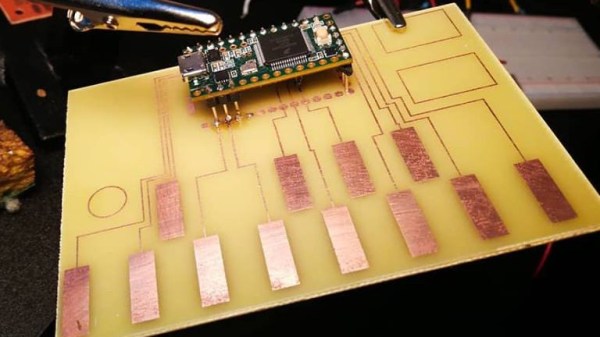
[Michael Sobolak] has a penchant for pianos, concern for capacitive touch, and special sentiment for solid state. This alliterate recipe results in a DIY PCB piano that leaves out the levers and is barren of buttons unless you count the stock RESET button on the Teensy. A real stickler might point out that speakers have moving cones. Beyond these tangential parts, which have motionless options, it is an electronic instrument with no moving parts.

The heart of the project is a Teensy 3.2 which natively supports twelve capacitive touch sensors. The infamous demo board is mounted to a homemade PCB featuring twelve keys but is actually an incomplete octave plus another key one octave above the first. If you look sharp, you already noticed the missing and extra touchpads. PCB traces were made in Illustrator because if you have a familiar tool, you use what you know and you cannot argue that it works. The design was transferred to a copper board using the old magazine page trick that we love and reliable old ferric acid.

We couldn’t help but notice that the posts of the Teensy were soldered to the top of the board, rather than drilling through, IMT-style. Again, the results speak, even if there is room for improvement. Reportedly, there is a second version on the way which includes every expected key.

Continue reading “DIY Piano: Look, Ma, No Moving Parts”

MIDI To CV The DIY Way

MIDI has been a remarkably popular interface since its inception way back in 1983. Based on existing serial interfaces, and with a broad enough set of features, it remains the defacto standard for communication between musical gear. However, older gear and many modular synths simply don’t grok digital data, instead using analog control voltages to get the job done. Never fear, though – you can convert from one to the other with the goMIDI2CV.

It’s a simple device, hewn from an ATTINY microcontroller. MIDI signals are received at TTL voltage levels, and converted to output voltages by the ATTINY via use of the PWM hardware. A lowpass filter is added to remove the high-frequency content from the output signal.  A 6N138 optocoupler completes the project, to comply with the MIDI standard and ensure the device is not subject to any dangerous voltages from the hardware plugged in.

It’s a simple way to control older non-MIDI compliant hardware, and might make an old modular rig just that much more useful in the studio of today. We’ve seen similar builds before, like this combined CV and Gate converter. 

MIDI Grid Can Glow Up With The Best Of Them

Traditional musical instruments have a variety of interfaces, some simple, some complex. The piano is a fairly intuitive machine with a key for every note and a couple of pedals you can ignore if you like. The saxophone is a little more complex, with its many interoperable keys used to produce varying pitches. However, modern electronic instruments are not constrained by physicalities, and there has been an explosion in such devices that simply present a MIDI interface and a big pile of glowing addressable buttons. [Gediminas]’s MIDI Grid build is a great example of the type.

The build relies on an STM32 to do the heavy lifting, talking to an 8×8 array of buttons, each with addressable RGB LEDs. These are combined with silicone pads for a wonderfully tactile feel. There are then a further 17 buttons on the side for various purposes, along with two rotary encoders – useful for implementing smooth fades and intoxicating filter sweeps. Unusually for this type of instrument, in addition to USB there’s also a hardware serial MIDI interface. Finally, a Nokia 5110 LCD is implemented to display relevant data.

There are precious few details on the case, but it appears to be made from lasercut wood pieces, with a nice stain giving it a rich color. Buttons also have printed labels for a more professional look.

The build has functionality most similar to Novation’s Launchpad line. [Gediminas] currently has it working primarily with Ableton Live, however there is scope for further work to integrate the device with other DAWs or MIDI hardware.

With electronic instruments such as these, it’s possible to make musical life more accessible through smart design choices – and the Kord Kontroller is another great example.

Truly Random MIDI Control

Generating random data is incredibly hard, and most of the random data around you isn’t truly random, but merely pseudo-random. For really random data, you’ll have to look at something like radioactive decay or *holds up spork* something like this. YouTube commenters will also suffice. The idea of using random data for generating musical notes is nothing new, but [Danny]’s experimental MIDI controller is something else. It’s a MIDI controller with the control removed, generating random musical notes based on radioactive decay.

The design of this controller is based on an off-the-shelf Geiger counter kit attached to an Arduino. The Arduino code simply counts up in a loop, and when the Geiger tube is triggered, an interrupt sets off a bit of code to generate a MIDI note. That’s simple enough, but where this project excels is its documentation. There’s a zine going through all the functions of this MIDI controller. There are single note or sequencer functions, a definable root note and scale type, an octave range, and velocity of the note can be set.

This is just a MIDI controller and doesn’t generate any noise on its own, but the video of the device in action shows off the range. [Danny] is getting everything from driving bass lines to strange ambient music out of this thing with the help of some synths and samplers. All the code and necessary files are available on the GitHub, with the video available below.

Continue reading “Truly Random MIDI Control”

Never Mind The Sheet Music, Here’s Spreadsheet Music

Nothing says Rockstar Musician Lifestyle like spreadsheet software. Okay, we might have mixed up the word order a bit in that sentence, but there’s always Python to add some truth to it. After all, if we look at the basic concept of MIDI sequencers, we essentially have a row of time-interval steps, and depending on the user interface, either virtual or actual columns of pitches or individual instruments. From a purely technical point of view, spreadsheets and the like would do just fine here.

Amused by that idea, [Maxime] wrote a Python sequencer that processes CSV files that works with both hardware and software MIDI synthesizers. Being Python, most of the details are implemented in external modules, which makes the code rather compact and easy to follow, considering it supports both drums and melody tracks in the most common scales. If you want to give it a try, all you need is the python-rtmidi and mido module, and you should be good to go.

However, if spreadsheets aren’t your thing, [Maxime] has also a browser-based sequencer project with integrated synthesizer ongoing, with a previous version of it also available on GitHub. And in case software simply doesn’t work out for you here, and you prefer a more hands-on experience, don’t worry, MIDI sequencers seem like an unfailing resource for inspiration — whether they’re built into an ancient cash register, are made entirely out of wood, or are built from just everything.

Continue reading “Never Mind The Sheet Music, Here’s Spreadsheet Music”

[Leo] Repairs A MIDI Sequencer

We all have that friend who brings us their sad busted electronics. In [Leo’s] case, he had a MIDI sequencer from a musician friend. It had a dead display and the manufacturer advised that a driver IC was probably bad, even sending a replacement surface mount part.

[Leo] wasn’t convinced though. He knew that people were always pushing on the switches that were mounted on the board and he speculated that it might just be a bad solder joint. As you can see in the video below, that didn’t prove out.

The next step was to fire up a hot air gun. Instead of removing the chip, he wanted to reflow the solder anyway. He was a little worried about melting the 7-segment LEDs so he built a little foil shield to protect it. That didn’t get things working, either.

Continue reading “[Leo] Repairs A MIDI Sequencer”

MIDI Association Announces MIDI 2.0 Prototyping

MIDI was introduced at the 1983 NAMM show as a means to connect various electronic instruments together. Since then, our favorite five-pin DIN has been stuffed into Radio Shack keyboards, MPCs, synths, eurorack modules, and DAWs. The standard basically hasn’t changed. Sure, we have MIDI SysEx messages to configure individual components of a MIDI setup, but at its core, MIDI hasn’t changed since it was designed as a current-loop serial protocol for 8-bit microcontrollers running at 1 MHz.

Now, ahead of the 2019 NAMM show, the MIDI Manufacturers Association (MMA) in conjunction with AMEI, Japan’s MIDI Association, are announcing MIDI 2.0. The new features include, “auto-configuration, new DAW/web integrations, extended resolution, increased expressiveness, and tighter timing”. It will retain backwards-compatibility with MIDI 1.0 devices.

The new initiative, like the release of the first MIDI spec, is a joint venture between manufacturers of musical instruments. The company lineup on this press release is as follows: Ableton/Cycling ’74, Art+Logic, Bome Software, Google, imitone, Native Instruments, Roland, ROLI, Steinberg, TouchKeys, and Yamaha.

This is not an official announcement of the MIDI 2.0 specification. This is the ‘prototyping’ phase, where manufacturers implement the MIDI 2.0 spec as envisioned, write some documentation, figure out what the new logo will look like, and design a self-certification process. Prototyping is expected to continue through 2019, when the final MIDI 2.0 spec will be released on the MIDI Association website.

As far as hardware hackers are concerned, there shouldn’t be any change to your existing MIDI implementation, provided you’re not doing anything new. It should be backwards compatible, after all. The new spec will allow for increased range in expression and ‘tighter’ timing, which might be an indication that the baud rate of MIDI (31,250 baud +/- 1%) may change. There’s some interesting things in store for the last old-school physical layer in existence, and we can’t wait to see what comes out of it.