PVC Pipe Transformed Into Handy Tool Box

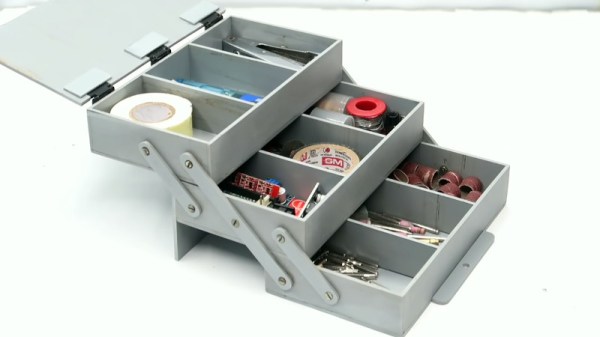
Would you believe the multi-tiered toolbox pictured here started its life as a piece of bog standard PVC pipe? It certainly wouldn’t be our first choice of building material, but as shown in the video after the break, it only takes a heat source and something suitably flat to convert a piece of PVC pipe into a versatile sheet material.

Flattening the heated PVC.

Unrolling the PVC pipe and getting it flat is covered in the first minute of the video, while the rest of the run time is dedicated to building the tool box. Each and every piece you see here, except for the screws and lid hinges, is carefully cut from the PVC sheet. Though we suspect a few more chunks of pipe went into this build than the video would have you believe.

Would we build such an elaborate box if we had to cut each piece of the thing out by hand? Probably not. But then, we can’t deny the final results here are pretty impressive. Incidentally, if you thought those hinges on the top looked a lot like links removed from a watch band…you’d be correct.

Admittedly we’re a bit late covering this one, and under normal circumstances we might have let it slip by given the several million views it’s amassed over the last year. But the central theme of reusing a common material to build something unexpected is solid Hackaday territory, and aligns closely with this year’s Hackaday Prize challenges.

Continue reading “PVC Pipe Transformed Into Handy Tool Box”

Retrotechtacular: Clay Pipe The Hard Way

Troll YouTube long enough and chances are good that you’ll come across all kinds of videos of the “How It’s Made” genre. And buried in with the frying pans and treadmills and dental floss manufacturers, there no doubt will be deep dives on how pipe is made. Methods will vary by material, but copper, PVC, cast iron, or even concrete, what the pipe factories will all have in common is the high degree of automation they employ. With a commodity item like pipe, it’s hard to differentiate yourself from another manufacturer on features, so price is about the only way to compete. That means cutting costs to the bone, and that means getting rid of as many employees as possible.

Such was not always the case, of course, as this look at how Irish Stoneware & Fireclays Ltd. made clay pipe, drain tiles, and chimney flues back in the 1980s shows. The amount of handwork involved in making a single, simple piece of clay pipe is astonishing, as is the number of hands employed at the various tasks. The factory was located in Carrickmacross, County Monaghan, Ireland, near an outcropping of shale that forms the raw material for its products. Quarrying the shale and milling it into clay were among the few mechanized steps in the process; although the extrusion of the pipe itself was also mechanized, the machines required teams of workers to load and unload them.

Continue reading “Retrotechtacular: Clay Pipe The Hard Way”

Heating A Home With Sunlight… And Water

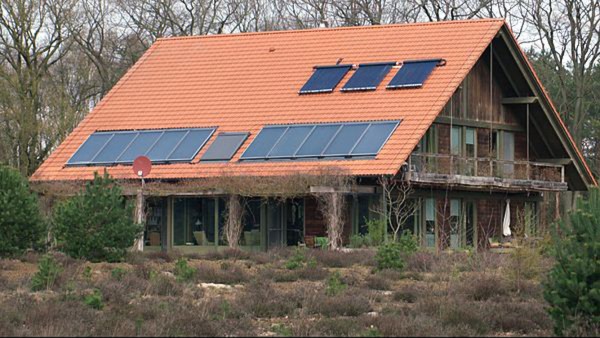
The sun is a tremendous source of energy, and while photovoltaic panels are an easy way to harvest some of that energy especially now that prices for them are incredibly low, there are plenty of other ways to tap into that free energy as well. [Engelbert] was looking for alternative ways to heat his house since traditional methods were prohibitively expensive, and ended up building a heat exchanger using solar-heated water to cover his home heating needs. (Google Translate from Dutch)

The system uses several large roof-mounted hot water heating panels. The heat captured by them is then pumped into an underground pipe network which is able to warm up a large area of earth in the summer. In the winter, that heat is able to be extracted back out of the earth and used to heat his home. The system includes almost three kilometers of pipe which are buried two meters below grade, so this will probably not be a weekend project, but it still cost much less than the €80,000 to install gas heating in his home.

[Engelbert] is able to use this self-built system to keep his home and another smaller building at a constant 23°C all year. He actually overbuilt the system slightly and has since disconnected almost half of the pipes, but we certainly understand the desire to over-engineer things around here. The only problem he has had is with various government entities that are slow to adopt energy-efficient systems like these. Perhaps the Dutch government can take some notes from the Swiss when it comes to installing geothermal systems like these.

Thanks to [Jero] for the tip!

Hydraulics Made Simple

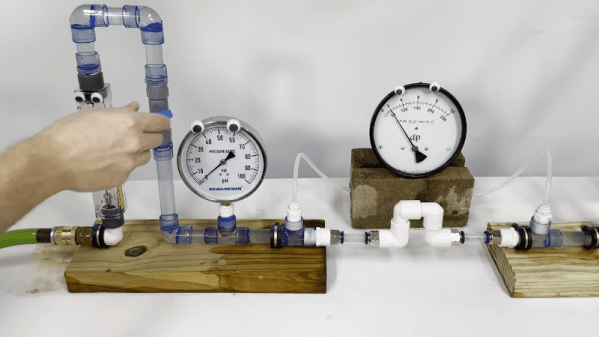
Corralling electrons is great and what most of us are pretty good at, but the best projects have some kind of interface to the real world. Often, that involves some sort of fluid such as water or air moving through pipes. If you don’t grasp hydraulics intuitively, [Practical Engineering] has a video you’ll enjoy. It explains how flow and pressure work in pipes.

Granted, not every project deals with piping, but plumbing, sprinkler systems, cooling systems, and even robotics often have elements of hydraulics. In addition, as the video points out, fluid flow in a pipe is very similar to electrical current flowing through wires.

Continue reading “Hydraulics Made Simple”

The Ground Beneath Your Feet: SuperAdobe Construction

Homes in different parts of the world used to look different from each other out of necessity, built to optimize for the challenges and benefits of local climate. When residential climate control systems became commonplace that changed. Where a home in tropical south Florida once required very different building methods (and materials) compared to a home in the cold mountains of New England, essentially identical construction methods are now used for single-family homes in any climate. The result is inefficient and virtually indistinguishable housing from coast to coast, regardless of climate. As regions throughout the world are facing increasingly dire housing shortages, the race is on to find solutions that are economical and available to us right now.

The mission of CalEarth, one of the non-profits that Hackaday has teamed up with for this year’s Hackaday Prize, is to address that housing shortage by building energy-efficient homes out of materials already available in the areas that they will be built. CalEarth specializes in building adobe, or earth, homes that have a large thermal mass and an inexpensive bill of materials. Not only does this save on heating and cooling costs, but transportation costs for materials can be reduced as well. Some downside to this method of construction are increased labor costs and the necessity of geometric precision of the construction method, both of which are tackled in this two-month design challenge.

Continue reading “The Ground Beneath Your Feet: SuperAdobe Construction”

Iron Pipe Makes A Great Workbench

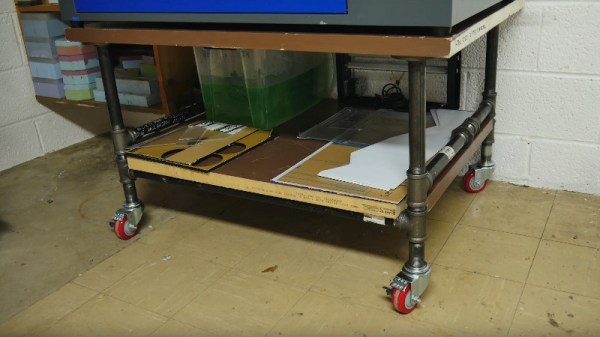
It’s a frequently encountered problem in any workshop; how do you make a bench? And once you’ve made a bench, how do you put it on wheels to move it about? [Eric Strebel] needed a cart for his laser cutter, so he designed his own in an unexpected material: malleable iron pipe.

The attraction of iron pipe is its ready availability and ease of assembly. [Eric] created a sturdy table complete with a worktop made from a solid door in a very short time. T pieces and joiners were used, along with a hefty set of flanges for the tabletop itself. The casters are the expanding stem variety, with a compressed rubber insert expanding to hold them securely in place.

The result as can be seen in the video below is a really neat trolley for the cutter, followed quickly by another workbench. It would be interesting to know more about this material, parameters such as its wall thickness and lateral strength, because in a table without any cross-bracing it becomes important to avoid an untimely collapse.

The most common material for benches seems still to be wood, indicating that for such a technophile community we can be surprisingly conservative in our choices. Sometimes though, benches are made from the most surprising things.

Continue reading “Iron Pipe Makes A Great Workbench”

Linux Fu: Pimp Your Pipes

One of the best things about working at the Linux (or similar OS) command line is the use of pipes. In simple terms, a pipe takes the output of one command and sends it to the input of another command. You can do a lot with a pipe, but sometimes it is hard to work out the right order for a set of pipes. A common trick is to attack it incrementally. That is, do one command and get it working with the right options and inputs. Then add another command until that works. Keep adding commands and tweaking until you get the final results.

That’s fine, but [akavel] wanted better and used Go to create “up” — an interactive viewer for pipelines.

Pipe Philosophy

Pipes can do a lot. They match in with the original Unix philosophy of making each tool do one thing really well. Pipe is really good at allowing Linux commands to talk to each other. If you want to learn all about pipes, have a look at the Linux Info project’s guide. They even talk about why MSDOS pipes were not really pipes at all. (One thing that write up doesn’t touch on is the named pipe. Do a “man fifo” if you want to learn more for now and perhaps that will be the subject of a future Linux Fu.)

This program — called up — continuously runs and reruns your pipeline as you make changes to the pipe. This way, every change you make is instantly reflected in the output. Here’s the video, here’s a quick video which shows off the interactive nature of up.

Installing

The GitHub page assumes you know how to install a go program. I tried doing a build but I didn’t have a few dependencies. Turns out the easy way to do it was to run this line:

go get -u github.com/akavel/up

This put the executable in ~/go/bin — which isn’t on my path. You can, of course, copy or link it to some directory that’s on your path or add that directory to your path. You could also set an alias, for example. Or, like I did in the video, just specify it every time.

Perfect?

This seems like a neat simple tool. What could be better? Well, I was a little sad that you can’t use emacs or vi edit keys on the pipeline, at least not as far as I could tell. This is exactly the kind of thing where you want to back up into the middle and change something. You can use the arrow keys, though, so that’s something. I also wished the scrollable window had a search feature like less.

Otherwise, though, there’s not much to dislike about the little tool. If writing a pipeline is like using a C compiler, up makes it more like writing an interactive Basic program.