Keeping Clocks On Time, The Swiss Way

Could there be a worse fate for a guy with a Swiss accent than to be subjected to a clock that’s seconds or even – horrors! – minutes off the correct time? Indeed not, which is why [The Guy With the Swiss Accent] went to great lengths to keep his IKEA radio-controlled clock on track.

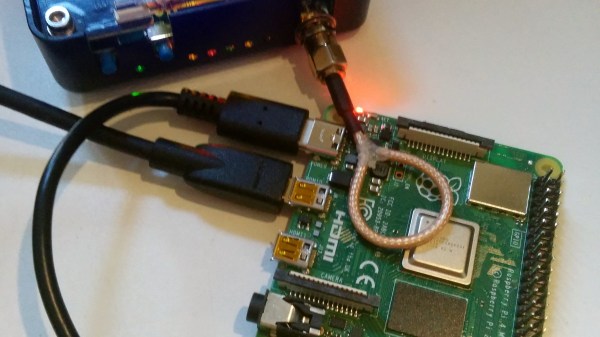
For those who haven’t seen any of [Andreas Spiess]’ YouTube videos, you’ll know that he pokes a bit of fun at Swiss stereotypes such as precision and punctuality. But really, having a clock that’s supposed to synchronize to one of the many longwave radio atomic clocks sprinkled around the globe and yet fails to do so is irksome to even the least chrono-obsessive personality. His IKEA clock is supposed to read signals from station DCF77 in Germany, but even the sensitive receivers in such clocks can be defeated by subterranean locales such as [Andreas]’ shop. His solution was to provide a local version of DCF77 using a Raspberry Pi and code that sends modulated time signals to a GPIO pin. The pin is connected to a ferrite rod antenna, which of course means that the Pi is being turned into a radio transmitter and hence is probably violating the law. But as [Andreas] points out, if the power is kept low enough, the emissions will only ever be received by nearby clocks.

With his clock now safely synced to an NTP server via the tiny radio station, [Andreas] can get back to work on his other projects, such as work-hardening copper wire for antennas with a Harley, or a nuclear apocalypse-Tweeting Geiger counter.

Continue reading “Keeping Clocks On Time, The Swiss Way”

Wall-Mounted Ground Station Tames Unruly SatNOGS Node

For many of us, ad hoc projects end up having a certain permanence to them. Think of the number of Raspberry Pis and RTL-SDRs that are just dangling from a USB cable under a desk or stuffed behind a monitor, quietly going about their business. If it ain’t broke, don’t fix it.

Some projects, though, just end up accreting past the acceptable point. This wall-mounted SatNOGS ground station is a great example of what happens when something needs to be done about the mess. The pile of stuff that [cshields] had cobbled together over time for his ground station needed tidying, so he laid hands on a new Pi 4 and a cool enclosure/breadboard called a Stegoboard. This is just a piece of acrylic with a variety of holes laid out to match every imaginable PC board, hard drive, PC motherboard, Arduino, and just about anything out there that needs mounting. To contain the mess, he mounted the Pi and a 7″ touchscreen to the Stegoboard, along with an RTL-SDR and an Arduino to control his antenna rotator. The ground station wiring is still a little rough, but worlds better than what it was, and now that it’s mounted on the wall it’ll be much easier to use.

For those not familiar with SatNOGS, check out our article back from when the Satellite Network of Ground Stations won the 2014 Hackaday Prize. In the half-decade since then, SatNOGS has only grown, with a huge following of dedicated enthusiasts pointing their antennas at the sky. We know how to pick ’em, and we’ll be selecting the 2019 Hackaday Prize winner very soon.

Thanks to [elkos] for the tip.

Warwalking For Radiation

Can’t find a recently updated survey of radioactivity in your neighborhood? Try [Hunter Long]’s DIY scintillation counter warwalking rig. (Video also embedded below.) What looks like a paint can with a BNC cable leading to an unassuming grey box is actually a complete kit for radiation surveying.

Inside the metal paint can is a scintillation counter, which works by attaching something that produces light when struck by ionizing radiation on the end of a photomultiplier tube, to make even the faintest hits “visible”. And the BNC cable leads to a Raspberry Pi, touch screen, GPS, and the high-voltage converters needed to make the photomultiplier do its thing.

The result is a sensitive radiation detector that logs GPS coordinates and counts per second as [Hunter] takes it out for a stroll. Spoilers: he discovers that some local blacktop is a little bit radioactive, and even finds a real “hot spot”. Who knows what else is out there? With a rig like this, making a radiation map of your local environment is a literal walk in the park.

[Hunter] got his inspiration for the paint-can detector from this old build by [David Prutchi], which used a civil-defense Geiger counter as its source of high voltage. If you don’t have a CD Geiger detector lying around, [Alex Lungu]’s entry into the Hackaday Prize builds a scintillation detector from scratch.
Continue reading “Warwalking For Radiation”

Machine Learning With Microcontrollers Hack Chat

Join us on Wednesday, September 11 at noon Pacific for the Machine Learning with Microcontrollers Hack Chat with Limor “Ladyada” Fried and Phillip Torrone from Adafruit!

We’ve gotten to the point where a $35 Raspberry Pi can be a reasonable alternative to a traditional desktop or laptop, and microcontrollers in the Arduino ecosystem are getting powerful enough to handle some remarkably demanding computational jobs. But there’s still one area where microcontrollers seem to be lagging a bit: machine learning. Sure, there are purpose-built edge-computing SBCs, but wouldn’t it be great to be able to run AI models on versatile and ubiquitous MCUs that you can pick up for a couple of bucks?

We’re moving in that direction, and our friends at Adafruit Industries want to stop by the Hack Chat and tell us all about what they’re working on. In addition to Ladyada and PT, we’ll be joined by Meghna Natraj, Daniel Situnayake, and Pete Warden, all from the Google TensorFlow team. If you’ve got any interest in edge computing on small form-factor computers, you won’t want to miss this chat. Join us, ask your questions about TensorFlow Lite and TensorFlow Lite for Microcontrollers, and see what’s possible in machine learning way out on the edge.

join-hack-chatOur Hack Chats are live community events in the Hackaday.io Hack Chat group messaging. This week we’ll be sitting down on Wednesday, September 11 at 12:00 PM Pacific time. If time zones have got you down, we have a handy time zone converter.

Click that speech bubble to the right, and you’ll be taken directly to the Hack Chat group on Hackaday.io. You don’t have to wait until Wednesday; join whenever you want and you can see what the community is talking about.

Cheese Grater Now Grates Cheese

If you’ve been using Apple products since before they were cool, you might remember the Power Mac G5. This was a time before Apple was using Intel processors, so compatibility issues were high and Apple’s number of users was pretty low. They were still popular in some areas but didn’t have the wide appeal they have now. The high quality of the drilled aluminum design lived on into the Intel era and gained more popularity, but the case was still colloquially known as the “Cheese Grater”. Despite not originally being able to grate cheese though, this Power Mac actually does grate cheese.

Ungrated cheese is placed in the CD drive slot where it passes through a series of 3D printed gears which grate the cheese into small chunks. The cheese grating drive is automatically started when it detects cheese via a Raspberry Pi. The Pi 4 also functions as a working desktop computer within the old G5 case, complete with custom-built I/O ports for HDMI that integrate with the case to make it look like original hardware.

Funnily enough, the Pi 4 has more computing power and memory than Apple’s flagship Mac at the time, and consumes about 100 times less power. It’s a functional build that elaborates on an in-joke in the hardware community, which we can all appreciate. Perhaps the next build should be something that uses the blue smoke for a productive purpose. Meanwhile, regular readers will remember that this isn’t the first Apple related cheese grating episode we’ve shown you.

Continue reading “Cheese Grater Now Grates Cheese”

3D-Printed Film Scanner Brings Family Memories Back To Life

There is a treasure trove of history locked away in closets and attics, where old shoeboxes hold reels of movie film shot by amateur cinematographers. They captured children’s first steps, family vacations, and parties where [Uncle Bill] was getting up to his usual antics. Little of what was captured on thousands of miles of 8-mm and Super 8 film is consequential, but giving a family the means to see long lost loved ones again can be a powerful thing indeed.

That was the goal of [Anton Gutscher]’s automated 8-mm film scanner. Yes, commercial services exist that will digitize movies, slides, and snapshots, but where’s the challenge in that? And a challenge is what it ended up being. Aside from designing and printing something like 27 custom parts, [Anton] also had a custom PCB fabricated for the control electronics. Film handling is done with a stepper motor that moves one frame into the scanner at a time for scanning and cropping. An LCD display allows the archivist to move the cropping window around manually, and individual images are strung together with ffmpeg running on the embedded Raspberry Pi. There’s a brief clip of film from a 1976 trip to Singapore in the video below; we find the quality of the digitized film remarkably good.

Hats off to [Anton] for stepping up as the family historian with this build. We’ve seen ad hoc 8-mm digitizers before, but few this polished looking. We’ve also featured other archival attempts before, like this high-speed slide scanner.

Continue reading “3D-Printed Film Scanner Brings Family Memories Back To Life”

Spot Adulterated Olive Oil With This Spectrophotometer

Olive oil at its finest quality is a product that brings alive the Mediterranean cuisine of which it is a staple. Unfortunately for many of us not fortunate enough to possess our own olive grove, commercial olive oils are frequently adulterated, diluted with cheaper oils such as canola. As consumers we have no way of knowing this, other than the taste being a bit less pronounced. Food standards agencies use spectrophotometers to check the purity of oils, and [Daniel James Evans] has created such a device using a Raspberry Pi.

A spectrophotometer shines white light through a sample to be tested, splits the light up into a spectrum with a prism or diffraction grating, and measures the light level at each point in the spectrum to gain a spectral profile of the sample. Different samples can then be compared by overlaying their profiles and looking at any differences. This build shines the light from an LED through a sample of oil, splits the result with a diffraction grating, and captures the spectrum with a Raspberry Pi camera. Commercial instruments are usually calibrated by co-incidentally sampling a pure sample of the same solvent the test subject is dissolved in, in this case the calibration is done against a sample of pure olive oil. The software requires the user to identify the spectrum in the resulting photograph, before generating a curve.

From a basis of having worked with and maintained spectrophotometers in the distant past we would have expected to see an incandescent bulb rather than an LED for a flatter response, but since this is an oil identifier rather than a finely calibrated laboratory instrument this is probably less of an issue.

Over the years we’ve had quite a few spectrophotometer projects here, this Hackaday Prize entry from 2016 is just one of many.