Ritewing Zephyr Build And Flight Footage

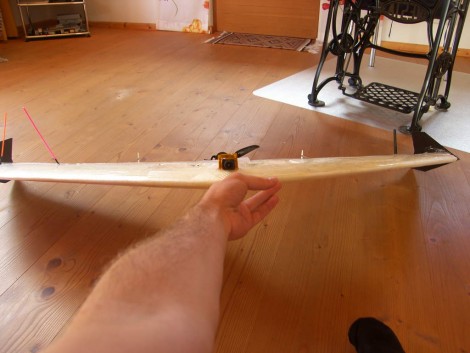
That’s a camera perched atop this aircraft’s wing. [Trappy] built the video system into his Ritewing Zephyr and his test flights in the Austrian Alps make for some breathtaking video. The foam wing is pretty easy to work with and the tool of choice here is a hot knife to cut out cavities for the electronics. The total build time came in between ten and twelve hours, but this isn’t the first time [Trappy] has worked with this model. We’re not sure what setup he’s using for control, we’d guess something head-mounted, but do take a look from the cockpit after the break. You’ll like what you see.

[Trappy] informed Hackaday that he’s planning some altitude and distance testing next weekend. The goal is to reach 15,000 feet and a range of 12 miles.

Continue reading “Ritewing Zephyr Build And Flight Footage”

Racing Game Uses A Physical Race Track And Vehicle

Racer is a racing video game with a very real element. The player sits in an arcade-style console; wheel, pedals, shifter, and television display. But in what must be an homage to Tron the game taking place is very real. You can see the track above, designed in CAD and cut from cardboard, which is navigated by that little vehicle the gentleman holds in his hand. It’s wireless and broadcasts video back to the control console. What we have here is a homemade drone but for now it’s confined to the gaming grid. Don’t miss the demos after the break. Continue reading “Racing Game Uses A Physical Race Track And Vehicle”

Driving With Android

[youtube=http://www.youtube.com/watch?v=tIx2ihZ7728]

[Elrik] converted an RC car so that it can be controlled with an Android phone. He wisely uses the accelerometer for steering with a button for forward and another for reverse. There’s even control for the headlights. The car itself has had a servo retrofit for steering but it’s the Bluetooth module that catches our eye. It’s a GP-GC021 which you can get your hands on for under $20. It has a serial UART for easy interface with a microcontroller at up to 9600 baud.

Now you can convert over that larger vehicle to use Bluetooth instead of WiFi, just don’t hurt yourself. And if you’re just starting out with writing Android apps, don’t miss our series: Android Development 101.

Fankart And The HolyF***k!ted Fan

Inspired by a ducted fan project to simulate lunar landers he had seen recently, [Charles Guan] decided to do the next logical thing and make a ducted fan driven shopping cart.  The first iteration had a bare prop mounted to the front of the cart. Steering was done by mounting a servo to the front wheels.  This ridiculously dangerous shopping cart can be seen in the videos buzzing around the halls and parking lots of MIT. The second iteration that has the ducted fan drive seems not only slightly safer, but somewhat quicker as well. He does mention that the prop shape isn’t really optimal for a ducted design, so expect future revisions to be everything you would expect from a fan powered shopping cart.

He has built a more practical mobile shopping cart, if there is such a thing, called Lolriokart. This thing probably deserves its own post as well as it is a fully drive-able shopping cart. You can see a video of it in action after the break.

Continue reading “Fankart And The HolyF***k!ted Fan”

Adding Motion Control To An RC Transmitter

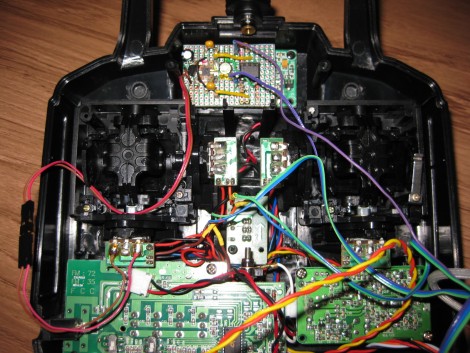
If your soldering skills are up to snuff you can add a motion control feature to your radio controlled transmitter. [Starlino] used a combination accelerometer and gyroscope module as an alternate source of analog control information. He built a filter to dial in the analog voltage range to match that of one of the sticks on the controller. A switch is used to disconnect the signal when motion input is not desired. This would be a nice addition to one of those more creative aerial hacks.

RC Car Taunts Man’s Best Friend

[Arkos] gutted an RC car from his childhood and made it into a dog-taunting remote platform. An Arduino replaces the original circuitry with a Bluetooth module for connectivity. He uses an Xbox 360 controller and has added a small speaker to act as a siren. But for our money it’s the camera that makes this hack. It streams video back to a laptop and because it’s mounted on a couple of servos the left stick controls where the lens is looking. The next evolution should replace the Arduino for a standalone microcontroller but what he’s come up with as a first prototype is delightful. See Fido run in terror after the break.

Continue reading “RC Car Taunts Man’s Best Friend”

BAMF2010: Spy TRAKR – No Lasers, $14,861 Cheaper

Maybe $15K for an elaborate balancing telepresence robot is a bit out of one’s league. In that case, another Bay Area Maker Faire exhibitor — Wild Planet — has you covered. Faire attendees got a hands-on sneak preview of the upcoming Spy Video TRAKR, a video-transmitting radio-controlled toy that’s programmable and extensively hackable.

The TRAKR has an impressive pedigree. It’s a collaborative effort between three successful and creative technology companies: Wild Planet, makers of the Spy Gear toy line; MOTO Development Group, designers of the Flip Video camera; and Making Things, software designers for the Make Controller.

So just how hackable are we talking? The Spy Video TRAKR is intended right out of the box to use downloadable apps, and allows development of new programs in C. The controller and vehicle each contain their own ARM9 processor, and the ’bot features 8 megs of RAM, an SD card slot and USB client and host (yes, host) ports. And that’s all with the cover still on. Pop the lid, and you’ll find links to online schematics and neatly-labeled breakout headers for deeper exploration.

The Spy Video TRAKR is expected to ship in October with a target price of $139 or less. Additional photos after the break.

Continue reading “BAMF2010: Spy TRAKR – No Lasers, $14,861 Cheaper”