Adding Character To The C64

The venerable Commodore 64, is there anything it can’t do? Like many 1980s computer platforms, direct access to memory and peripherals makes hacking easy and fun. In particular, you’ll find serial & parallel ports are ripe for experimentation, but the Commodore has its expansion/cartridge port, too, and [Frank Buss] decided to hook it up to a two-line character LCD.

Using the expansion port for this duty is a little unconventional. Unlike the parallel port, the expansion port doesn’t have a stable output, as such. The port contains the data lines of the 6510 CPU and thus updates whenever RAM is read or written to, rather then updating in a controlled fashion like a parallel port does. However, [Frank] found a way around this – the IO1 and IO2 lines go low when certain areas of memory are written to. By combining these with latch circuitry, it’s possible to gain up to 16 parallel output lines – more than enough to drive a simple HD44780 display! It’s a testament to the flexibility of 74-series logic.
It’s all built on a C64 cartridge proto-board of [Frank]’s own design, and effort was made to ensure the LCD works with BASIC for easy experimentation. It’s a tidy mod that could easily be built into a nice enclosure and perhaps used as the basis for an 8-bit automation project. Someone’s gotta top that Amiga 2000 running the school district HVAC, after all!

The Modern Retrocomputer: An Arduino Driven 6845 CRT Controller

[MmmmFloorPie] revived an old project to create the retro mashup of a 6845 CRT controller and a modern Arduino Uno. When it comes to chips, the Motorola 6845 is the great granddaddy of Cathode Ray Tube (CRT) interfaces. It was used in the IBM Monochrome display adapter, the Hercules graphics controller, CGA, Apple II terminal cards, and a host of other microcomputer and terminal systems.

Way back in 1989, [MmmmFloorPie] was a senior in college. His capstone project was a 68000 based computer which could record and playback audio, as well as display waveforms on a CRT. The CRT in question was ordered from a classified add in Popular Science magazine. It was a bare tube, so the heavy cardboard box it shipped in was repurposed as a case.

Fast forward to today, and  [MmmmFloorPie] wanted to power up his old project. The 68000 board was dead, and he wasn’t up to debugging the hundreds of point to point soldered connections. The CRT interface was a separate board including the 6845 and 32 KByte of RAM. It would only take a bit of hacking to bring that up. But what would replace the microprocessor?

Continue reading “The Modern Retrocomputer: An Arduino Driven 6845 CRT Controller”

TI 99/4A Weather Station

If you still have a drawer full of slap bracelets from the 1990s because, you know, they might come back, then you’ll appreciate [Vorticon’s] latest project. Sure, we see lots of weather stations, but this one is controlled by a TI 99/4A computer. This home computer from the 1980s was actually ahead of its time with a 16-bit processor.

The sensors use Xbee modules and an Arduino Uno. Of course, the Uno has more power than the TI computer, but that’s not really the point, right? He’s made a series of videos detailing the construction (you can see the first one below, but there are five, so far).

Continue reading “TI 99/4A Weather Station”

Vintage COSMAC Elf Is Pretty Close To Original

Popular Electronics was famous for the article introducing the Altair 8800 back in 1975 (well, the cover date was 1975; it really came out in late 1974). That was so popular (no pun intended), that they ran more computer construction articles, including the SWTPC 680 late in 1975. But in 1976 a very popular article ran on building a very simple computer called the COSMAC ELF. [Youtubba] had an Altair, but always wanted a “cute” COSMAC ELF. Now, forty-something years later, he finally got around to it. He made the very detailed video about his experience, below.

Surprisingly, he didn’t have to look very hard for too many of the components as most of them were available from Digikey. He had to get compatible RAM chips, the 1802 CPU and LED displays. He also couldn’t find a look-alike crystal, so he used a fake one and a hidden oscillator. The result looks awfully close to the original. He even did a nice front panel using Front Panel Express.

Continue reading “Vintage COSMAC Elf Is Pretty Close To Original”

An Old 68000 SBC Is New Again

[Jeff Tranter] has done a number of retrocomputing projects. But he wanted to tackle something more substantial. So he set out to build a 68000-based single board computer called the TS2 that he found in a textbook. He’s documented it in a series of blog posts (about 30 posts, by our count) and a video that you can see below.

The 68000 had a very rational architecture for its day. A flat memory space was refreshing compared to other similar processors, and the asynchronous bus made hardware design easier, too. While most CPUs of the era assumed bus devices could perform their service in a fixed amount of time, the 68000 used a handshake with devices to allow them to take the time they needed. Most other CPUs had to provide a mechanism for a slow device to stall the bus which was complicated and, in many cases, less efficient.

Continue reading “An Old 68000 SBC Is New Again”

PIC Retrocomputer Boasts VGA, PS/2 Keyboard

You might think that our community would always strive to be at the cutting edge of computing and use only the latest and fastest hardware, except for the steady stream of retrocomputing projects that appear. These minimalist platforms hark back to the first and second generation of accessible microcomputers, often with text displays if they have a display at all, and a simple keyboard interface to a language interpreter.

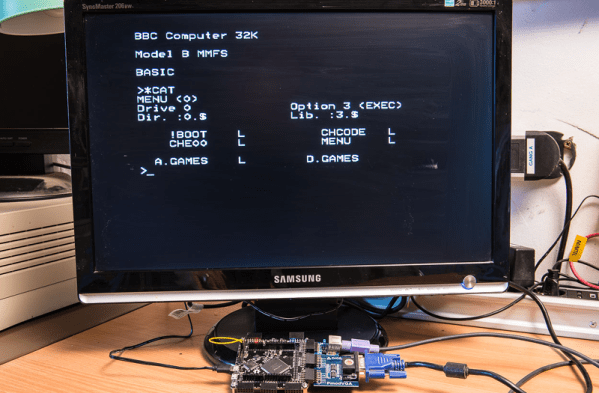
Often these machines strive to use the hardware of the day, and are covered with 74 logic chips and 8-bit processors in 40-pin dual-in-line packages, but there are projects that implement retrocomputers on more modern hardware. An example is [Sebastian]’s machine based upon a couple of PIC microcontrollers, one of which is an application processor with a PS/2 keyboard interface, and the other of which handles a VGA display interface. The application it runs calculates whether a 4-digit number is a prime and displays its results.

His write-up gives a fascinating overview of the challenges he found in creating a reliable VGA output from such limited hardware, and how he solved them. Though this one-sentence description makes a ton of work sound easy, horizontal sync pulses are generated as hardware PWM, and pixel data is streamed from the SPI bus. The VGA resolution is 640×480, upon which he could initially place a 10×10 block of text. Later optimizations extend it to 14×14.

Sometimes it’s not the power of the hardware but the challenge of making it perform the impossible that provides the attraction in a project, and on this front [Sebastian]’s retrocomputer certainly delivers. We’ve featured many other retrocomputers before here, some of which follow [Sebastian]’s example using modern silicon throughout, while others mix-and-match old and new.

The Impressive Z80 Computer With The Unfortunate Name

We’ve seen a lot of retro builds around the Z80. Not many are as neatly done or as well-documented as [dekeNukem’s] FAP80 project. Before you rush to the comments to make the obvious joke, we’ll tell you that everyone has already made up their own variation of the same joke. We’ll also tell you the name is a cross between an old design from [Steve Ciarcia] called the ZAP80 and a reference to the FPGA used in this device.

[dekeNukem] says his goal was to create a Z80 computer without all the baggage of using period-correct support chips. You can argue about the relative merits of that approach versus a more purist build, but the FAP80 has a 5 slot backplane, VGA output, a PS/2 keyboard port and more. You can see one of many videos showing the machine below.

Continue reading “The Impressive Z80 Computer With The Unfortunate Name”