Autonomous Tractor Brings In The Harvest

[Matt Reimer] is a farmer in Southwestern Manitoba, Canada. It’s grain country, and at harvest time he has a problem. An essential task when harvesting is that of the grain cart driver, piloting a tractor and grain trailer that has to constantly do the round between unloading the combine harvester and depositing the grain in a truck. It’s a thankless, unrelenting, and repetitive task, and [Matt]’s problem is that labour is difficult to find when every other farmer in the region is also hiring.

His solution was to replace the driver with a set of Arduinos and a Pixhawk autopilot controlling the tractor’s cab actuators, and running ArduPilot, DroneKit, and his own Autonomous Grain Cart software. Since a modern tractor is effectively a fly-by-wire device this is not as annoying a task as it would have been with a tractor from several decades ago, or with a car. The resulting autonomous tractor picks up the grain from his combine, but he reminds us that for now it still deposits the harvest in the truck under human control. It is still a work-in-progress with only one harvest behind it, so this project is definitely one to watch over the next few months.

Writing from the point of view of someone who grew up on a farm and has done her share of harvest-time tractor driving it’s possible to see both the strengths and weaknesses of an autonomous grain cart. His fields on the Canadian prairie are very large and flat, there is plenty of space and the grain makes its way from the field to the elevator in a truck. To perform the same task in the smaller and irregular fields of southern England for example with a mile round trip down country lanes to the grain store would be a much greater challenge. Aside from that it’s worth noting that his John Deere is a 220hp 4WD workhorse that is capable of going over almost any terrain on a farm with very few obstacles able to stop it. This thing can do serious damage to life and property simply by running it over or driving straight through it, so safety has a dimension with an autonomous tractor in a way that it never will with for example a vacuum cleaner or even a lawnmower.

Those observations aside, this kind of technology undeniably represents a step change in farming practice on a par with the move from horse power to tractors in the first half of the last century. However the technological barriers that remain end up being solved, it’s likely that you’ll see plenty more machines like this in the fields of the future.

The video below the break shows the autonomous grain cart in action. Plenty of big-sky tractoring action, and for those of you unfamiliar with farming it should provide some understanding of the task of getting grain from combine to store.

We’ve talked about robotic farming more than once here at Hackaday. The gantry-based Farmbot, the six-legged Prospero robot farmer, or another hexapod confusingly also called Farmbot, for example. But these have all been hacker’s solutions to the problem using the concepts with which they are familiar. What makes [Matt]’s project different is that it is a farmer’s solution to a real farming problem by automating the machinery he already uses to do the job. Farmers have been doing what we would now call hacking at the hardware of their craft since time immemorial, [Matt]’s work is just the latest manifestation of a rich heritage.
Continue reading “Autonomous Tractor Brings In The Harvest”

Office Supplies Hexapod Tramples Your Excuses

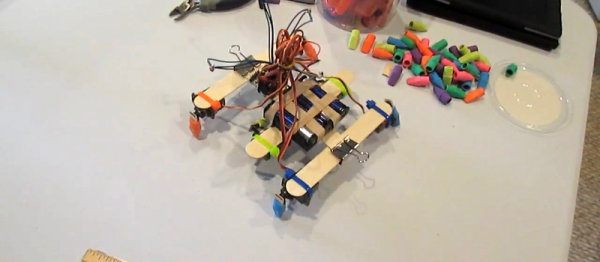
We all have reasons why we’re not building cool robots. “I don’t have a lasercutter.” “I don’t have a 3D printer.” [JAC_101]’s hexapod robot dances all over your excuses with its tongue-depressor body and pencil-eraser feet!

Some folks like to agonize over designs, optimizing this and tweaking that on the blackboard. Other folks just build stuff and see what works. If you’re in the mood for some of the latter, check out some of the techniques at work here. Tongue depressors make a simple frame, and servos are lashed on with zip ties in place of fancy servo mounts (or hot glue). Photoresistors are soldered directly to their load resistors, making a simple light sensor. It’s all very accessible and brutally minimalistic, but it seems to walk. (Check out the video, below.)

Arduino code is available for you to play with, naturally.

Continue reading “Office Supplies Hexapod Tramples Your Excuses”

Pipe In (Robot) Hand

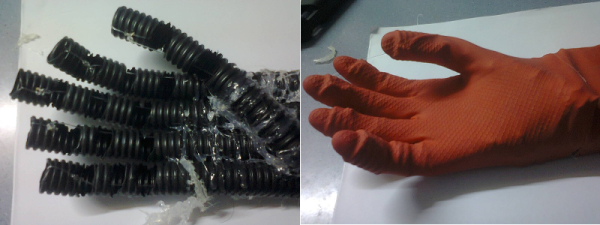
How do you make a robot hand? If you are [Robimek], you start with some plastic spiral tubing, some servo motors, and some fishing line. Oh, and you also need an old glove.

The spiral tubing (or pipe, if you prefer) is cut in a hand-like shape and fused together with adhesive. The knuckle joints are cut out to allow the tubing to flex at that point. The fishing line connects the fingertips to the servo motors.

The project uses an Arduino to drive the servos, although you could do the job with any microcontroller. Winding up the fishing line contracts the associated finger. Reeling it out lets the springy plastic pipe pull back to its original position.The glove covers the pipes and adds a realistic look to the hand.
Continue reading “Pipe In (Robot) Hand”

Making Dumb Robots Evolve

Evolution is a fact of life, except in Kansas. It is the defining characteristic of life itself, but that doesn’t mean a stupid robot can’t evolve. For his entry into the Hackaday Pi Zero contest, [diemastermonkey] is doing just that: evolution for robots built around microcontrollers and a Raspberry Pi.

[diemastermonkey]’s project is a physical extension to genetic algorithms. Just like DNA and proteins have no idea what they’re actually doing, microcontrollers don’t either. Instead of randomly switching up base pairs and amino acids, [diemastermonkey]’s project makes random connections pins depending on the values of those pins.

The potential of these crappy, randomly programmed robots is only as good as the fitness function, and so far [diemastermonkey] has seen some surprising success. When putting these algorithms into a microcontroller connected to a tilting table mechanism and a PIR sensor, the robot eventually settled on a bit of code that would keep a ball in motion. You can check out the video of that below.


Raspberry_Pi_LogoSmall

The Raspberry Pi Zero contest is presented by Hackaday and Adafruit. Prizes include Raspberry Pi Zeros from Adafruit and gift cards to The Hackaday Store!
See All the Entries

Continue reading “Making Dumb Robots Evolve”

Petite Package Provides Powerful Robot

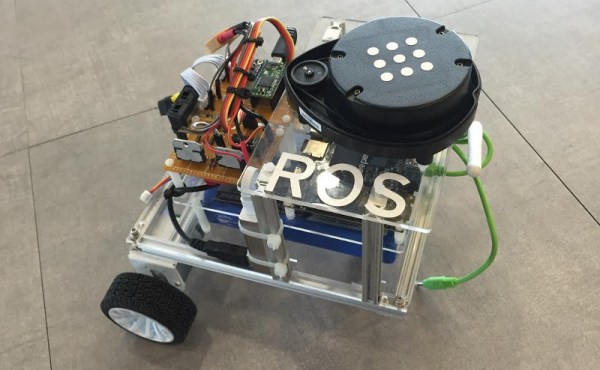
The Robot Operating System (ROS) is typically associated with big robots but [Grassjelly] decided to prove differently by creating Linorobot. This small, differential drive robot is similar in appearance to many small Arduino based robots often used for line following. Linorobot packs a lot more computing power with a Teensy 3.1 connected to a Radxa Rock Pro. The Teensy handles the motors, reading their encoders, and acquisition of IMU data.

The Radxa, new to us here at Hackaday, is a single board computer based on the quad-core ARM Cortex-A9 1.6 GHz CPU. It may not have been seen on our pages but if you’re at Hackaday Belgrade you can attend a session on building a cluster using it. The ability to run Linux is key to using ROS, which is an open source system for controlling robots. With the Radxa running ROS it interfaces directly to the Neato XV-11 Lidar’s dedicated controller board.

The Linorobot packs into a small robot the capabilities usually seen in much larger and expensive robots such as the Turtlebot 2. With this diminutive robot hackers can learn about doing SLAM (Simultaneous Localization and Mapping) and autonomous navigation, plus the other capabilities of ROS.

[Grassjelly] has a tutorial on building the robot which is also a good introduce to ROS. He provides the software as open source. It’s an impressive project which provides a small, comparatively affordable robot for learning and working with ROS. A video of Linorobot SLAMing and navigating [Grassjelly’s] lab is after the break.

Continue reading “Petite Package Provides Powerful Robot”

Wall-E Goes Corporate, Offering Telepresence Service

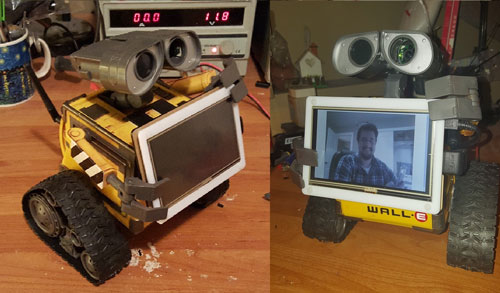
I guess if you are going to build a robot to do something boring like telepresence, you might as well make it cute. That’s obviously what [Andrew Maurer] was thinking when he built a telepresence robot using a Wall-E toy. The result is kind of adorable: Wall-E is holding the 5-inch HDMI screen that shows the video, and can scoot around in true Pixar fashion under remote control.

It’s also a neat build on the inside, using a Raspberry Pi for the brains and an Adafruit MotorHat to control the motors. The original toy didn’t have motors, so he added a new RC gearbox and motors to drive the little fella around. Installed behind Wall-Es eye is a USB webcam. Running behind the scenes is a mumble server that does the audio, a copy of Chromium that shows the video, and an Apache server that feeds the captured video to the other end of the conversation. The whole thing is tied together by a few scripts that kick things off appropriately and allow the user to remotely control Wall-E. It’s a cute build, and hopefully Wall-E can still find his EVE while performing his new corporate duties.

[via reddit]

Tiny Open Source Robot

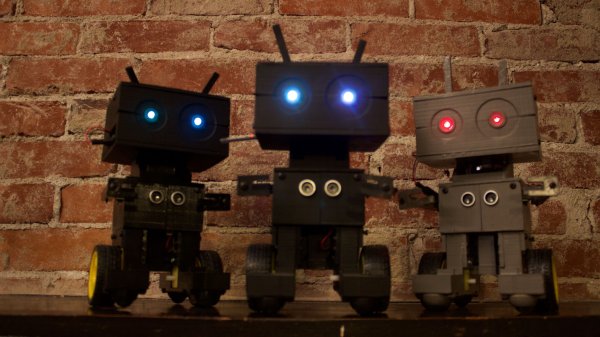
We watched the video introduction for this little open source robot, and while we’re not 100% sure we want tiny glowing eyes watching us while we sleep, it does seem to be a nice little platform for hacking. The robot is a side project of [Matthew], who’s studying for a degree in Information Science.

The robot has little actuated grippy arms for holding a cell phone in the front. When it’t not holding a cellphone it can use its two little ultrasonic senors to run around without bumping into things. We like the passive balancing used on the robot. Rather than having a complicated self-balancing set-up, the robot just uses little ball casters to provide the other righting points of contact.

The head of the robot has plenty of space for whatever flavor of Arduino you prefer. A few hours of 3D printing and some vitamins is all you need to have a little robot shadow lurking in your room. Video after the break.

Continue reading “Tiny Open Source Robot”