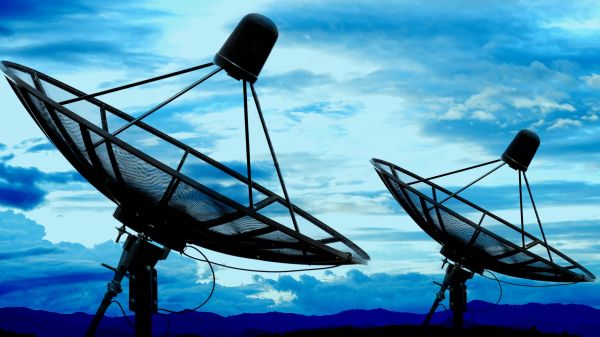
Satellite Communications Hack Chat

Join us on Wednesday, June 2 at noon Pacific for the Satellite Comms Hack Chat with Paul Marsh!

All things considered, space isn’t that far away; you could drive the equivalent distance in an hour or two, with time for a couple of stops on the way. Of course, getting to space isn’t as simple as a Sunday drive, and yet despite the expense and trouble, we’ve still managed to fill our little corner of the solar system with an astonishing number of satellites.

Almost every single one of the spacecraft we’ve put in orbit represents a huge capital investment, both in terms of building something that can withstand the extreme environment up there and as far as the expense involved in getting it there. So once it gets there, it needs to start producing results, and for the most part that means sending some kind of messages back down to Earth. And those communications can be tempting indeed to hardware hackers.

Monitoring messages from on high is what the satcom radio hobby is all about. Learning how to do it properly can be tricky, though. What frequencies does one use? What are the modulation schemes? What kind of antennas would someone need? And what about tracking these birds as they whizz overhead?

To answer these questions and more, Paul Marsh from UHF-Satcom will stop by the Hack Chat. Paul has been interested in satellites since the early 1990s and coupled with his background in infosec and pentesting, he has uncovered a lot about the ins and outs of satellite snooping. Stop by the Hack Chat and learn how to sniff in on what’s going on upstairs.

join-hack-chatOur Hack Chats are live community events in the Hackaday.io Hack Chat group messaging. This week we’ll be sitting down on Wednesday, June 2 at 12:00 PM Pacific time. If time zones have you tied up, we have a handy time zone converter.

Click that speech bubble to the right, and you’ll be taken directly to the Hack Chat group on Hackaday.io. You don’t have to wait until Wednesday; join whenever you want and you can see what the community is talking about.


The Last Days Of The Wild West

We loved it a few weeks ago when an international team of hackers managed to record and decode telemetry and images from SpaceX launches. And now it looks like SpaceX has started encrypting it all in response. Booo!

Decoding satellite and other space ship transmissions has been a great hacker pastime. Most recently, we’ve seen a group working on listening in to the Chinese Tianwen-1 Mars probe shortly after its launch, but listening to the Deep Space Network or even just decoding weather satellite broadcasts can give folks a reason to stretch their radio muscles.

We understand that SpaceX runs some contract missions for US gov’t agencies that don’t appreciate leaking info about their satellite’s whereabouts, but for non-secret missions, we don’t see the harm in letting the amateurs listen in over their shoulder. Maybe they’re doing it for PR reasons if/when something goes badly wrong?

Whatever the reasons, it’s a shame. Space has been open to hackers for a long time, knowingly in the case of amateur satellites, and unknowingly in the case of many other satellites which until the mid-90s had command channels that were unencrypted. (I’ll have to stick with “unnamed sources” on this one, but I do know a person who has rotated a satellite that he or she didn’t own.) There’s a lot to be learned by listening to signals from above, and while you can still decode weather satellite data yourself, it’s not quite as sexy as downloading images straight from a Falcon 9.

The cool hand for SpaceX to have played would have been to say “of course — we broadcast unencrypted as PR to our biggest fans” but it looks instead like they simply didn’t think that anyone would be listening in, and this caught them by surprise and they panicked. In 2021, with something as complicated as a space mission, that’s a little bit embarrassing. Anyway, to those of you who managed to get in before encryption, kudos!

The Raspberry Pi Pico As An SDR Receiver

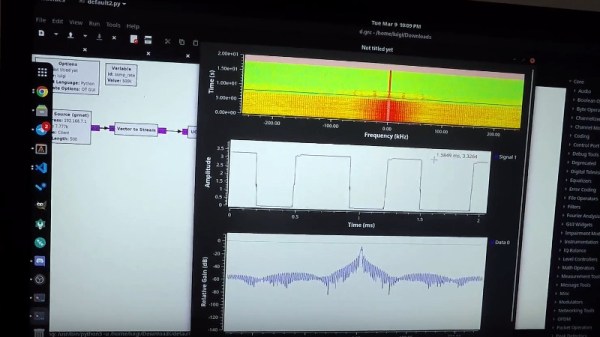
With the profusion of cheap RTL-SDR devices and the ever-reducing prices of more capable SDRs there might seem to be little place left for the low-bandwidth devices we’d have been happy with a decade or more ago, but there’s still plenty to be learned from something so simple. It’s something [Luigi Cruz] shows us with a simple SDR using the analogue-to-digital capabilities of the Raspberry Pi Pico, and since it works with GNU Radio we think it’s rather a neat project. CNX Software have the full story, and and quickly reveal that with its 500k samples per second bandwidth it’s not a machine that will set the SDR world on fire even when pushing Nyquist’s Law to the limit.

So with the exception of time signals and a few Long Wave broadcast stations if you live somewhere that still has them, you’ll need a fliter and receive converter to pull in anything of much use radio-wise with this SDR. But a baseband SDR with a couple of hundred kHz useful bandwidth and easy hackability through GNU Radio for the trifling cost of a Raspberry Pi Pico has to be worth a second look. You can see it in action in the video below the break, and if you’re at a loss for what to do with it take a look at Michael Ossmann and Kate Temkin’s 2019 Superconference talk.

Continue reading “The Raspberry Pi Pico As An SDR Receiver”

Spectrogram Drawing For Fun And Coding

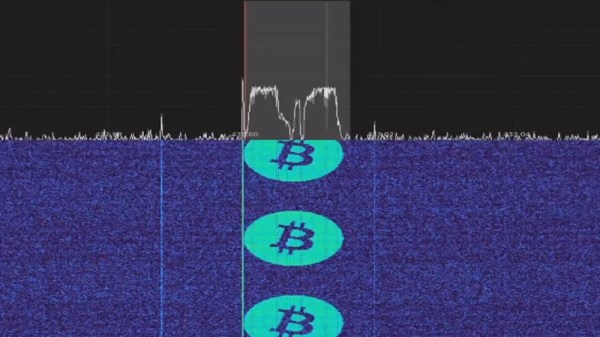
It probably can’t have taken long after the first spectrum waterfall display was created, before somebody had a go at creating a waveform that would create an image in the waterfall. We don’t know who that pioneer was, but it’s over 20 years since Aphex Twin famously used the technique in their music, so it’s nothing new. If you fancy a go for yourself, [Gokberk Yaltirakli] has the project for you, creating waterfall images with an SDR from image files, using a bit of Python code.

The value here isn’t necessarily in creating the waterfall of Bitcoin logos that can be seen in the video he’s put on the page, instead it’s in the simple explanation of creating I and Q values for an SDR. The code is a bit slow so writes its values to a file which is output by a HackRF, but it could just as easily be used by any other capable output device such as GNU Radio and a soundcard if you too want an Aphex Twin moment. The hardware for displaying a spectrum waterfall doesn’t even have to be very complex.

Thanks [Leo] for the tip.

Decoding NOAA Satellite Images In Python

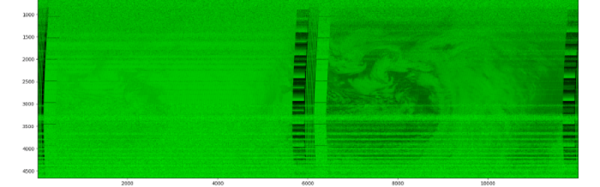
You’d be forgiven for thinking that receiving data transmissions from orbiting satellites requires a complex array of hardware and software, because for a long time it did. These days we have the benefit of cheap software defined radios (SDRs) that let our computers easily tune into arbitrary frequencies. But what about the software side of things? As [Dmitrii Eliuseev] shows, decoding the data satellites are beaming down to Earth is probably a lot easier than you might think.

Well, at least in this case. The data [Dmitrii] is after happens to be broadcast from a relatively old fleet of satellites operated by the National Oceanic and Atmospheric Administration (NOAA). These birds (NOAA-15, NOAA-18 and NOAA-19) are somewhat unique in that they fly fairly low and utilize a simple analog signal transmitted at 137 MHz. This makes them especially good targets for hobbyists who are just dipping their toes into the world of satellite reception.

Continue reading “Decoding NOAA Satellite Images In Python”

A Few Of My Favorite Things: Amateur Radio

Hackaday has among its staff a significant number of writers who also hold amateur radio licenses. We’re hardware folks at heart, so we like our radios homebrew, and we’re never happier than when we’re working at high frequencies.

Amateur radio is a multi-faceted hobby, there’s just so much that’s incredibly interesting about it. It’s a shame then that as a community we sometimes get bogged down with negativity when debating the minutia. So today let’s talk about a few of my favourite things about the hobby of amateur radio. I hope that you’ll find them interesting and entertaining, and in turn share your own favorite things in the comments below.

Continue reading “A Few Of My Favorite Things: Amateur Radio”

Remoticon Video: Learning The Basics Of Software-Defined Radio (SDR)

Have you dipped your toe into the SDR ocean? While hacker software-defined radio has been a hot topic for years now, it can be a little daunting to try it out for the first time. Here’s your change to get your legs under you with the SDR overview workshop presented by Josh Conway during the 2020 Hackaday Remoticon.

Josh’s presentation starts with a straightforward definition of SDR before moving to an overview of the hardware and software that’s out there. Hardware designs for radios can be quite simple to build, but they’ll be limited to a single protocol — for instance, an FM radio can’t listen in on 433 Mhz wireless doorbell. SDR breaks out of that by moving to a piece of radio hardware that can be reconfigured to work with protocols merely by making changes to the software that controls it. This makes the radio hardware more expensive, but also means you can listen (and sometimes transmit) to a wide range of devices like that wireless doorbell or automotive tire pressure sensors, but also radio-based infrastructure like airplane transponders and weather satellites.

This is the quickstart you want since it explains  a lot of topis at just the right depth. The hardware overview covers RTL-SDR, ADALM-PLUTO, HackRF, KerberosSDR, and BladeRF (which we just featured over the weekend used on the WiFi procotol). For software, Josh recaps GQRX, SDR#, SDRAngel, ShinySDR, Universal Radio Hacker, Inspectrum, SigDigger, RPITX, GnuRadio Companion, and REDHAWK. He also takes us through a wide swath of the antenna types that are out there before turning to questions from the workshop attendees.

If SDR is still absent in your toolbox, now’s a great time to give it another look. Once you’ve made it through the ‘hello world’ stage, there’s plenty to explore like those awesome RF Emissions testing tricks we as in another Remoticon talk.

Continue reading “Remoticon Video: Learning The Basics Of Software-Defined Radio (SDR)”