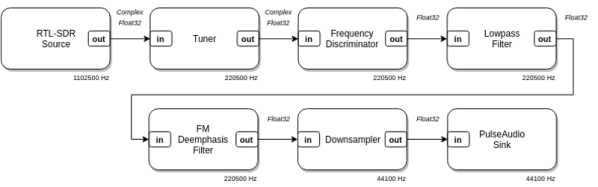
LuaRadio Gives Insight Into SDR

In theory, you shouldn’t need any help to develop a software-defined radio (SDR) application. But in real life you really don’t want to roll your own code every time to read the IQ samples, perform various transformations on them, and then drive audio output. At worst, you’ll use some libraries (perhaps GNU Radio) but usually, you’ll use some higher-level construct such as GNU Radio Companion (GRC). GRC is a bit heavyweight, though, so if you’ve found it daunting before, you might check out some of the material on the LuaRadio website.

We’ve looked at LuaRadio several years ago, but it has undergone a lot of changes since then and has some excellent documentation. Like Lua itself, LuaRadio emphasizes fast scripting. It supports quite a few pieces of common hardware and nearly anything that feeds data through a soundcard.

Continue reading “LuaRadio Gives Insight Into SDR”

All Your SDR Software In A Handy Raspberry Pi Image

The SDR revolution has brought a bonanza of opportunities for experimentation to the radio enthusiast, but with it has come a sometimes-confusing array of software for which even installation can be a difficult prospect for an SDR novice. If you’re bamboozled by it all then help may be at hand courtesy of [Luigi Cruz], who has packaged a suite of ready-to-go popular SDR software in an OS image for the Raspberry Pi.

On board the Raspbian-based OS image are SDR Angel, Soapy Remote, GQRX, GNURadio, LimeUtil, and LimeVNA. In hardware terms the RTL-SDR is supported, along with the LimeSDR, PlutoSDR, Airspy, and Airspy HF. All are completely ready-to-go and even have desktop shortcuts, so if the CLI scares you then you can still dive in and play. More importantly it’s designed for use with SDR transmitters as well as receivers, so the barrier for full SDR operation for radio amateurs has become significantly lower too.

This year has seen the seven-year anniversary of the RTL-SDR hack that probably did most to kickstart the use of SDRs in our community. Our colleague [Tom Nardi] wrote a retrospective that’s worth a look for its overview of some SDR tricks that have evolved over that time. Meanwhile if you don’t mind restricting your outlook somewhat, it’s possible to turn the Raspberry Pi 3 into an SDR all without any extra hardware.

Software Defined Radio Gets Physical Control

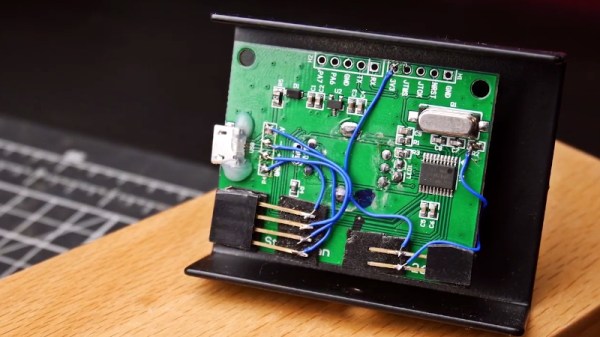
Software Defined Radio (SDR) is a great technology, but there’s something so satisfying about spinning a physical knob to cruise the airwaves. Wanting to restore that tactile experience, [Tysonpower] purchased a cheap USB volume knob and set out to get it working with his software. Unfortunately, getting it up and running took a lot more work than you’re probably expecting.

Programming the knob’s STM32

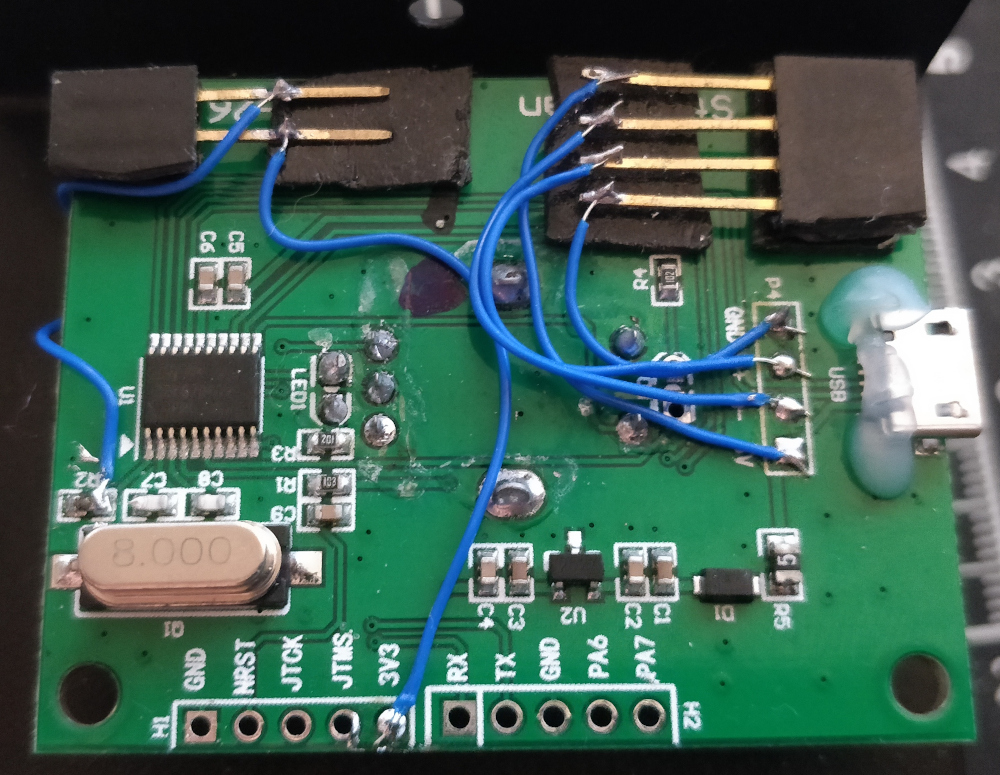
After verifying that the knob worked for volume control on his computer, [Tysonpower] decided to try and pull the firmware from the device’s STM32 microcontroller. Unfortunately, this is where things got tricky. It turned out the chip had Code Protection enabled, so when it was wired up to a programmer and put into DFU mode, the firmware got wiped. Oops.

That left [Tysonpower] with no choice but to write a new firmware from scratch, which naturally required reverse engineering the device’s hardware. Step one was reading up on STM32 development and getting the toolchain working, which paved the way to getting the knob’s LED to blink. A couple more hours worth of work and some multimeter poking later, and he was able to read the knob’s movement. He describes getting USB HID working as a nightmare due to lack of documentation, but eventually he got that sorted out as well.

The end result is a firmware allows the volume knob to mimic a mouse scroll wheel, which can be used for tuning in many SDR packages. But we think the real success story is the experience [Tysonpower] gained with reverse engineering and working with the STM32 platform. After all, sometimes the journey is just as important as the end result. Continue reading “Software Defined Radio Gets Physical Control”

Keep An Eye On The Neighborhood With This Passive Radar

If your neighborhood is anything like ours, walking across the street is like taking your life in your own hands. Drivers are increasingly unconcerned by such trivialities as speed limits or staying under control, and anything goes when they need to connect Point A to Point B in the least amount of time possible. Monitoring traffic with this passive radar will not do a thing to slow drivers down, but it’s a pretty cool hack that will at least yield some insights into traffic patterns.

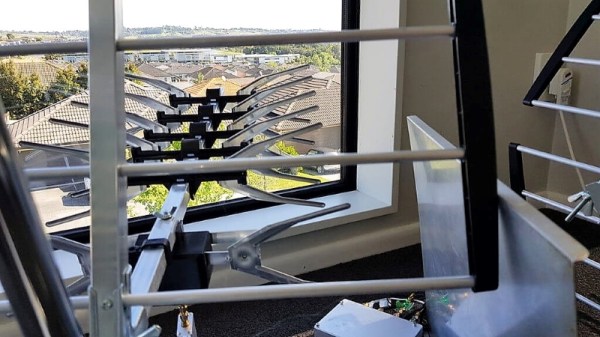
The principle behind active radar – the kind police use to catch speeders in every neighborhood but yours – is simple: send a microwave signal towards a moving object, measure the frequency shift in the reflected signal, and do a little math to calculate the relative velocity. A passive radar like the one described in the RTL-SDR.com article linked above is quite different. Rather than painting a target with an RF signal, it relies on signals from other transmitters, such as terrestrial TV or radio outlets in the area. Two different receivers are used, both with directional antennas. One points to the area to be monitored, while the other points directly to the transmitter. By comparing signals reflected off moving objects received by the former against the reference signal from the latter, information about the distance and velocity of objects in the target area can be obtained.

The RTL-SDR test used a pair of cheap Yagi antennas for a nearby DVB-T channel to feed their KerberosSDR four-channel coherent SDR, a device we last looked at when it was still in beta. Essentially four SDR dongles on a common board, it’s available now for $149. Using it to build a passive radar might not save the neighborhood, but it could be a lot of fun to try.

Hackaday Links Column Banner

Hackaday Links: September 29, 2019

In a sure sign that we’ve arrived in the future, news from off-world is more interesting this week than Earth news. When the InSight probe landed on Mars last year, it placed the first operating magnetometer on the Red Planet. Since then, the sensitive instrument has been logging data about the planet’s magnetic field, and now there are reports that researchers have discovered a chain of pulsations in the magnetic field. Pulsations in planetary magnetic fields aren’t all that strange; pulse trains that occur only at Martian midnight are, though. Researchers haven’t got a clue yet about what this means. We assume they’ve eliminated artifacts like something on the lander being turned on at local midnight, so when they figure it out it should be fascinating.

In more news from the future, Boston Dynamics is trolling us again. We covered the announcement early this week that they’re putting their Spot quadruped robot on sale – sort of. Turns out you need to be selected to qualify based on the application you have in mind, plus have several Ferraris full of cash to spend. While everyone was watching the adorable antics of Spot as it wandered through improbably industrial vignettes, Boston Dynamics also released this slightly terrifying video of their Atlas robot running through a gymnastics routine.  It starts with a headstand and a front roll and ends with a slipt leap and whatever the gymnastics equivalent of a figure skating axel jump is. Yes, it has a special roll cage attached to make the tumbles a bit smoother, but it’s still some remarkable stuff.

How are your RF design skills? If they’re good enough to design an RF power amp, you might want to check out this homebrew RF design challenge. Put on by NXP Semiconductors, the design must use one of their new LDMOS RF power transistors. They’ll send you samples so you can build your design, and you stand to win up to $3000 plus $1000 worth of NXP products. The contest opened back in May but is running through the middle of November, so you’d better hurry.

Speaking of RF, wouldn’t it be interesting to see a snapshot of the RF spectrum over the entire planet? ElectroSense thinks so, and they’re working on a crowdsourcing model to set up a globe-spanning network of connected RF sensors. The idea is similar to what FlightAware does for monitoring the locations of aircraft with a distributed network of ADS-B receivers. But where FlightAware only monitors a narrow slice of spectrum, ElectroSense wants it all – DC to 6 GHz. You can build a sensor from an SDR and a Raspberry Pi and start contributing to the effort, which only has a handful of sensors at the moment.

Has affordable metal 3D-printing finally arrived? For certain values of affordability, it soon will, when One Click Metal launches their new selective laser melting printer. Thomas Sanladerer did a video with the principals, and the prototype looks promising. SLM is not a new process, but patents on the core process recently ran out, so startups like One Click Metal are jumping into the market. Their printer won’t be cheap — you’ll still need to write a check with many zeroes — but with more players, the price should come down.

And finally, what’s this world coming to when a startup specializing in building giant fighting robots can’t make a go of it? MegaBots is shutting down, and while that’s certainly bad news for its founders and employees, it’s great news for anyone in the market for used battle bots. The company’s flagship bot, the 15-ton Eagle Prime, is currently up for auction on eBay. Bidding started at $1 with no reserve, but if you were looking for a steal, you’re a bit late. The high bid is currently $100,100, which is still an incredible buy considering it cost $2.5 million to build. You’ll have to pay for shipping, but you’ll have a super-destructive mecha of your own to drive around. And think how cool you’ll look rolling into some kid’s backyard birthday party. Presumably one you’ve been invited to.

Probe The Galaxy On A Shoestring With This DIY Hydrogen-Line Telescope

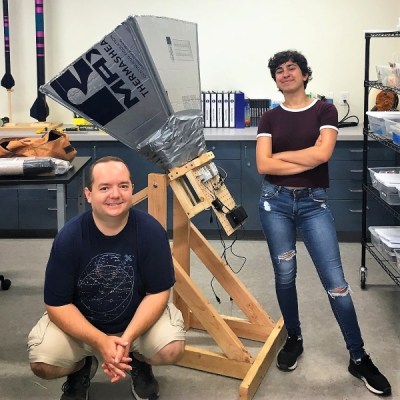
Foil-lined foam insulation board, scraps of lumber, and a paint-thinner can hardly sound like the tools of a radio astronomer. But when coupled with an SDR, a couple of amplifiers, and a fair amount of trial-and-error tweaking, it’s possible to build your own hydrogen-line radio telescope and use it to image the galaxy.

As the wonderfully named [ArtichokeHeartAttack] explains in the remarkably thorough project documentation, the characteristic 1420.4-MHz signal emitted when the spins of a hydrogen atom’s proton and electron flip relative to each other is a vital tool for exploring the universe. It lets you see not only where the hydrogen is, but which way it’s moving if you analyze the Doppler shift of the signal.

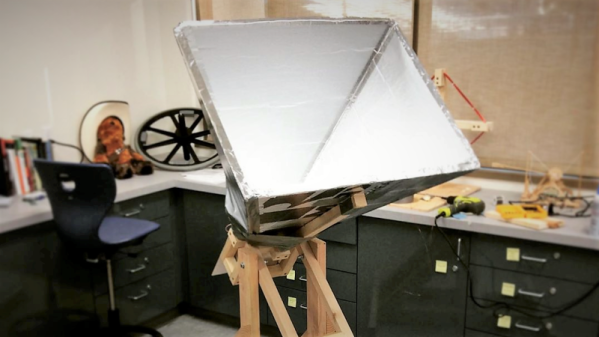
But to do any of this, you need a receiver, and that starts with a horn antenna to collect the weak signal. In collaboration with a former student, high school teacher [ArtichokeHeartAttack] built a pyramidal horn antenna of insulation board and foil tape. This collects RF signals and directs them to the waveguide, built from a rectangular paint thinner can with a quarter-wavelength stub antenna protruding into it. The signal from the antenna is then piped into an inexpensive low-noise amplifier (LNA) specifically designed for the hydrogen line, some preamps, a bandpass filter, and finally into an AirSpy SDR. GNURadio was used to build the spectrometer needed to determine the galactic rotation curve, or the speed of rotation of the Milky Way galaxy relative to distance from its center.
We’ve seen other budget H-line SDR receiver builds before, but this one sets itself apart by the quality of the documentation alone, not to mention the infectious spirit that it captures. Here’s hoping that it finds its way into a STEM lesson plan and shows some students what’s possible on a limited budget.

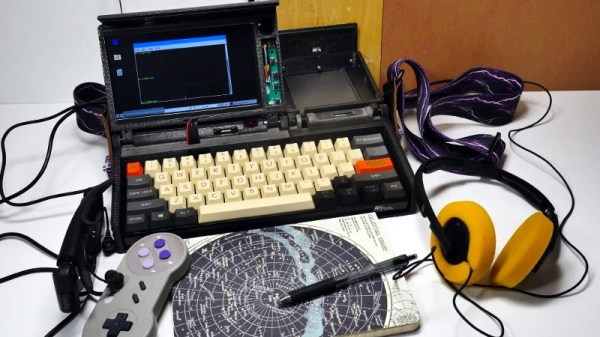
3D Printed VirtuScope Is A Raspberry Pi 4 Cyberdeck With A Purpose

William Gibson might have come up with the idea for the cyberdeck in 1984, but it’s only recently that technology like desktop 3D printing and powerful single board computers have enabled hackers and makers to assemble their own functional versions of these classic cyberpunk devices. Often the final product is little more than a cosplay prop, but when [Joe D] (better known on the tubes as [bootdsc]) started designing his VirtuScope, he wanted to create something that was actually practical enough to use. So far, it looks like he’s managed to pull it off.

Many of the cyberdeck builds we see are based around the carcass of a era-appropriate vintage computer, which looks great and really helps sell the whole retro-future vibe. Unfortunately, this can make the projects difficult and expensive to replicate. Plus there’s plenty of people who take offense to gutting a 30+ year old piece of hardware just so you can wear it around your neck at DEF CON.

[bootdsc] deftly avoided this common pitfall by 3D printing the entire enclosure for the VirtuScope, and since he’s shared all of the STLs, he’s even made it so anyone can run off their own copy. The majority of the parts can be done on any FDM printer with a 20 x 20 x 10cm build area, though there are a few detail pieces that need the resolution of an SLA machine.

Under the hood the VirtuScope is using the Raspberry Pi 4, which [bootdsc] says is key to the build’s usability as the latest version of the diminutive Linux SBC finally has enough computational muscle to make it a viable for daily computing. Granted the seven inch LCD might be a tad small for marathon hacking sessions, but you could always plug in an external display when you don’t need to be mobile. For your wireless hacking needs, the VirtuScope features an internal NooElec SDR (with HF upconverter) and a AWUS036AC long-range WiFi adapter; though there’s plenty of room to outfit it with whatever kind of payload you’d find useful while on the go.

Documentation for this project is still in the early stages, but [bootdsc] has already provided more than enough to get you started. He tells us that there are at least two more posts coming that will not only flesh out how he built the VirtuScope, but explain why it’s now become his portable SDR rig of choice. We’re excited to see more details about this build, and hope somebody out there is willing to take on the challenge of building their own variant.

In the past we’ve seen partially 3D printed cyberdecks, and at least one that also went the fully-printed route, but none of them have been quite as accessible as the VirtuScope. By keeping the geometry of the printed parts simple and utilizing commonly available components, [bootdsc] may well have laid the groundwork for hackerdom’s first “mass produced” cyberdeck.

Continue reading “3D Printed VirtuScope Is A Raspberry Pi 4 Cyberdeck With A Purpose”