Programmable Wrist Synth Pushes The Envelope

Synths are a ton of fun no matter how good or bad they sound. Really, there are no bad-sounding ones, it’s just that some are more annoying to listen than others to if you’re not the one making the beep boops. [Clem] had built a tiny LDR-based synth into a watch case a few years back and took it to many a Maker Faire, where it delighted and annoyed until it ultimately broke.

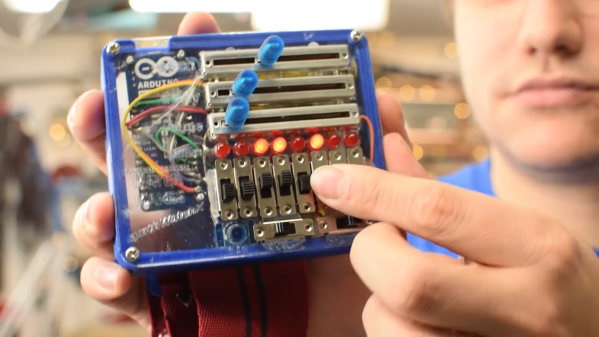
Naturally, it was time to make a new version that’s more capable. Whereas the first one was Atari-punk-console-meets-light-Theremin, this one has a bunch of inputs and can be programmed on the fly to record and play back bendable tones. It’s driven by an Arduino MKR, and the inputs are managed by an impressively squash bug-wired shift register. [Clem] used beefy switches this time in the hopes that this one will last longer. We think the slide pots are a great touch, as are the candy-colored knobs printed in PMMA.

Our favorite part is that [Clem] took advantage of the random states the microcontroller pins are in when it’s first powered on. If you don’t want to program any notes, you can use the ones generated at boot and just play around with those. Be sure to check out the build video after the break.

We’ve seen our share of synths, but few as delicious-looking as KELPIE from this year’s Hackaday Prize.

Continue reading “Programmable Wrist Synth Pushes The Envelope”

Dub Siren Synth Does It The Old School Way

There’s little that can compare to the sheer obnoxious thrill of mashing the DJ siren when its your turn behind the decks. We’ve certainly been guilty of abusing the privilege at local house parties, and unsurprisingly have not been invited back. If we ever get another shot, though, we’d be glad to have [lonesoulsurfer]’s dub siren at the ready.

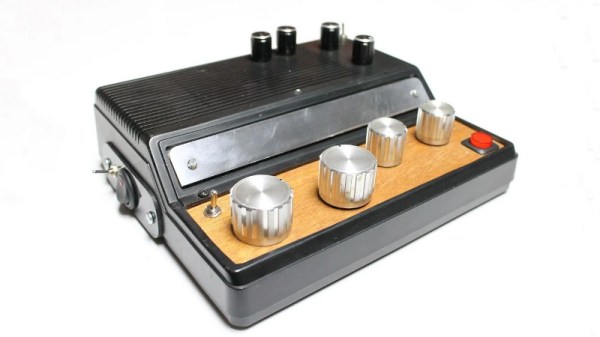
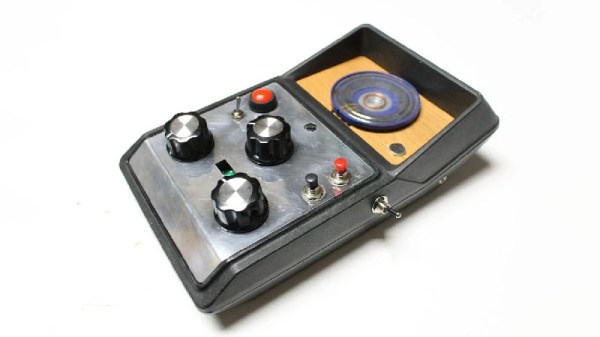
This is a build for the old-school purists. There’s no microcontrollers or digital hardware here. The synth relies on two 555 timer ICs as the oscillators and an LM741 op-amp. These parts harken right back to the dawn of the integrated circuit era, and still do a great job in this application. There’s also a cheap reverb/echo module added in to fatten up the sound. It’s all laced up in an old CB radio enclosure, with the classic woodgrain applique doing much to add to the aesthetic.

It’s a build that’s simple enough for the electronics beginner, and would make a great tactile, analog addition to any DJ’s rig. If you need some wubwubs to go with your woowoos, then consider building a Ball of Dub, too.

Continue reading “Dub Siren Synth Does It The Old School Way”

Finally Your Air Drumming Has An Outlet

Two engineering students are hard at work on this air drum which they hope will help disabled people and people in nursing homes. Though, we think it just looks fun!

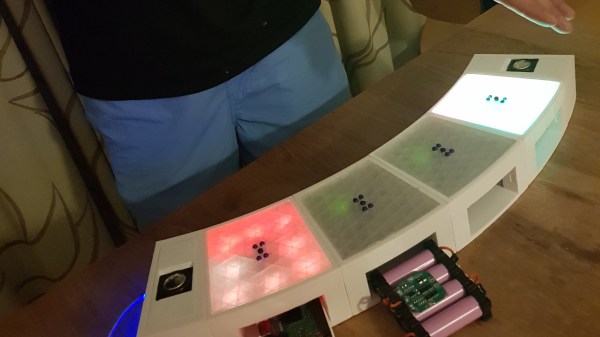
Each board is its own module consisting of the electronics and 3D printed cases. The modules each contain an arduino mini, IR sensor, and LEDs. They share power, audio, and communicate with an i2c bus. Two modules are special, one holds the power system and the other a Raspberry Pi. The units can be put together in different configurations. Finally, they are capped with speaker units.

The demo shown in the video, which you can see after the break, looks fun. The response time is pretty fast and it looks like you can measure all sorts of parameters. This can then be translated into different velocities, pitches, and instruments. It’s somewhere between a theremin and a drum kit, very cool.

Continue reading “Finally Your Air Drumming Has An Outlet”

World’s Smallest MIDI Synth, Now Even Better

We’re pretty sure there’s no internationally recognized arbiter of records like “World’s smallest full-featured polyphonic stereo MIDI synthesizer that fits in a DIN shell”. If there isn’t, there sure should be, and we’re pretty sure [mitxela]’s Flash-Synth would hold that particular record.

This is one of those lessons that some people just can’t leave a challenge alone. First [mitxela] built a MIDI synthesizer into a DIN connector, then a couple of months later he made a somewhat more streamlined version. While both were feats of engineering derring-do, neither was entirely satisfactory. With only square wave synthesis and a limit of eight voices, plus some unpleasant audio issues and a total lack of manufacturability, the next challenge was clear.

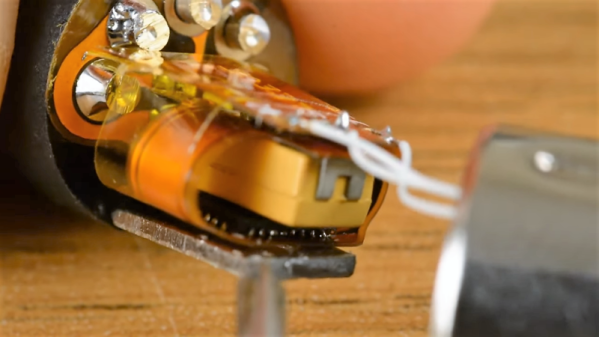
We won’t pretend to follow all the audio arcana, of which the video below and the build log have plenty, but the technical achievement is obvious enough. The Flash-Synth has an STM32, a tantalum SMD filter capacitor that dwarfs it, and a few support components on a flexible PCB that folds back on itself twice. This bit of circuit origami is connected to a 5-pin DIN plug and stuffed into the connector’s shell, which in turn mates to a custom-machined metal housing. A stereo audio jack lives at the other end of the assembly, and the whole synth is powered parasitically off the MIDI port.

The first half of the video below is mostly a demo that proves the synth sounds great and can do just about anything; skip to the 22-minute mark for the gory build details. Suffice it to say that [mitxela]’s past experience with ludicrous scale soldering served him well here.

Continue reading “World’s Smallest MIDI Synth, Now Even Better”

Circuit Bending Those Adorable Voices

Leapfrog make some pretty awesome kids electronics. Especially admirable is the low cost, the battery life, and the audio quality of these devices. This circuit bending hack takes advantage of those audio circuits by turning the Alphabet Pal into your lead vocalist. The performance in the demo video begins with some impressive tricks, but just wait for it because by the end the little purple caterpillar proves itself an instrument worthy of a position beside that fancy Eurorack you’ve been assembling.

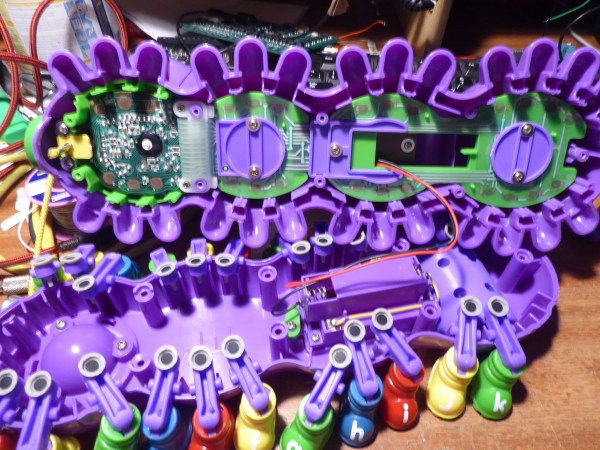
The image above provides a great look inside the beastie. [Jason Hotchkiss] mentions he’s impressed by the build quality, and we have to agree. Plus, look at all of those inputs — this is begging to leave toyland and join the band. With an intuitive sense that can only be gained through lots of circuit-bending experience, he guessed that the single through-hole resistor on the PCB was used to dial in the clock speed. That made it easy to throw in a trimpot for pitch-bending and he moved on to figure out individual note control.



All of those caterpillar feet are arranged in a keyboard matrix to detect button presses. After pulling out the oscilloscope for a bit of reverse engineering, [Jason] grabbed a PIC microcontroller and added it to the same solder points as the stock ribbon connector. The result is that the buttons on the feet still work, but now the Alphabet Pal also has MIDI control.

Take a look at the writeup for full details, and the video after the break to hear it in action. If you’re a fan of circuit-bent toys, this pretty pink keyboard hack always impressed us, especially the spring reverb that was added!

Continue reading “Circuit Bending Those Adorable Voices”

The Motor Synth Is What You Get When You Forget Hammond Organs Exist

There’s nothing new, ever. It’s all been done. But that doesn’t mean you can’t invent something interesting. A case in point is the Motor Synth, a crowdfunding project from Gamechanger Audio. It’s what you get when you combine advanced quadcopter technology with the market for modular and semi-modular synthesizers.

The core feature of the Motor Synth is an octet of brushless motors tucked behind a plexiglass window. These (either through an electromagnetic pickup or something slightly more clever) produce a tone, giving the Motor Synth four-note polyphony with two voices per key. On top of these motors are reflective optical discs sensed with infrared detectors. These are mixed as harmonics to the fundamental frequency. The result? Well, they got an endorsement from [Jean-Michel Jarre] at Superbooth earlier this month (see video below). That’s pretty impressive. Continue reading “The Motor Synth Is What You Get When You Forget Hammond Organs Exist”

Hacker Dosed With LSD While Restoring Historical Synth

[Eliot Curtis] found himself a little too close to 1960’s counterculture while restoring a vintage modular synthesizer — he began tripping out on acid. The instrument in question is a Buchla Model 100. The Buchla is a modular synth. Instead of a keyboard, it used capacitance-sensitive touch plates. This particular model 100 was purchased by California State University East Bay Campus. The synth was popular for a while, but eventually fell into disuse, and was stored in a classroom closet.

Modular synths are experiencing a renaissance, as can be seen right here on Hackaday. The Buchla was pulled out of storage and given a proper restoration. [Eliot Curtis] is the Broadcast Operations Manager at KPIX 5, the San Francisco CBS TV station. He also is the hacker who volunteered to restore the Buchla.
During the restoration, [Curtis] found residue and crystals stuck under one of the knobs of the Control Voltage Processing Module. Was it flux, conformal coating, or something else? [Eliot] hit the board with contact cleaner and wiped it down. Within 45 minutes, he was feeling a strange tingling. It was the beginning of a nine-hour LSD trip. Three independent tests on the module came back positive for LSD.

Lysergic acid diethylamide (LSD for short) can be readily absorbed through the skin, which is exactly what happened to [Eliot]. Synth designer [Don Buchla] was friends with [Owsley Stanley], who worked for the Grateful Dead and allegedly cooked up some very potent LSD. Some of Buchla’s modules even found their way into Ken Keesey’s hands, where they wound up on his famous bus “further”. As it turns out there were rumors that modules had been dipped in LSD back in the ’60s. Why someone would do that to an electronic module, we’re not sure — they must have been on drugs. [Eliot] recovered from his brush with the ’60s and continued with the restoration with gloves on.

If there is a moral here, it should be to take precautions when working on equipment which might contain dangerous substances. We’ve learned this lesson ourselves cracking open broken laptops. You might find anything from coffee to soda, to pet urine or worse. A box of nitrile gloves definitely should be standard equipment in any hacker’s lab.