
What One-Winged Squids Can Teach The Airship Renaissance

It’s a blustery January day outside Lakehurst, New Jersey. The East Coast of North America is experiencing its worst weather in decades, and all civilian aircraft have been grounded the past four days, from Florida to Maine. For the past two days, that order has included military aircraft, including those certified “all weather” – with one notable exception. A few miles offshore, rocking and bucking in the gales, a U.S. Navy airship braves the storm. Sleet pelts the plexiglass windscreen and ice sloughs off the gasbag in great sheets as the storm rages on, and churning airscrews keep the airship on station.

If you know history you might be a bit confused: the rigid airship USS Akron was lost off the coast of New Jersey, but in April, not January. Before jumping into the comments with your corrections, note the story I’ve begun is set not in 1933, but in 1957, a full generation later.

The airship caught in the storm is no experimental Zeppelin, but an N-class blimp, the workhorse of the cold-war fleet. Yes, there was a cold war fleet of airships; we’ll get to why further on. The most important distinction is that unlike the last flight of the Akron, this story doesn’t end in tragedy, but in triumph. Tasked to demonstrate their readiness, five blimps from Lakehurst’s Airship Airborne Early-Warning Squadron 1 remained on station with no gaps in coverage for the ten days from January 15th to 24th. The blimps were able to swap places, watch-on-watch, and provide continuous coverage, in spite of weather conditions that included 60 knot winds and grounded literally every other aircraft in existence at that time. Continue reading “What One-Winged Squids Can Teach The Airship Renaissance”

How To Properly Patch Your Iowa-Class Battleship

There’s a saying among recreational mariners that the word “boat” is actually an acronym for “bring out another thousand”, as it seems you can’t operate one for long without committing to expensive maintenance and repairs. But this axiom isn’t limited to just civilian pleasure craft, it also holds true for large and complex vessels — although the bill generally has a few more zeros at the end.

Consider the USS New Jersey (BB-62), an Iowa-class battleship that first served in the Second World War and is now operated as a museum ship. Its recent dry docking for routine repair work has been extensively documented on YouTube by curator [Ryan Szimanski], and in the latest video, he covers one of the most important tasks crews have to attend to while the ship is out of the water: inspecting and repairing the hundreds of patches that line the hull.

These patches aren’t to repair damage, but instead cover up the various water inlets and outlets required by onboard systems. When New Jersey was finally decommissioned in 1991, it was hauled out of the water and plates were welded over all of these access points to prevent any potential leaks. But as the Navy wanted to preserve the ship so it could potentially be reactivated if necessary, care was taken to make the process reversible.

Continue reading “How To Properly Patch Your Iowa-Class Battleship”

Hackaday Links Column Banner

Hackaday Links: December 18, 2022

By now everyone has probably seen the devastation wrought by the structural failure of what was once the world’s largest free-standing cylindrical aquarium. The scale of the tank, which until about 5:50 AM Berlin time on Friday graced the lobby of the Raddison Blu hotel, was amazing — 16 meters tall, 12 meters in diameter, holding a million liters of saltwater and some 1,500 tropical fish. The tank sat atop a bar in the hotel lobby and was so big that it even had an elevator passing up through the middle of it.

But for some reason, the tank failed catastrophically, emptying its contents into the hotel lobby and spilling the hapless fish out into the freezing streets of Berlin. No humans were killed by the flood, which is miraculous when you consider the forces that were unleashed here. Given the level of destruction, the displaced hotel guests, and the fact that a €13 million structure just up and failed, we’re pretty sure there will be a thorough analysis of the incident. We’re pretty interested in why structures fail, so we’ll be looking forward to finding out the story here.

Continue reading “Hackaday Links: December 18, 2022”

X-37B Spaceplane To Test Power Beaming Technology

Since 2010, the United States military has been operating a pair of small reusable spaceplanes that conduct secretive long-duration flights in low Earth orbit. Now officially operating under the auspices of the newly formed Space Force, the X-37Bs allow the military to conduct in-house research on new hardware and technology with limited involvement from outside agencies. The spaceplane still needs to hitch a ride to space on a commercial rocket like the Atlas V or the Falcon 9, but once it’s separated from the booster, the remainder of the X-37B’s mission is a military affair.

An X-37B being prepared for launch.

So naturally, there’s a lot we don’t know about the USSF-7 mission that launched from Cape Canaveral Air Force Station on May 17th. The duration of the mission and a complete manifest of the experiments aboard are classified, so nobody outside the Department of Defense truly knows what the robotic spacecraft is up to. But from previous missions we know the craft will likely remain in orbit for a minimum of two years, and there’s enough public information to piece together at least some of the investigations it will be conducting.

Certainly one the most interesting among them is an experiment from the U.S. Naval Research Laboratory (NRL) that will study converting solar power into a narrow microwave beam; a concept that has long been considered the key to unlocking the nearly unlimited energy potential offered by an orbital solar array. Even on a smaller scale, a safe and reliable way to transmit power over the air would have many possible applications. For example it could be used to keep unmanned aerial vehicles airborne indefinitely, or provide additional power for electric aircraft as they take-off.

Performing an orbital test of this technology is a serious commitment, and shows that all involved parties must have a fairly high confidence level in the hardware. Unfortunately, there isn’t much public information available about the power beaming experiment currently aboard the X-37B. There’s not even an indication of when it will be performed, much less when we should expect to see any kind of report on how it went. But we can make some educated guesses based on the work that the Naval Research Laboratory has already done in this field.

Continue reading “X-37B Spaceplane To Test Power Beaming Technology”

Plasma “Ghosts” May Help Keep Future Aircraft Safe

Air-to-air combat or “dogfighting” was once a very personal affair. Pilots of the First and Second World War had to get so close to land a hit with their guns that it wasn’t uncommon for altercations to end in a mid-air collision. But by the 1960s, guided missile technology had advanced to the point that a fighter could lock onto an enemy aircraft and fire before the target even came into visual range. The skill and experience of a pilot was no longer enough to guarantee the outcome of an engagement, and a new arms race was born.

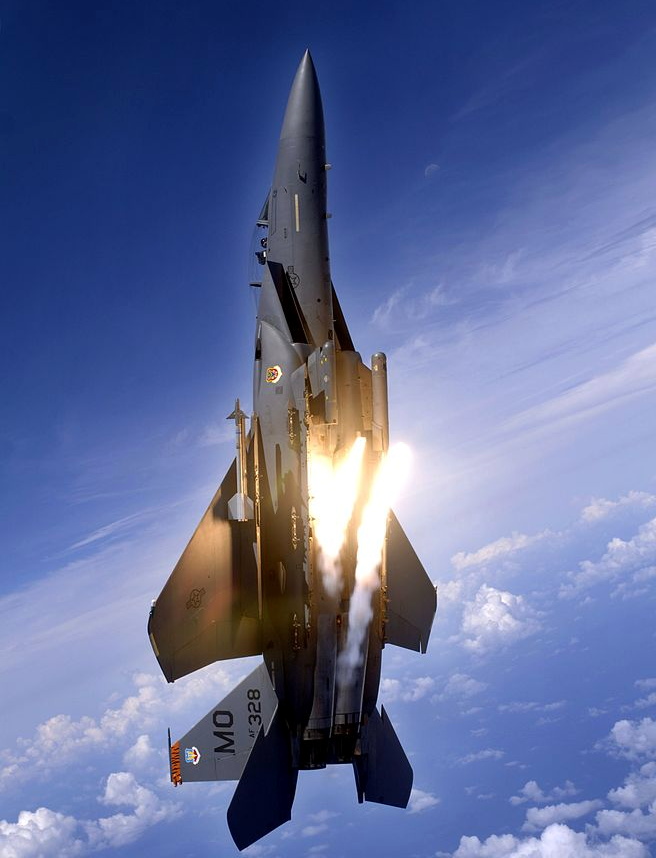
An F-15 launching flare countermeasures.

Naturally, the move to guided weapons triggered the development of defensive countermeasures that could confuse them. If the missile is guided by radar, the target aircraft can eject a cloud of metallic strips known as chaff to overwhelm its targeting system. Heat-seeking missiles can be thrown off with a flare that burns hotter than the aircraft’s engine exhaust. Both techniques are simple, reliable, and have remained effective after more than a half-century of guided missile development.

But they aren’t perfect. The biggest problem is that both chaff and flares are a finite resource: once the aircraft has expended its stock, it’s left defenseless. They also only work for a limited amount of time, which makes timing their deployment absolutely critical. Automated dispensers can help ensure that the countermeasures are used as efficiently as possible, but sustained enemy fire could still deplete the aircraft’s defensive systems if given enough time.

In an effort to develop the ultimate in defensive countermeasures, the United States Navy has been working on a system that can project decoy aircraft in mid-air. Referred to as “Ghosts” in the recently published patent, several of these phantom aircraft could be generated for as long as the system has electrical power. History tells us that the proliferation of this technology will inevitably lead to the development of an even more sensitive guided missile, but in the meantime, it could give American aircraft a considerable advantage in any potential air-to-air engagements.

Continue reading “Plasma “Ghosts” May Help Keep Future Aircraft Safe”

Perhaps August Dvorak Is More Your Type

One of the strangest things about human nature is our tendency toward inertia. We take so much uncontrollable change in stride, but when our man-made constructs stop making sense, we’re suddenly stuck in our ways — for instance, the way we measure things in the US, or define daytime throughout the year. Inertia seems to be the only explanation for continuing to do things the old way, even when new and scientifically superior ways come along. But this isn’t about the metric system — it’s about something much more personal. If you use a keyboard with any degree of regularity, this affects you physically.

Many, many people are content to live their entire lives typing on QWERTY keyboards. They never give a thought to the unfortunate layout choices of common letters, nor do they pick up even a whisper of the heated debates about the effectiveness of QWERTY vs. other layouts. We would bet that most of our readers have at least heard of the Dvorak layout, and assume that a decent percentage of you have converted to it.

Hardly anyone in the history of typewriting has cared so much about subverting QWERTY as August Dvorak. Once he began to study the the QWERTY layout and all its associated problems, he devoted the rest of his life to the plight of the typist. Although the Dvorak keyboard layout never gained widespread adoption, plenty of people swear by it, and it continues to inspire more finger-friendly layouts to this day.

Continue reading “Perhaps August Dvorak Is More Your Type”

US Navy Looking To Retire Futuristic Prototype Ships

From the Age of Sail through to the Second World War, naval combat was done primarily in close quarters and with cannons. Naturally the technology improved quite a bit in those intervening centuries, but the idea was more or less the same: the ship with the most guns and most armor was usually the one that emerged victorious. Over the years warships became larger and heavier, a trend that culminated in the 1940s with the massive Bismarck, Iowa, and Yamato class battleships.

But by the close of WWII, the nature of naval combat had begun to change. Airplanes and submarines, vastly improved over their WWI counterparts, presented threats from above and below. A few years later, the advent of practical long-range guided missiles meant that adversaries no longer had to be within visual range to launch their attack. Going into the Cold War it became clear that to remain relevant, warships of the future would need to be smaller, faster, and smarter.

The aft flight deck of a modular LCS

It was this line of thinking that lead the US Navy to embark on the Littoral Combat Ship (LCS) program in the early 2000s. These ships would be more nimble than older warships, able to quickly dash through shallow coastal waters where adversaries couldn’t follow. Their primary armament would consist of guided missiles, with fast firing small-caliber guns being relegated to defensive duty. But most importantly, the core goal of the LCS program was to produce a modular warship.

Rather than being built for a single task, the LCS would be able to perform multiple roles thanks to so-called “mission modules” which could be quickly swapped out as needed. Instead of having to return to home port for a lengthy refit, an LCS could be reconfigured for various tasks at a commercial port closer to the combat area in a matter of hours.

A fleet of ships that could be switched between combat roles based on demand promised to make for a more dynamic Navy. If the changing geopolitical climate meant they needed more electronic reconnaissance vessels and fewer minesweepers, the Navy wouldn’t have to wait the better part of a decade to reshuffle their assets; the changeover could happen in a matter of weeks.

Unfortunately, the Littoral Combat Ships have been plagued with technical problems. Citing the expensive refits that would be required to keep them operational, the Navy is now looking at retiring the first four ships in the fleet, the newest of which is just six years old.

Continue reading “US Navy Looking To Retire Futuristic Prototype Ships”