Increasing Cable Length In Precision Video Applications

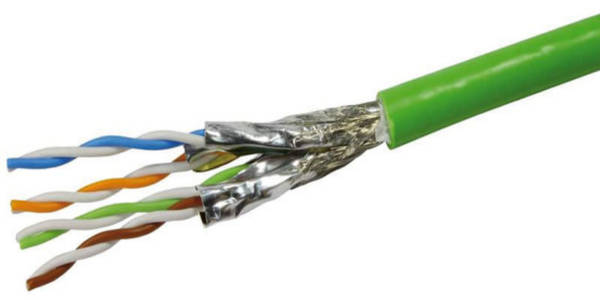
Transmitting video signals over long distances can be tricky. Cheap co-ax cables won’t do the job. You either need amplifiers along the path, or need to use expensive, high quality shielded co-ax cables – both of which can end up costing a lot. [Maurizio] built a low cost solution to transmit video over long distances using twisted pair cables.

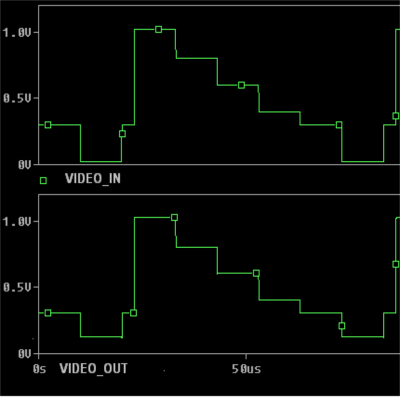
The system is cheap and uses readily available parts. The idea is to convert the video signal into a differential output using a pair of op amps and transmit them over a pair of twisted pair wires, then extract the signal at the receiving end using another amplifier.

twisted-pair-03A differential amplifier usually requires a dual-polarity power supply, which may not be available when adding this upgrade to an existing system. To over come this limitation, [Maurizio] uses a bias voltage equal to half of the power supply value. This bias voltage is added to the non-inverting amplifier signal, and subtracted from the inverting amplifier signal. The resultant differential signal is then fed into the twisted pair cable through impedance matching resistors. At the receiving end, a single amplifier receives the differential signals and outputs a signal that corresponds to the original video signal.



This symmetrical configuration renders the system immune to external noise. The design was tested for transmitting video on inexpensive CAT-3 twisted pair wire. According to him, when transmitting on 300m of wire, good quality color video was displayed on a monitor with an NTSC input. He used LMH6643 op-amps for this experiment, but other devices with similar characteristics can be used. Here’s a useful PDF document that discusses signals, cables and connections.

If you want to check out more of [Maurizio]’s work, see how he figured out how to send serial data from Excel.

Video Standards Are More Than Video Signals

The number of hours we spend staring at screens is probably best unknown, but how about the technology that makes up the video on the screen? We’ve all seen a reel-to-reel projector on TV or in a movie or maybe you’re old enough to have owned one, surely some of you still have one tucked away real nice. Whether you had the pleasure of operating a projector or just watched it happen in the movies the concept is pretty straight forward. A long piece of film which contains many individual frames pass in front of a high intensity lamp while the shutter hides the film movement from our eyes and our brain draws in the imaginary motion from frame to frame. Staring at a Blu-ray player won’t offer the same intuition, while we won’t get into what must the painful detail of decoding video from a Blu-ray Disc we will look into a few video standards, and how we hack them.

Continue reading “Video Standards Are More Than Video Signals”

Why Starting A Kickstarter Could Kick Your Butt

So you’ve come up with a great idea and now you’re thinking about starting a crowdfunding campaign – and why not, all the cool kids are doing it. Now, let’s say you already have a working prototype, or maybe you even built a small run for friends online. You’ve made 10 here, or 20 there. Sure it took some time, but making 1000, or 10,000 would be so much easier once you get all the orders in, right? Wrong.

Before you even think of setting up something like a Kickstarter, we would like to invite you to have a seat and watch this series of videos covering the things many people don’t know about manufacturing. It’s going to cost you 7 hours of sofa time, but if you’re serious about getting something to production these seven hours will pay in spades. Dragon Innovation has had many notable clients over the years – Pebble, Sphero, Makerbot, to name a few. They help startups find their way through the manufacturing mine-feild, for a fee of course. The founders are former iRobot employees, and have quite a bit of hard fought, yet free knowledge to share.

You’ll learn about how important decisions early on can make huge impacts on the success or failure of a product. There’s quite a bit of raw technical info on injection molding, design for manufacture, testing, pricing and everything under the sun. So do yourself (and everyone else) a favor, and before you click submit on that Kickstarter campaign, sit back and enjoy this free seminar.

We’re really enjoying the manufacturing oriented videos which have been popping up. Just a couple of weeks ago we came across a pair of hardware talks from [Bunnie Huang] that were a pleasure to watch. At 20 minutes this might be a good primer before you take the plunge with the playlist below.

Continue reading “Why Starting A Kickstarter Could Kick Your Butt”

Random Parcel Launches Steganographic Compulsion

A mysterious CD arrives in the mail with a weird handwritten code on it. What should you do? Put it in the computer and play the thing, of course!

Some might be screaming at their screens right now… this is how modern horror films start and before you know it the undead are lurking behind you waiting to strike. Seasonal thrills aside, this is turning into an involved community effort to solve the puzzle. [Johny] published the video and posted a thread on reddit.

We ran a similar augmented reality game to launch the 2014 Hackaday Prize solved by a dedicated group of hackers. It’s really hard to design puzzles that won’t be immediately solved but can eventually be solved with technology and a few mental leaps. When we come across one of these extremely clever puzzles, we take note.

This has all the hallmarks of a good time. The audio spectrogram shows hidden data embedded in the file — a technique known as steganography. There are some real contortions to make meaning from this. When you’re looking for a solution any little hit of a pattern feels like you’ve found something. But searching for the decrypted string yields a YouTube video with the same name; we wonder if they’ve tried to recover steganographic data from that source?

[Johny] mentions that this parcel was unsolicited and that people have suggested it’s a threat or something non-sensical in its entirety. We’re hoping it’s a publicity stunt and we’re all disappointed in the end, because solving the thing is the best part and publicity wouldn’t work if there was no solution.

The bright minds of the Hackaday community should be the ones who actually solve this. So get to work and let us know what you figure out!

Spit Out VGA With Non-Programmable Logic Chips

It’s not uncommon to bitbang a protocol with a microcontroller in a pinch. I2C is frequently crunched from scratch, same with simple serial protocols, occasionally complex systems like Ethernet, and a whole host of other communication standards. But VGA gets pretty tricky because of the timing requirements, so it’s less common to bitbang. [Sven] completely threw caution to the wind. He didn’t just bitbang VGA on an Arduino, but he went one step further and configured an array of 7400 logic chips to output a VGA signal.

[Sven]’s project is in two parts. In part one, he discusses choosing a resolution and setting up the timing signal. He proceeds to output a simple(-ish) VGA signal that can be displayed on a monitor using a single gate. At that point only a red image was displayed, but getting signal lock from the monitor is a great proof of concept and [Sven] moved on to more intricate display tricks.

With the next iteration of the project [Sven] talks about adding in more circuitry to handle things like frame counting, geometry, and color. The graphics that are displayed were planned out in a simulator first, then used to design the 7400 chip configuration for that particular graphic display. It made us chuckle that [Sven] reports his monitor managed to survive this latest project!

We don’t remember seeing non-programmable integrated circuits used for VGA generation before. But bitbanging the signal on an Arduino or from an SD card slot is a great test of your ability to calculate and implement precise timings with an embedded system. Give it a try!

Continue reading “Spit Out VGA With Non-Programmable Logic Chips”

Video From Audio And Pure Data

Although graphical programming languages have been around for ages, they haven’t really seen much use outside of an educational setting. One of the few counterexamples of this is Pure Data, and Max MSP, visual programming languages that make music and video development as easy as dropping a few boxes down and drawing lines between them.

A few years ago, [Thomas] and [Danny] developed a very cool Pure Data audio-visual presentation. The program they developed only generated graphics, but though clever coding they were able to generate a few audio signals from whatever video was coming out of their computer. The project is called TVestroy, and it’s one of the coolest audio-visual presentations you’ll ever see.

The entire program is presented on three large screens and nine CRT televisions. With some extremely clever code and a black box of electronics, the video becomes the audio. Check it out below.

Although this is a relatively old build, [Thomas] thought it would be a good idea to revisit the project now. He’s open sourced most of the Pure Data files, and everything can be downloaded on the project page.

Continue reading “Video From Audio And Pure Data”

Numato Opsis: FPGA-based Open Video Platform

Imagine that you’re running a conference and you want to do a professional job recording the speakers and their decks. You’ll need to record one video stream from the presenter’s laptop, and it’d be nice to have another of the presenter taken with a camera. But you also need to have the presenter’s screen displayed on a projector or two for the live audience. And maybe you’d like all of this dumped down to your computer so that you can simultaneously archive the presentation and stream it out over the Internet.

io-ports_png_project-bodyThat’s exactly the problem that the hdmi2usb project tries to solve on the software side for open-source software conventions. And to go with this software, [Tim Ansell] has built the Numato Opsis FPGA video board, to tie everything together. What’s great about the platform is that the hardware and the firmware are all open source too.

Because everything’s open and it’s got an FPGA on board doing the video processing, you’re basically free to do whatever you’d like with the content in transit, so it could serve as an FPGA video experimenter board. It also looks like they’re going to port code over so that the Opsis could replace the discontinued, but still open source, Milkimist One video effects platform.

One thing that’s really cute about the design is that it reports over USB as being a camera, so you can record the resulting video on any kind of computer without installing extra drivers. All in all, it’s an FPGA-video extravaganza with a bunch of open-source software support behind it. Very impressive, [Tim]!