A Smart Printer Enclosure For The Open Source World

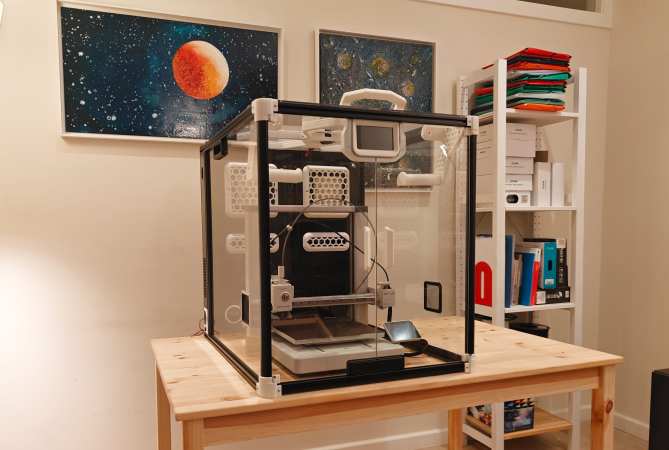
3D printing has had its time to spread its wings into the everyday home, yet many of those homes lack the proper ventilation to prevent the toxic VOCs from escaping. Because of this, [Clura] has put together an entire open-sourced smart enclosure for most open concept printers.

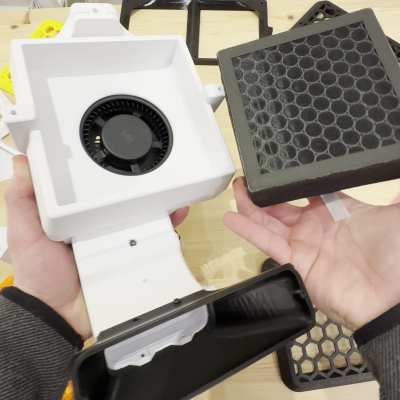
While certain 3D printers or filament choices lend themselves to being worse than others, any type of plastic particles floating around shouldn’t find their way into your lungs. The [Clura] enclosure design includes HEPA and carbon filters in an attempt to remove this material from the air. Of course, there’s always the choice to have a tent around your printer, but this won’t actually remove any VOCs and air located inside a simple enclosure will inevitably escape.

What makes this enclosure different from other, either commercial or open-source designs, is the documentation included with the project. There are kits available for purchase, which you may want for the custom PCB boards for smart features such as filament weighing or fume detection. Even still, if you don’t want to purchase these custom boards the Gerber files are available on their GitHub page.

As smart as this enclosure is, it still won’t fix the issues of what happens to the toxins in your print after it’s done printing. If you are interested in this big picture question, you are not alone. Make sure to stay educated and help others learn by checking out this article here about plastic in our oceans.

Breathe Easy While Printing With This VOC Calculator

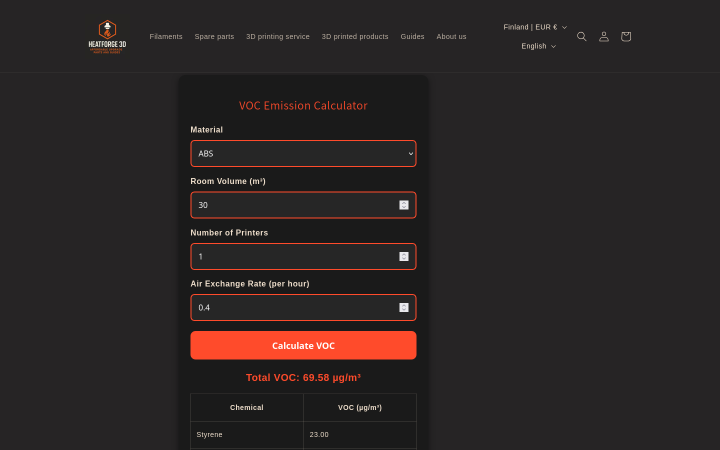
We love 3D printing here, but we also love clean air, which produces a certain tension. There’s no way around the fact that printing produces various volatile organic compounds (VOCs), and that we don’t want to breathe those any more than necessary. Which VOCs, and how much? Well, [Jere Saikkonen] has created a handy-dandy calculator to help you guesstimate your exposure, or size your ventilation system, at least for FDM printing.

The emissions of most common FDM filaments are well-known by this point, so [Jere] was able to go through the literature and pull out values for different VOCs of concern like styrene and formaldehyde for ABS, PLA, Nylon, HIPS and PVA. We’re a bit disappointed not to see PETG or TPU on there, as those are common hobbyist materials, but this is still a great resource.

If you don’t like the numbers the calculator is spitting out, you can play with the air exchange rate setting to find out just how much extra ventilation you need. The one limitation here is that this assumes equilibrium conditions, which won’t be met save for very large prints. That’s arguably a good thing, since it errs on the side of over- rather than underestimating your exposure.

If you want to ground-truth this calculator, we’ve featured VOC-sensing projects before. If you’re convinced the solution to pollution is dilution, check out some ventilated enclosures. If you don’t want to share chemistry with the neighborhood, perhaps filtration is in order. 

Thanks to [Jere] for the tip!

Street with polluted smoggy air

Serious Chemical Threat Sniffer On A Budget

Chemical warfare detection was never supposed to be a hobbyist project. Yet here we are: Air Quality Guardian by [debdoot], the self-proclaimed world’s first open source chemical threat detection system, claims to pack lab-grade sensing into an ESP32-based build for less than $100. Compare that with $10,000+ black-box hardware and you see why this is worth trying at home, even if this project might not have the nut cracked just yet.

Unlike your air monitor from IKEA, the device aims to analyze raw gas sensor resistance – ohm-level data most devices throw away – combined with temporal spikes, humidity correlations, and a database of 35+ signatures. Of course, there is a lot of work to be done here on the calibration side, and we don’t have any chemical warfare agents on hand to test against, so we have no idea how well it works, and we’d expect false positives. Still, the idea of taking a more granular look at the data coming off the sensor may bear some fruit.

(Editor’s note: edited with a hefty dash of skeptical salt.)

Featured Image by Arjun Lama on Unsplash

Keep Your Lungs Clean And Happy With A DIY Supplied-Air Respirator

The smell of resin SLA printing is like the weather — everybody complains about it, but nobody does anything about it. At least until now, as [Aris Alder] tackles the problem with an affordable DIY supplied-air respirator.

Now, we know what you’re thinking, anything as critical as breathing is probably best left to the professionals. While we agree in principle, most solutions from reputable companies would cost multiple thousands of dollars to accomplish, making it hard to justify for a home gamer who just doesn’t want to breathe in nasty volatile organic compounds. [Aris] starts the video below with a careful examination of the different available respirator options, concluding that a supplied air respirator (SAR) is the way to go.

His homebrew version consists of an affordable, commercially available plastic hood with a built-in visor. Rather than an expensive oil-free compressor to supply the needed airflow, he sourced a low-cost inline duct fan and placed it outside the work zone to pull in fresh air. Connecting the two is low-cost polyethylene tubing and a couple of 3D printed adapters. This has the advantage of being very lightweight and less likely to yank the hood off your head, and can be replaced in a few seconds when it inevitably punctures.

Another vital part of the kit is a pulse oximeter, which [Aris] uses to make sure he’s getting enough oxygen. His O2 saturation actually goes up from his baseline when the hood is on and powered up, which bodes well for the system. Every time we pick up the welding torch or angle grinder we wish for something like this, so it might just be time to build one.

Continue reading “Keep Your Lungs Clean And Happy With A DIY Supplied-Air Respirator”

Better Air Quality Sensing With CO2

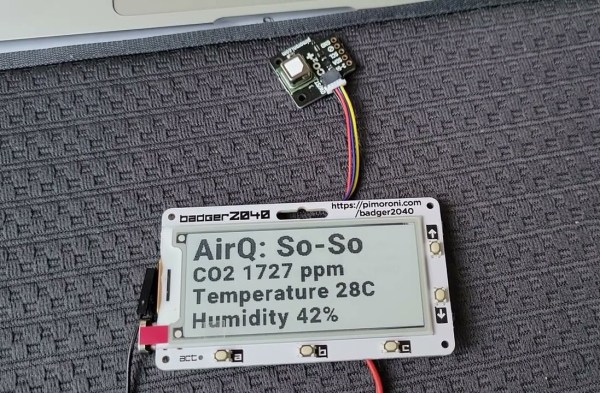
Measuring air quality, as anyone who has tried to tackle this problem can attest, is not as straightforward as it might seem. Even once the nebulous term “quality” is defined, most sensors use something as a proxy for overall air health. One common method is to use volatile organic compounds (VOCs) as this proxy but as [Larry Bank] found out, using these inside a home with a functional kitchen leads to a lot of inaccurate readings. In the search for a more reliable sensor, he built this project which uses CO2 to help gauge air quality.

Most of the reason that CO2 sensors aren’t used as air quality sensors is cost. They are much more expensive than VOC sensors, but [Larry] recently found one that was more affordable and decided to build this project around it. The prototype used an Arduino communicating over I2C to the sensor and an OLED screen, which he eventually put in a 3D printed case to carry around to sample CO2 concentration in various real-world locations. The final project uses a clever way of interfacing with the e-paper display that we featured earlier.

While CO2 concentration doesn’t tell the full story of air quality in a specific place, it does play a major role. [Larry] found concentrations as high as 3000 ppm in his home, which can cause a drop in cognitive function. He’s made some lifestyle changes as a result which he reports has had a beneficial impact. For human-occupied indoor spaces, CO2 can easily be the main contributor to poor air quality, and we’ve seen at least one other project to address this concern directly.

Nevermore Is What You Get When Engineers Design Air Filters For 3D Printers

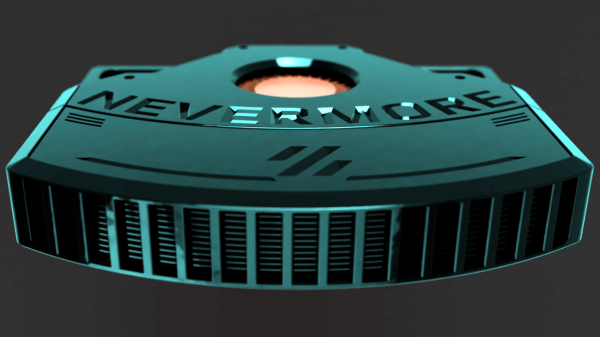
What happens when an air filter for 3D printers gets designed by engineers with a passion for function, a refusal to compromise, and a desire to do without bad smells or fumes? You get the Nevermore, a design for a recirculating active-carbon filtration system to deal with VOCs (volatile organic compounds) from 3D printing.

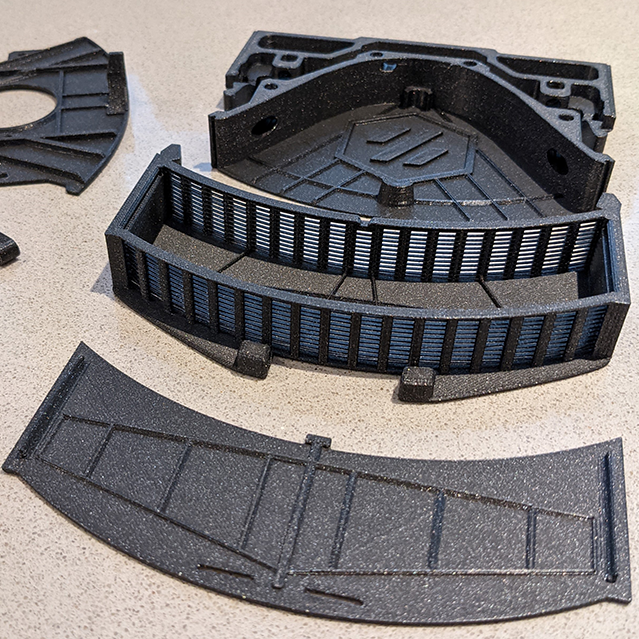
3D-printable parts and an easy-to-fill chamber for bulk-activated carbon make this recirculating air filter for VOCs a smart, space-saving design.

The Nevermore Micro (and larger Nevermore Max) were originally intended to complement the Voron 3D printer design, but are made such that they can be used with just about anything else. These filters use 3D-printable parts, and are designed to be easily filled (and refilled) using bulk-activated carbon instead of some kind of proprietary pre-packed filter like most commercial offerings. The Voron project is all about a printer without compromises, and the Nevermore comes from that same design ethos.

A Nevermore filter sits inside the build chamber, and works by recirculating air inside while passing it through the activated carbon. The idea is that by concentrating on dealing with the problem at the source inside a relatively small build chamber, one doesn’t need a lot of airflow. A small recirculating air filter can do the job efficiently, though for best results, the build chamber should be as sealed as possible.

One interesting caution is that it seems not all activated carbon is the same, and it is absolutely crucial to use only acid-free, steam-activated (not acid-washed) carbon in a recirculating filter like the Nevermore. There are horrifying photos of oxidized metal surfaces resulting from using acid-residue carbon, some of which took only minutes to occur. Thankfully, there are pointers to trusted sources for the known-good stuff.

It’s known that 3D printing results in chemical and particle emissions. These differ significantly depending on both material and type of printer, but it’s enough of an issue to warrant attention. One deals with particulates with something like a HEPA filter, but VOCs require a carbon filter. This is where the Nevermore comes in. Active carbon filters will wear out simply from exposure to the air, so if one is serious about cleaning VOCs when printing, it is definitely worth looking into bulk carbon with a design like the Nevermore.

3D Printer Emission Monitor Quantifies The Stench

While we don’t yet know the long-term effects of hanging out around 3D printers, it doesn’t take a in-depth study to figure out that their emissions aren’t healthy. What smells toxic usually is toxic. Still, it’s oh-so-fun to linger and watch prints grow into existence, even when we have hundreds or thousands of hours of printing under our belts.

Most of us would agree that ABS stinks worse than PLA, and that’s probably because it releases formaldehyde when melted. PLA could be viewed as slightly less harmful because it has a lower melting point, and more volatile organic compounds (VOCs) are released at higher temperatures. Though we should probably always open a window when printing, human nature is a strong force. We need something to save us from our stubbornness, and [Gary Peng] has the answer: a smart 3D printer emission monitor.

The monitor continually checks the air quality and collects data about VOC emissions. As the VOCs become elevated during printing, the user is notified with visual, audio, and phone notifications. Green means you’re good, yellow means open a window, red means GTFO. There’s a brief demo after the break that also shows the phone interface.

The heart of this monitor is a CCS811 gas sensor, which provides VOC data to a Particle Photon. [Gary] built a simple Blynk interface to handle the alerts and graph historical VOC readings. He’s got the code and STLs available, so let this be the last time you watch something print in blissful semi-ignorance.

Concerned about air quality in general? Here’s a standalone portable monitor designed to quantify the soul-crushing stuffiness of meetings.

Continue reading “3D Printer Emission Monitor Quantifies The Stench”