Firefox Reality, A Browser For VR Devices

The browser you are reading this page in will be an exceptionally powerful piece of software, with features and APIs undreamed of by the developers of its early-1990s ancestors such as NCSA Mosaic. For all that though, it will very probably be visually a descendant of those early browsers, a window for displaying two-dimensional web pages.

Some of this may be about to change, as in recognition of the place virtual reality devices are making for themselves, Mozilla have released Firefox Reality, in their words “a new web browser designed from the ground up for stand-alone virtual and augmented reality headset“. For now it will run on Daydream and GearVR devices as a developer preview, but the intended target for the software is a future generation of hardware that has yet to be released.

Readers with long memories may remember some of the hype surrounding VR in browsers back in the 1990s, when crystal-ball-gazers who’d read about VRML would hail it as the Next Big Thing without pausing to think about whether the devices to back it up were on the market. It could be that this time the hardware will match the expectation, and maybe one day you’ll be walking around the Hackaday WrencherSpace rather than reading this in a browser. See you there!

They’ve released a video preview that disappointingly consists of a 2D browser window in a VR environment. But it’s a start.

Continue reading “Firefox Reality, A Browser For VR Devices”

Google Light Fields Trying To Get The Jump On Magic Leap

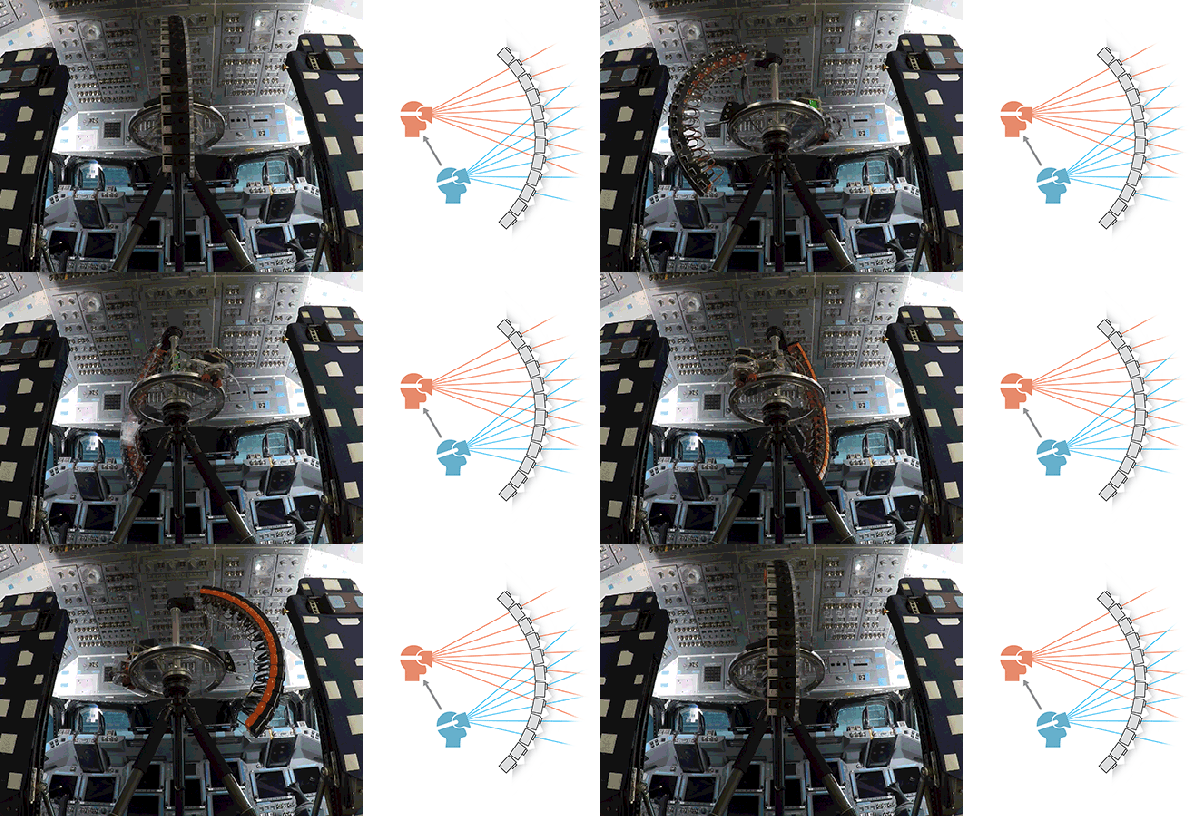
Light Field technology is a fascinating area of Virtual Reality research that emulates the way that light behaves to make a virtual scene look more realistic. By emulating light coming from multiple angles entering the eye, the scenes look more realistic because they look closer to reality. It is rumored to be part of the technology included in the forthcoming Magic Leap headset, but it looks like Google is trying to steal some of their thunder. The VR research arm of the search giant has released a VR app called Welcome to Light Fields that uses a similar technique on existing VR headsets, such as those from Oculus and Microsoft.

Continue reading “Google Light Fields Trying To Get The Jump On Magic Leap”

Immersive VR With A 200-Degree Stereoscopic Camera

VR is in vogue, but getting on board requires a steep upfront cost. Hackaday.io user [Colin Pate] felt that $800 was a bit much for even the cheapest commercial 360-degree 3D camera, so he thought: ‘why not make my own for half that price?’

[Pate] knew he’d need a lot of bandwidth and many GPIO ports for the camera array, so he searched out the Altera Cyclone V SOC FPGA and a Terasic DE10-Nano development board to host it. At present, he has four Uctronics OV5642 cameras on his rig, chosen for their extensive documentation and support. The camera mount itself is a 3D-printed octagon so eight of the OC5642 can capture a full 360-degree photo.

Next: producing an image!

Continue reading “Immersive VR With A 200-Degree Stereoscopic Camera”

Nintendo Power Glove Achieves Its Promise As Vive Controller

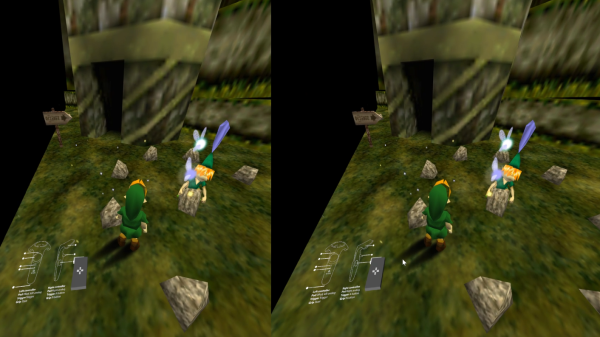
You have to hand it to Nintendo, for blazing the virtual reality trail in consumer products a couple of decades before everyone else, even if the best that can be said for their efforts in that direction is that they weren’t exactly super-successful. Their 1989 Power Glove became little more than a difficult-to-use peripheral for everyday console games, and their 1995 Virtual Boy console was streets ahead of its time but had a 3D effect that induced discomfort in its players.

Many years later though, the Power Glove remains an intriguing product, and one that can be readily found second-hand. The folks at Teague Labs think that perhaps its time has come as the basis of a peripheral for modern VR systems, as a controller for the HTC Vive.

They’ve taken a Power Glove, and through an Arduino Due with a custom shield, interfaced it to the Vive controller mounted where the buttons would have been in its Nintendo days. The Vive provides positional data, while the Nintendo sensors provide hand data. Thus they’ve made an accomplished glove peripheral with a lot less heartache than they would have seen had they done so from scratch.

They show us a couple of environments using the glove, an iPad simulation which we’re having a little difficulty getting our heads round, and a rock/paper/scissors game which looks rather fun. If you are interested in further work, all their code is on GitHub.

We’ve shown you another hugely-upgraded Power Glove in the past, but how about one controlling a quadcopter?

Hackaday Prize Entry: Telepresence With The Black Mirror Project

The future is VR, or at least that’s what it was two years ago. Until then, there’s still plenty of time to experiment with virtual worlds, the Metaverse, and other high-concept sci-fi tropes from the 80s and 90s. Interactive telepresence is what the Black Mirror Project is all about. Their plan is to create interactive software based on JanusVR platform for creating immersive VR experiences.

The Black Mirror project makes use of the glTF runtime 3D asset delivery to create an environment ranging from simple telepresence to the mind-bending realities the team unabashedly compares to [Neal Stephenson]’s Metaverse.

For their hardware implementation, the team is looking at UDOO X86 single-board computers, with SSDs for data storage as well as a bevy of sensors — gesture, light, accelerometer, magnetometer — supplying the computer with data. There’s an Intel RealSense camera in the build, and the display is unlike any other VR setup we’ve seen before. It’s a tensor display with multiple projection planes and variable backlighting that has a greater depth of field and wider field of view than almost any other display.

Hacked Headset Brings VR To The Commodore 64

The venerable Commodore 64 got a lot of people started in computers, and a hard core of aficionados keeps the platform very much alive to this day. But a C64 just doesn’t have the horsepower to do anything more than some retro 8-bit graphics games, right?

Not if [jim_64] has anything to say about it. He’s created a pair of virtual-reality goggles for the C64, and the results are pretty neat. Calling them VR is a bit of a stretch, since that would imply the headset is capable of sensing the wearer’s movements, which it’s not. With just a small LCD screen tucked into the slot normally occupied by a smartphone in the cheap VR goggles [jim64] used as a foundation for his build, this is really more of a 3D wearable display — so far. The display brings 3D-graphics to the C64, at least for the “Street Defender” game that [jim64] authored, a demo of which can be seen below. We’ll bet position sensing could be built into the goggles to control the game too. Even then it won’t be quite the immersive (and oft-times nauseating) experience that VR has become, but for a 35-year old platform, it’s not too shabby.

Looking for more C64 love? We’ve got a million of ’em — case mods, C64 laptops, tablets, even CPU upgrades.

Continue reading “Hacked Headset Brings VR To The Commodore 64”