Tank Router Defends Your Pets?

The guys over at Section9 Hackerspace in Springfield, Missouri just finished building this treaded robot. Despite the juxtaposition of the cat, it really doesn’t defend anything. The project is a reconnaissance robot controlled over the network with video feedback.

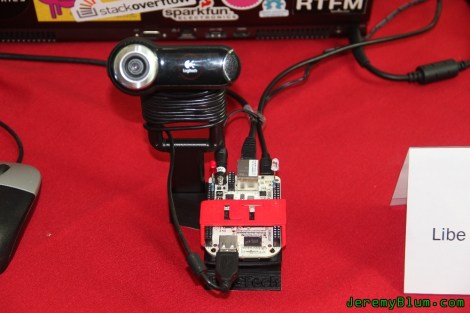
The team started off with some lofty goals. They wanted to the robot to be able to climb stairs and to feature a detachable flying portion in order to get a better look at hard to reach places. Cost and complexity are cited as the reasons they ditched the idea of the flyer. The rest of the features came out much as planned. The motor controller for the treads is connected to an Arduino. This uses an Ethernet shield to connect to the WRT54G router which is also coming along for the ride. This seems a bit over-powered but it makes it easy to connect the webcam on the front (also via Ethernet).

On the software side they wrote an Android app. It controls the movement of the robot, as well as that of the camera. Of course you need to see where you’re going so they went the extra mile to include video from the webcam. Check out their show-and-tell video after the break.

Continue reading “Tank Router Defends Your Pets?”

Turning A Webcam Into A Spectrometer

If you want to find out what something is made out of, you’ll probably be using a spectrometer. These devices allow scientists to determine what something is made of by shining light through an object and recording what colors are absorbed. Professional spectrometers cost many thousands of dollars, but you can build your own using a simple USB web cam, an old DVD-R, and a VHS cassette case.

In this tutorial of Public Labs’ DIY video spectrometer, [Jeffery] takes us through the process of building a spectrometer. After cutting a small bit of plastic from a DVD-R and mounting it on the lens of a web cam, [Jeff] puts the webcam in a VHS case and shines a light through a small slit. The result is a rainbow pattern captured by the webcam, and by putting different translucent materials in front of the light source, the spectrum slightly changes.

Of course a DIY spectrometer is nearly useless without a library of materials and their associated spectra. [Jeffery] is working on this as well with a wiki-style app called Spectral Workbench.

There’s a video tutorial for making your own DIY spectrometer available after the break. It seems like an easy build, if you can find the requisite VHS cassette case in your basement and/or attic.

Continue reading “Turning A Webcam Into A Spectrometer”

Motion Sprinkler Chases Away Defecating Dogs

Don’t want dogs pooping on the front lawn? You could put up a sign, your could chase them away like a crotchety old miser, or you could build a motion detecting sprinkler system. It’s pretty hard to line up for a doody when you’re getting sprayed in the face (or worse) with cold water.

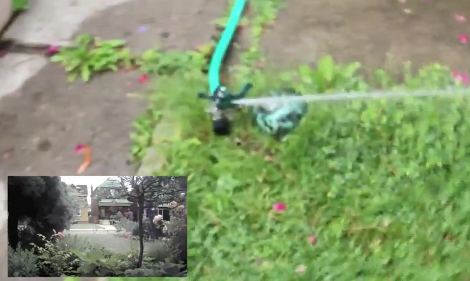
The setup is pretty simple. The bump-in image above shows the view from a webcam. The server monitoring the video is running software that detects motion between one frame and the next. When it sees something in the right position it signals an Arduino to trigger the solenoid which has been holding back the water. Check out the movie after the break which shows [Phil Tucker] tramping across the grass to trigger the  trap.

Sprinkler hacks are always a lot of fun. This variable-range sprinkler is still one of our favorites.

Continue reading “Motion Sprinkler Chases Away Defecating Dogs”

Catch Neighborhood Speeders With Your Webcam

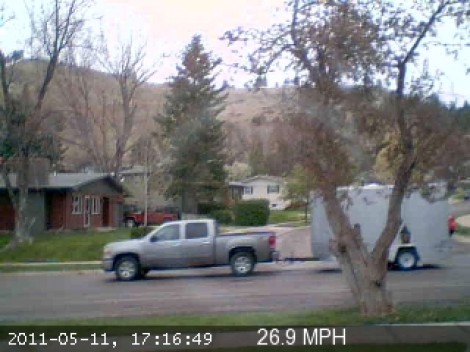
[John] is keeping the neighborhood safe by keeping an eye out for speeders. Well, he’s really keeping a webcam out for speeders. His technique doesn’t use radar or lasers. He’s processing webcam frames in Python to calculate speed.

It comes down to some basic image manipulation. He firsts gathers the images necessary to make the calculations by using a motion-detecting webcam program called YawCam. The images are analyzed to establish which parts have changed between frames; this gets rid of all the stationary objects. Now the frames can be compared to establish the distance in pixels. By calibrating the shot through measurements of the target area, this data can be directly converted into actual distance. It is then compared with the timestamps from each frame to arrive at speed. This can be used for vehicles on the street like we see above, or more whimsical measurements like pet turtle progress.

Monitor Your Heartbeat With A Webcam And A Flashlight

After seeing some heart rate monitor apps for Android which use the camera and flashlight features of the phones, [Tyson] took on the challenge of coding this for himself. But he’s not using a smart phone, instead he grabbed a headlamp and webcam for his heat rate monitor.

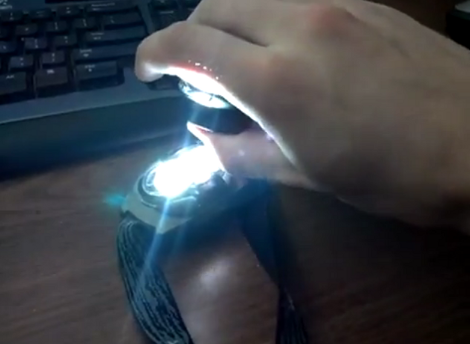
To start out he recorded a test video with his smart phone to see what it looks like to cover both the flash LED and camera module with his thumb. The picture is mainly pink, but there’s quite obviously a color gradient that pulses with each gush of blood through his skin. The next task was to write some filtering software that could make use of this type of image coming from a webcam. He used C# to write a GUI which shows the live feed, as well as a scrolling graph of the processed data. He took several tries at it, we’ve embedded one of the earlier efforts after the break.

Continue reading “Monitor Your Heartbeat With A Webcam And A Flashlight”

Getting A Textured 3D Scan From Just A Webcam

Here’s an oldie but a goodie that passed us up the first time it went around the Internet. [Qi Pan], (former) PhD student at Cambridge, made a 3D modeling program using only a simple webcam. Not only does this make very fast work of building 3D models, the real texture is also rendered on the virtual object.

The project is called ProFORMA, and to get some idea of exactly how fast it is, the model of a church seen above was captured and rendered in a little over a minute. To get the incredible speed of ProFORMA, [Qi] had his webcam take a series of keyframes. When the model is rotated about 10°, another keyframe is taken and the corners are triangulated with some very fancy math.

Even though [Qi]’s project is from 2009, it seems like it would be better than the ReconstructMe, the Kinect-able 3D scanning we saw a while ago. There’s a great video of [Qi] modeling a papercraft church after the break, but check out the actual paper for a better idea of how ProFORMA works.

Continue reading “Getting A Textured 3D Scan From Just A Webcam”

Land ROV Is Internet Connected And Packed Full Of Stuff

[Blair Kelly] has always been interesting in the concept of Remote Operated Vehicles. As soon as he got his hands on an Arduino he began his endeavor to turn an RC vehicle into a land-based ROV. What he’s done so far is incredible.

Here he’s showing off features of the build using a PS3 controller. But it can also take commands from an Xbox 360 controller or an arcade-style steering wheel. We like the latter the best, which is shown off at about six and a half minutes into the video (embedded after the break). Since there’s a webcam on board, this ends up being a virtual cockpit for the pint-sized car. But it gets better. That webcam is mounted on a servo motor, and [Blair] included controls that pan the camera. This lets the driver ‘look’ left and right. On the front of the vehicle there’s an accelerometer. Data is collected by the Arduino and sent via the WiFly module. This adds rumble to the controller if you’re using one that has that ability.

It’s a big project already, but it sounds like [Blair] has not end of ideas for future versions. Right now he’s planning to increase the overall size which will let him explore places that aren’t as flat as his livingroom.

Continue reading “Land ROV Is Internet Connected And Packed Full Of Stuff”