Wireless Hackerspace Music Control

skipbutton_bitlair.nl

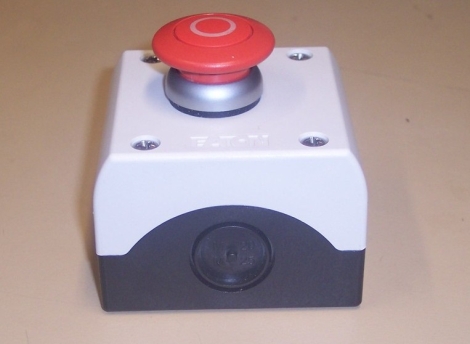
The crew at the Netherlands-based Bitlair hackerspace love their music, and have set up a digital jukebox for their workshop using mpd and fookebox. One problem that you run into with a bunch of different people working in one place is that everyone has their own distinct taste in music. The rhythmic “wub wub wub” of Dubstep might be great for some while leaving others trying to solder while simultaneously covering their ears. To ensure that everyone can exercise a musical veto (a la Empire Records) now and again, they built a Skipbutton which allows members to change what’s playing.

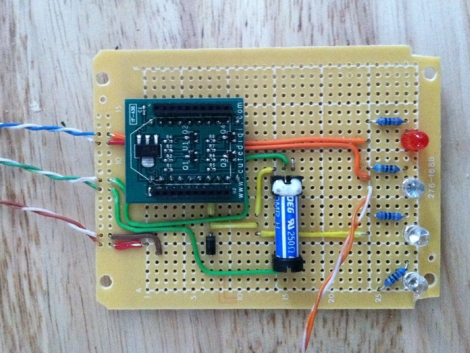
The button allows users to skip to the next song in the queue. as well as to control the volume of the space’s sound system. It uses an Arduino pro mini to run the show, sending signals to the mpd daemon using a 433 MHz transmitter. Bitlair is pretty large and they often spend time outdoors, so they had to ensure that the Skipbutton worked wherever they did. To do this, they built a Yagi-Uda antenna at the receiving end to ensure that the button functions no matter where it’s being triggered from.

Check out their wiki if you’re interested in making a similar system for your home or hackerspace – all of the code and schematics are available for the taking.

Portable Power Strip Control Lights And Appliances Using SMS

sms_triggered_appliance_control

[Julian] wanted a way to remotely control various appliances and lights around his house without spending an arm and a leg on home automation. He also desired the ability to easily switch what items he was controlling without a ton of hassle. Since he couldn’t find anything reasonably priced to do what he desired, he built his own SMS-triggered remote control system.

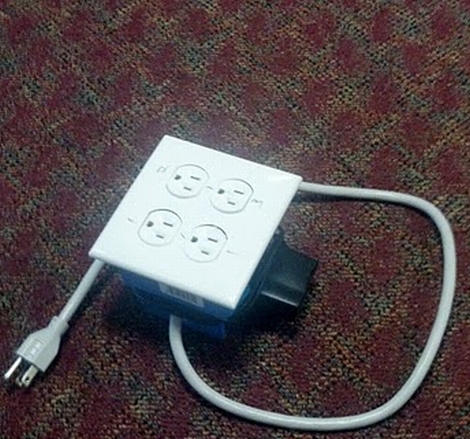
He designed his system to be used like an extension cord, hence the portable junction box enclosure. This enables him to regulate up to four different items at a time, with the ability to swap out components or relocate his controller at will.

The power strip is controlled by an Arduino which receives commands from his PC via an Xbee module. Any text messages sent to his Gmail account are retrieved by his computer and then transmitted to the Arduino. The Arduino in turn triggers relays as designated by [Julain’s] text messages, utilizing H-bridges to provide the required current.

Check out his schematics and code if you’re interested in implementing something similar in your home.

Making A Bluetooth Headset Into A Wireless Music Streaming Device

This bluetooth headset hack, although simple, may provide some hacking inspiration. Turning a Bluetooth headset into a wireless input for one’s stereo is definitely something that makes one think “why didn’t I think of that?” It’s also good if you’ve got a tight hacking budget as there’s not a lot of stuff to buy.

In addition to a possibly broken headset, a 3.5mm stereo plug and some wires are needed for this. Throw in some tools that every good hacker should have around like a soldering iron and glue gun and you’re ready to get started. [Dex] does a good job of describing the process, from disassembling the headset to wiring the stereo plug to it. When making the conversion, one must remember to bridge the left and right output channels, as most headsets only output a mono signal.

There’s not a whole lot else required to do this hack.  Could be a good beginner project. For another Bluetooth-based hack using scrounged equipment, check out this Cellphone controlled retro-radio hack.

Wireless Fiber Optic Mood Lighting

ceiling_mounted_starfield

There’s something calming about looking up into the night sky and seeing an array of shining stars off in the distance. [Marou] is a big fan of stargazing, but sometimes conditions are not optimal, so he decided to bring the stars inside.

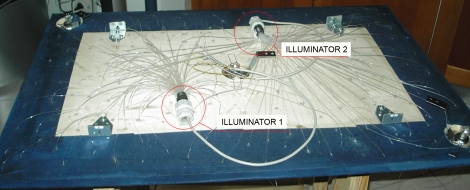
His idea was to build a ceiling lamp that didn’t bask the room with light, but rather one that reproduced the peaceful twinkle of the night sky. He covered a wooden table with dark fabric and drilled a ton of tiny holes into the surface. He fitted the holes in the table with two big bundles of optical fibers since one bundle couldn’t quite cover the entire thing.

To light the cables, he built a pair of 4-LED illuminators, which contain red, blue, green, and white LEDs. Each light source is controlled via an Arduino which takes its direction from [Marou’s] infrared remote.

While the idea isn’t new, the implementation is pretty cool. At first we were expecting a small lamp, but anchoring an entire table to the ceiling as a light panel is definitely something we hadn’t seen before.

If you want to build something similar in your own living room, [Marou’s] Arduino code is free for the taking.

Controlling Dioder Light Strips Wirelessly

dioder_universal_io

[SeBsZ] does a lot of work in home automation, using Xbee modules, LEDs, and other home lighting systems. Naturally, people look to him for help with different electronics projects, but one thing he has been asked time and time again is if he can make a simple mood lighting solution that can be easily installed.

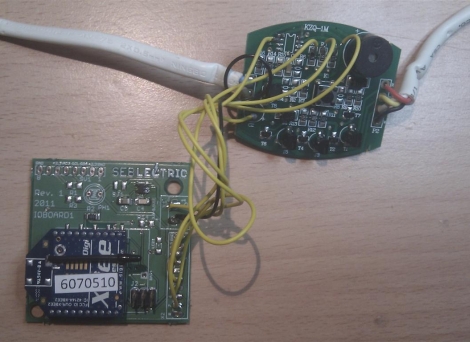
He has always been interested in playing around with RGB LEDs, but he wasn’t looking to reinvent the wheel with this project. Instead he based his work off the Ikea Dioder product, an off-the-shelf set of adjustable LED strips. As we’ve seen before, the control module for these LEDs leaves a bit to be desired, so he removed the Dioder’s onboard PIC and wired up a controller of his own. His “Universal IO Board” uses an Atmega88 for control and has all the pins required to attach an Xbee wireless module. With everything wired up, he now has full wireless control of the Dioder light strips, without a ton of fuss.

Although he’s selling a few different hardware kits, the schematics for his IO board are freely available on his site, should you want to make your own. The only thing that we didn’t see was the code for the Atmega, but we’re guessing he has that posted somewhere as well.

Adding Wireless Controls To Vintage Stereo Equipment

marantz_wifi_remote_control

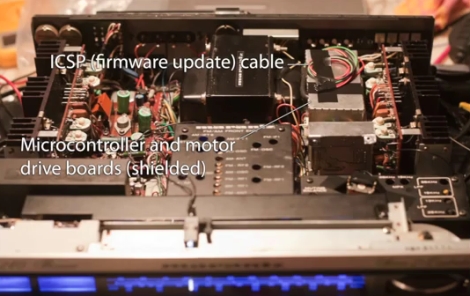
[Jean] was shopping around for a vintage stereo receiver, and happened upon a broken, but repairable Marantz 4240. After getting things back to working order, he thought it would be great if he could use his iPhone to remotely control the unit (PDF Writeup, Schematics and Code).

He scrounged around for parts, and after locating a PIC and a handful of parts from old copiers and printers, he got down to business. He etched some custom boards to house electronic bits, then strapped motors to the volume and source selection knobs. He also rigged up the push button power switch on the receiver, using a small servo and a bit of string.

Now, he can control everything using his iPhone, which communicates with the stereo over WiFi. While the power, volume knob, and input selector can be triggered remotely, he still has the ability to tweak any of these items manually if desired.

We think that this is a great way to add modern amenities to vintage electronics, without ruining the aesthetics of the components. Don’t take our word for it though, check out the video demonstrations [Jean] but together after the jump.

Continue reading “Adding Wireless Controls To Vintage Stereo Equipment”

Robots Tends Your Lawn While You Veg Out On The Couch

nuntius_the_garden_avenger

Most people can agree that picking weeds is not a whole lot of fun. [Dave] was not a big fan of sitting out in the heat toiling over his lawn, so he did the only rational thing and built a robot to do it for him.

Nuntius, the Garden Avenger, is a remote controlled robot that [Dave] can use to pick weeds from the comfort of his couch. The robot is controlled by a Propeller microcontroller, taking its commands wirelessly via a pair of XBee modules. Nuntius’ controller is pretty intuitive, consisting of a 5-axis arm complete with a gripper that [Dave] can articulate in any number of directions. His motions cause the robot’s arm to move in sync, and driving Nuntius is as easy as holding down a button and moving the controls in the desired direction.

[Dave] can monitor what Nuntius is doing via a wireless camera he has installed on the robot’s arm, allowing him to sit back and relax indoors while the robot handles the hard work.

Keep reading to see a short video demo of Nuntius in action.

[via Make]

Continue reading “Robots Tends Your Lawn While You Veg Out On The Couch”