DIYLILCNC: do-it-yourself CNC mill

posted Nov 13th 2009 6:03pm by Phil Burgess
filed under: cnc hacks

DIYLILCNC

The DIY LIL CNC project is the newest member of the homebrew fabrication scene. This is a three-axis CNC mill that can be built by anyone with basic shop skills and about $700 in their pocket. Many of the materials can be acquired from the likes of Home Depot: the basic framework is assembled from Masonite, while other cost-cutting measures include the use of skate bearings and a common Dremel tool for powering the cutting bit. About half of the cost is for the HobbyCNC driver and stepper motor package that runs the show.

The instructions for the DIY LIL CNC are distributed under a Creative Commons license, allowing for modification and distribution with few restrictions. They’re well-written and quite thorough, including all patterns and a complete bill of materials with suppliers, part numbers and costs. As documented, the ’bot can produce parts up to 12 x 14 x 2 inches, but the project’s creators offer some suggestions on adapting the design for larger work. It’s not self-replicating like the RepRap aims for; you’ll need access to a laser cutter for some of the parts. If you can clear that hurdle, this looks like a great introduction to CNC production.

Stereoscopic 3d with a PIC micro

posted Nov 4th 2009 9:00am by Caleb Kraft
filed under: classic hacks, home entertainment hacks, portable video hacks

tomy2 (Custom)

[Pyrofer] sent in his stereoscopic game project and we are just giddy with excitement. He has hacked apart an old TomyTronic 3D handheld viewer and put new guts in. He’s using a PIC micro to push stereoscopic imagery to twin LCDs. He wrote all code from scratch including the 3d library, wii nunchuck driver, and LCD driver. This thing even has bluetooth so he can play multiplayer if he ever makes a second one. The whole unit is kept alive via a lithium polymer battery so you don’t have to worry about any cords other than the wii nunchuck.  This thing is awesome, we would love to play with one. You can see a video after the break.

Read the rest of this entry »


CNC used to make 3D video using one camera

posted Oct 27th 2009 3:00pm by Mike Szczys
filed under: cnc hacks, digital cameras hacks

3d-video-one-camera-cnc

[Gabriel] is making 3D movies using only one camera. This should be impossible because true 3D needs to be stereoscopic, with images from different perspectives for each eye. He’s worked this out by mounting the camera on a CNC gantry and programming it to make two passes along slightly different paths. He’s plotting the camera paths using SketchUp and a plugin that exports paths as CamBam files, automatically adjusting for perspective. The two videos are then merged using Stereo Movie Maker.

We’ve embedded both a 3D video as well as behind-the-scenes filming video after the break but you’ll need the red and blue 3D glasses to view the former. It’s not too much of a stretch to tweak his methods and use this for stopped motion video where one button press takes a frame for each eye. Now, who will be the first to bring us a Star Wars remake filmed in stopped-motion 3D using the original action figures? Read the rest of this entry »

3D Magnetometer mouse in processing

posted Oct 18th 2009 3:00pm by Zach Banks
filed under: arduino hacks, peripherals hacks

FFB4SV5G0SD7J7G_MEDIUM

[etgalim] works in Solidworks extensively and wanted a more intuitive way of rotating objects onscreen. To do this, he created a mouse that responds to rotation. He put a 3D compass module inside an old mouse and wired it up to an Arduino. The Arduino then relays the I2C sensor data to the computer. So far, he has a Processing script that uses the mouse to rotate a cube, but eventually he wants to write a Solidworks plugin. It’s a bit shaky, and we think it would be a bit smoother (and cheaper) if he used gyros like the jedipad. Video after the jump.

Read the rest of this entry »

Portable, digital stereoscopic image viewer

posted Oct 9th 2009 11:00am by Caleb Kraft
filed under: digital cameras hacks

FSI6C3BFZWXORMT.MEDIUM[madaeon] couldn’t find a digital viewer for his stereoscopic 3D images. He felt that he could probably build one, so he did.  He found two identical digital picture frames and made a custom rig to hold the two frames.  The method he is using involves polarized lenses, so you do have to put glasses on to see it. Being polarized though, you get full color, like modern 3D movies. We think it would be even nicer to see them without glasses, but some people have a really hard time with this style of 3d image.


DIY 3D gets a nod at SIGGRAPH

posted Aug 27th 2009 1:00pm by Phil Burgess
filed under: laser hacks, video hacks

3dscan

Among the courses at this year’s SIGGRAPH (an annual technical conference and showcase of the latest in computer graphics research) was an introduction to 3D scanning that covers all the bases: mathematical foundations, two different build-your-own hardware approaches, and how to process and render the resulting datasets. The presenters have assembled all the course materials on a top-notch web site featuring slide shows, complete source code, and an extensive round-up with links to both commercial and homebrew 3D scanning gear. The simplest of these methods requires nothing more than a webcam, halogen light source, and a stick!

SIGGRAPH and 3D scanning have been highlighted many times on Hack a Day, but we’re swelling with pride now seeing an academic venue give a favorable nod to the DIY hacking community (on their links page). Okay, so Hack a Day isn’t called out by name, but just wait’ll next year!

[Thanks Fahrzin]

Sticky light

posted Aug 4th 2009 12:39pm by Zach Banks
filed under: laser hacks, multitouch hacks

light

With the availability of webcams and projectors, multitouch and interactive demos have become increasingly popular because they’re so easy. Students at the University of Tokyo took a new approach that uses lasers instead. They created Sticky Light, which uses mirrors, a laser, and a single photodetector. Unlike camera-tracking setups, this system requires no visual processing. The laser moves around and bumps into dark objects, sticking to them. It can follow drawings on the table or objects in space, such as shirt designs. They also created a few basic games and a demo that makes sounds based on the movement of the spots. Video of the project after the break.

Read the rest of this entry »

Electrostatic computer interface

posted Apr 28th 2009 6:43am by Caleb Kraft
filed under: digital audio hacks, news, pcs hacks, peripherals hacks


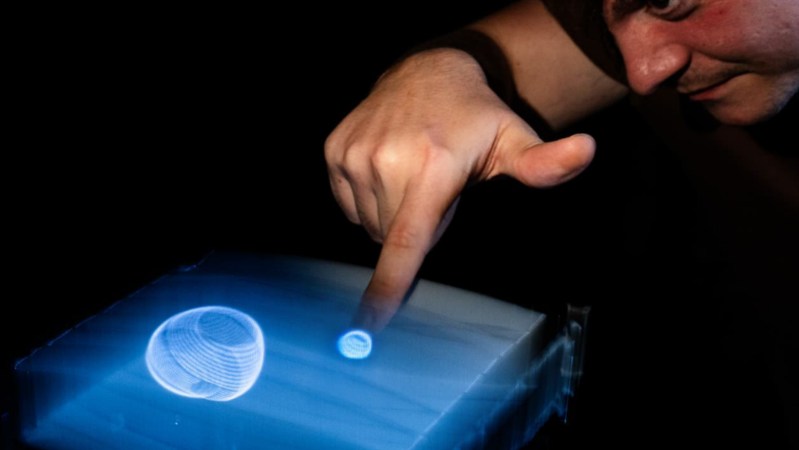
[Justin] sent in his 1st place winning project from Northeastern’s Electrical Engineering Senior Design Capstone. It’s an interface that uses electrostatics to detect your hand position above it. As you can see in the video, it has decent resolution and can detect position on all 3 axes. When they uncover it, you can see the sensors arranged in a grid. They point out that each sensor isn’t just like a button, but rather detects a range of motion. They are using a pic 18×4550 to handle the sensors, which then communicates to the PC via USB. This could be pretty useful for musical performances as well as an alternative interface for people who can’t use a mouse.EO


Printing circuits on the RepRap

posted Apr 19th 2009 7:37pm by Eliot Phillips
filed under: cnc hacks, tool hacks

reprappcb

[Rhys Jones] has been working with the RepRap team to develop a way to print circuit boards. The machine first prints the plastic substrate with channels for the metal to be deposited into. They adapted their pinch wheel feeder to work with solid core solder (flux creates a mess). The extruded solder’s specific heat isn’t hot enough to melt the plastic. They made a video (embedded below) of their test piece: an optical endstop. The team has also been experimenting with decoupling the feed mechanism from the extruder.

Read the rest of this entry »

Build a Wiremap

posted Feb 9th 2009 11:50am by Caleb Kraft
filed under: classic hacks, peripherals hacks

wiremap

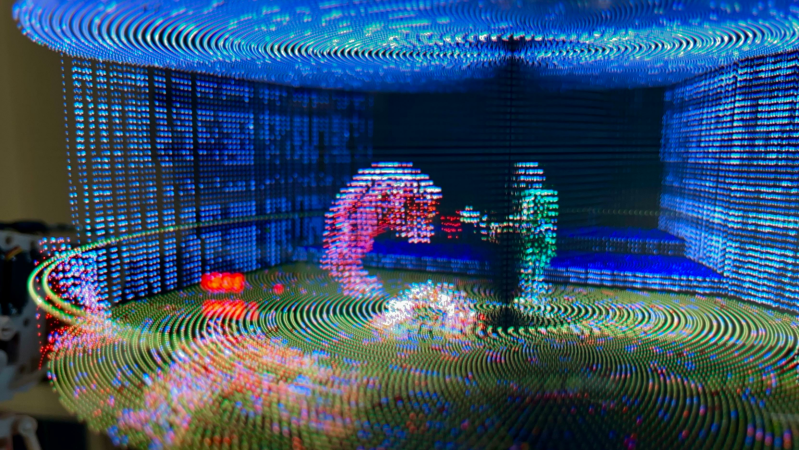
For those of you who don’t recall, the Wiremap is a 3d volumetric display built from hundreds of tiny strands. An image is projected onto the strands to achieve 3d effects. [phedhex] has posted an in depth instructable on how to build a wiremap. He covers the construction with lots of good tips as well as giving links to the software for Windows, Mac, and Linux. Check out the video after te break to see some fairly impressive 3d patterns.

Read the rest of this entry »

Hack a Day serves up fresh hacks each day, every day from around the web and a special How-To hack each week.

Send us your hacks