posted Jul 25th 2011 6:04am by
Mike Nathan
filed under:
classic hacks,
clock hacks

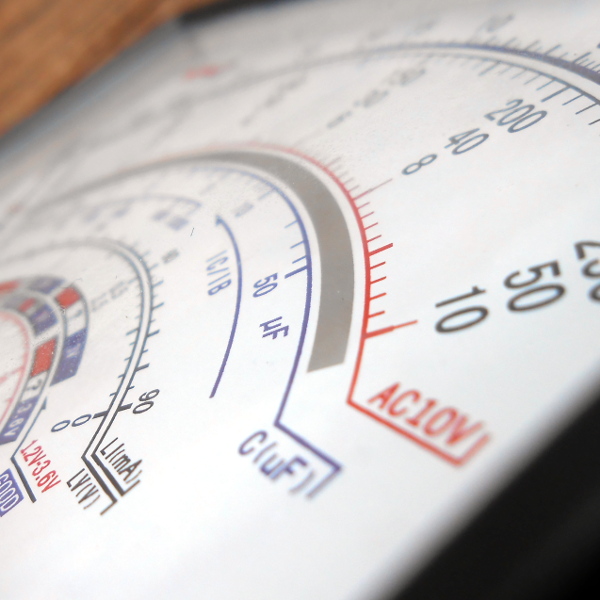
A few years ago, Tube Clock forum member[Sine1040] bought a set of four brand new aircraft indicator units that were built some time in the early 70’s. He had no idea what the units were actually used for, but he did know that he could repurpose them into some pretty slick looking clocks.
He disassembled all four boxes and between them, scrounged enough parts to build three clocks. After gutting the clocks and rearranging the digits, he built a timekeeping circuit using an ATMega8 which is clocked by a DS32 oscillator.
While the time is displayed using the large projection-style digit displays, the seconds are ticked off in the left-most analog meter. Minutes are also represented in the clock’s right-most analog window, swinging the needle from top to bottom as each one passes.
[Sine1040] paid special attention to keeping the boxes looking as stock as possible, with the only external modification being a power plug installed in place of an old grounding screw. The clock is definitely a different take on keeping time, and we think it looks great.
Continue reading to see a quick demo video of the clock in action.
[Thanks Brian]
Read the rest of this entry »
posted Jul 18th 2011 8:58am by
Mike Nathan
filed under:
misc hacks

[Dane] bought a reasonably cheap ($17) Hobbyking Echo-6 battery charger and wanted to see what sort of information he could pull from the unit. Since the charger is designed for a variety of battery chemistries and sports an LCD screen, he figured that it contained a fairly decent microcontroller which he could tap into for some useful data.
He disassembled the unit and started looking around for any useful items. He discovered that it used an ATMega32 microcontroller and had quite a few unpopulated areas on the PCB, which led [Dane] to believe that the Echo-6 shared its main board with a more robust charger. He tapped into the ATMega’s UART and began seeing data immediately. Once he figured out what was coming over the serial line, he piped the data into LogView, resulting in some nice graphs showing off the charge/discharge processes in detail.
Tapping into the Echo-6 seems easy enough for any skill level, and we assume that just about anyone would benefit from getting kind of information out of their battery charger.
posted Jul 11th 2011 10:01am by
Mike Nathan
filed under:
clock hacks,
led hacks

After seeing the TIX clock for the first time, [Gweedo Steevens] really wanted one, but wasn’t interested in paying the seemingly high asking price over at ThinkGeek. He figured it wouldn’t be too incredibly hard to build his own, so he decided to give it a shot.
The clock relies on 27 LEDs to display the time, which were multiplexed to make the most of his ATMega16 microcontroller’s available IO pins. Once he was happy with how things functioned on breadboard, he migrated the LEDs to a piece of perf board, and etched his own PCB for the controller circuit.
He used an office overhead lighting grate to separate the LEDs, providing nice uniform light segments. He put a piece of clear perspex on the front to cover the LEDs, but later switched it out for a much darker piece, for better daylight viewing.
The finished product is fantastic, and in our opinion looks even better than the retail version – awesome job!
[via HackedGadgets]
posted Jul 5th 2011 2:46pm by
Mike Nathan
filed under:
gps hacks

Hackaday forum member [nes] was training for an endurance race, and rather than having someone verbally call out his lap times, he wanted something he could keep in-vehicle to help keep track of his performance. With the race budget running dry, he and his teammates needed something cheap, if not free, to get the job done.
He scored a “broken” GPS receiver on eBay for a measly £4 and found that the receiver worked, but corrupted software prevented the unit from mapping routes. Since he didn’t require routing functions to keep track of his lap times, he splayed the GPS receiver open and started hunting around for a serial bit stream. He found what he was looking for after a bit of probing and hooked it up to his computer to see if the data contained NMEA sentences.
He cut the receiver down to the necessary parts and then started work on the lap timer itself. The timer uses an ATMega32 to run the show, displaying relevant time and location information on an LCD panel he scavenged from the trash bin.
He admits that the wiring is a bit questionable, but says that after about seven hours of rough use, everything is still intact and working great.
posted Jun 12th 2011 6:01am by
Mike Nathan
filed under:
home hacks

Living in a brushfire-prone area, [Erich] had a set of roller shutters installed to protect his home. Mains power can be spotty in emergencies, so the shutters are powered by NiMH batteries which are housed inside the shutters’ remote control units. After encountering a good handful of dead batteries, he decided it was time to search around for a better means of powering the shutters rather than pay another $80 AUD for batteries that he knew would fail in short order.
After disassembling the shutters and the remotes, he found a litany of problems. The remotes are ATMega-based, so he assumed the programming was robust, but he found that the charging algorithm was quite poorly implemented. The batteries were allowed to get extremely hot while charging, a result of the fact that charging was done for a set period of time rather than monitoring battery voltage. Additionally, the shutter motors required a 4 amp instantaneous current when activated, something that seemed to contribute to the quick draining of the 1500 mAH battery packs.
To remedy his issues, he upgraded to a much larger sealed lead acid battery pack, which he mounted in a wall cavity. The remotes were tweaked to add a modular power plug, enabling him to easily connect and disconnect the remotes as needed. Not only did he save a ton of money on constantly replacing batteries, he’s got a nice 12v power supply in the wall that he can tap into at will.
posted Jun 2nd 2011 4:27am by
Mike Nathan
filed under:
misc hacks,
news

[Jerry] wrote in to share a little device he built to solve a problem he was having at work. You see, every computer in his office has a policy-enforced idle timeout, requiring the user to enter a password in order to regain access to their desktop.
This is a huge pain, since he sporadically uses an old computer for the sole purpose of monitoring some applications running in his data center. With the computer timing out every 10 minutes, he is constantly required to enter his password in order to take a 10 second glance at the screen to ensure everything is OK.
Rather than circumvent the screen saver using a local security policy or by implementing a microcontroller-based signal generator, he opted to create a mechanical solution instead. His computer’s optical mouse resides inside a wooden frame, and is periodically swept from side to side by an ATmega-controlled servo, keeping the screensaver permanently at bay.
Call it a hack, call it a kludge, call it what you will. All we know is that while we might have done it a little differently, it works just fine for [Jerry], and it generates all sorts of interesting conversation to boot.
Stick around for a quick video demonstration of his mouse wiggler box.
Read the rest of this entry »
posted May 16th 2011 3:30pm by
Mike Nathan
filed under:
security hacks

For their senior ECE 4760 project, engineering students [Brian Harding and Cat Jubinski] put together a pretty impressive portable face recognition system called FaceAccess. The system relies on the eigenface method to help distinguish one user from another, a process that the pair carried out using MatLab.
They say that the system only needs to be hooked up to a computer once, during the training period. It is during this period that faces are scanned and processed in MatLab to create the eigenface set, which is then uploaded to the scanner.
Once programmed, the scanner operates independently of the computer, powered by its own ATmega644 micro controller. Users enroll their face by pressing one button on the system, storing their identity as a combination of eigenfaces in the onboard flash chip. Once an individual has been enrolled, a second button can be pressed to gain access to whatever resources the face recognition system is protecting.
The students say that their system is accurate 88% of the time, with zero false positives – that’s pretty impressive considering the system’s portability and cost.
Stick around to see a quick demo video of their FaceAccess system in action.
Read the rest of this entry »
posted May 10th 2011 3:11pm by
Mike Nathan
filed under:
android hacks,
misc hacks

Pace clocks are used in a variety of sports, from swimming to track. The systems are typically expensive however, often beyond the reach of smaller organizations and underfunded programs. For their electrical and computer engineering final project, Cornell students [Paul Swirhun and Shao-Yu Liang] set out to build a much cheaper alternative to commercial pace clocks, with a far simpler wireless user interface.
Their clock uses an ATmega32a to handle all of the processing which is paired with a RN-42 Bluetooth module for communicating with Android smartphones. Their seven-segment displays are built using custom PCBs that they designed and fabricated for the project which are controlled by TLC5940NT LED drivers. The Android software allows users to connect to the pace clock remotely, creating any sort of multi-layered swimming or running routines.
When the project was completed, the pair tallied their total hardware cost to be under $250 apiece at low production volumes. Even when taking assembly time into account, their solution is several magnitudes cheaper than similar commercial systems.
Stick around if you are interested in seeing a demo video of their final product in action.
Read the rest of this entry »