posted Sep 12th 2011 10:01am by
Brian Benchoff
filed under:
tool hacks,
toy hacks

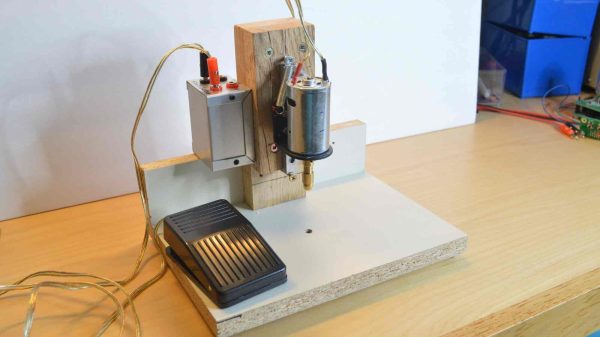
[Sid] makes a few PCBs a month and the hardest part of his fabrication process is always drilling the through-holes. He has a PCB hand drill that usually results in a sore index finger. After a few unsuccessful attempts of using a full-size electric drill and not wanting to invest in a commercial solution, [Sid] made a PCB drill from a broken R/C car.
The toy car was donated by [Sid]‘s 4-year-old after a terrible crash. [Sid] took the gearbox from the car and added a small circuit to control the direction of the drill. After attaching the drill chuck to the former R/C car axle and adding the power leads to a 5 Volt adapter, a PCB drill press was born.
Most of the parts for this build were salvaged from the toy car’s radio control circuit. Except for the chuck from [Sid]‘s hand drill and a few switches, everything on this build was pulled from a broken remote control car. While the build is a lot simpler than this semi-automatic PCB drill, [Sid]‘s drill seems to work well. Check out the demo video after the break.
Read the rest of this entry »
posted Jul 21st 2011 3:01pm by
Mike Nathan
filed under:
repair hacks

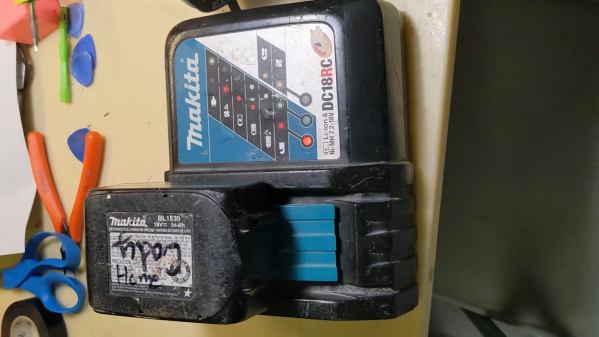
[Webby] inherited a cordless drill from his dad and when he finally got around to using it, found that the charger was dead in the water. He disassembled it and narrowed the issue down to the charger’s primary transformer, but didn’t know where to go from there. A friend suggested that the coil’s thermal fuse might have blown, and upon further investigation, [Webby] discovered that his friend was right.
He removed the dead fuse and soldered in a piece of wire just for testing – not surprisingly the charger sprang to life. He picked up a new thermal fuse to replace the old one, but he wasn’t quite satisfied with the fix just yet. If the fuse burned out once already, there’s little to stop it from happening again, so he decided that installing a small cooling fan would be a good idea. He mounted the fan on the outside of the case after cutting some vent holes, leeching power from the charger itself.
While simply adding a fan to the charger might not be everyone’s idea of a perfect solution, it has worked out quite well for [Webby] in the past, so if it isn’t broken…
[via HackedGadgets]
posted Jun 29th 2011 5:06am by
Jeremy Cook
filed under:
misc hacks

Although not a hack in itself, many of you may be interested in seeing how a printed circuit board is made in the manufacturing world. This tour of Advanced Circuits does a good job of explaining the process. The article explains how a PCB will go through a CAD/CAM review, drilling, deburring, and the various chemical etch, plating, and curing processes.
Although many hackers make their own PCBs, having it professionally done can be a good option depending on how many copies are needed. One benefit of this is that PCBs can be checked by an optical inspection process, or even by a “flying lead” machine which works by contacting leads automatically in a computer controlled setup.
A video of this incredible machine is included after the break. Around 0:26 is when it really starts to get going. Read the rest of this entry »
posted Jun 5th 2011 10:38am by
Jeremy Cook
filed under:
tool hacks

Necessity is the mother of invention, or so they say. [Jason] was in such a situation where he needed to install some safety railing at his grandmother’s house. He didn’t have the necessary tools available, like a drill, so he fashioned one himself out of a pencil sharpener and some fittings and wire that he was able to find.
Although crude, and probably not what one would choose to use if an actual drill was available, this “drill-pencil-sharpener” actually does a pretty decent job of cutting through plywood as seen in the video after the break. Read the rest of this entry »
posted Jan 6th 2011 12:24pm by
Mike Szczys
filed under:
HackIt,
Kinect hacks,
peripherals hacks,
tool hacks

[Brett Graham] and [David Cox] are taking the Kinect out into the world thanks to this handheld hack they call the Drill of Depth. Apparently, the Kinect wants 12V at 1A which is quite easy to provide with a rechargeable power tool like this Ryobi drill. The setup features a 4.3″ touchscreen display, connected to the Gumstix Overo Air that is running Linux. They claim that there’s a “legitimate scientific reason” for building the device but they’re not sharing it yet.
So what would you use this for? We wonder if it would be possible to roll a GPS into the mix, then use post processing from the captured data to recreate the environment in a virtual setting? Imagine if a weekend spent walking around campus and processing the results let you model your University and make it an add-on level for your favorite game. Or perhaps this could be paired with a regular camera to generate high-quality 3D skinning data for Google Earth. That’s what we came up with, what do you think?
posted Oct 25th 2010 9:00am by
Mike Szczys
filed under:
home hacks

[Nollie551] sent us a demonstration of his head spinning yard prop. Adding a possessed child as part of your Halloween display is a nice touch. But when her head starts to spin (think: The Exorcist) as trick-or-treaters saunter by it should scare the life out of them. You can see that all it took is a jig to hold an inexpensive power drill in place. He didn’t include details of how this is hooked up but we think it would be a great way to use that drill switch hack that [Ben Krasnow] did a while back.
Join us after the break for some video.
Read the rest of this entry »
posted Sep 20th 2010 9:56am by
Mike Szczys
filed under:
tool hacks

[Rob] just finished reinforcing a cheap drill motor. He picked up the tool at Harbor Freight and ditched the case. The plastic retaining ring was replaced with a thick metal washer which he machine The washer uses three bolts to attach to the mounting plate that he welded together. We’re not exactly sure what he’s got in mind as he only mentioned that this will be used with a robot. We wouldn’t mind having one of these as a bench motor but there must be hundreds of uses now that it can be attached to just about anything. It seems Harbor Freight has become popular as hacking’s raw material source. The last example we saw of this was a welding table made from a utility cart.
posted Aug 31st 2010 6:15am by
Mike Szczys
filed under:
tool hacks,
toy hacks

This peculiar setup allows [Ben Krasnow] to control an alternating current device using one pin on a microcontroller. He’s experimenting with a power drill and has relocated the trigger circuitry that makes it spin. On that board he found a variable resistor combined with a capacitor which control a triac, actuating the speed of a drill. [Ben's] solution works great and isolates the drill from the control circuitry. He replace the variable resistor with a cadmium sulfide photoresistor (basically a variable resistor whose resistance depends on the intensity of light). Pulse-width modulation is used to adjust the brightness of an LED shining on that photoresistor and thereby affect the speed of the drill. This is such as simple alteration to the drill we’d call it MacGyver-esque.
See a demonstration after the break.
Read the rest of this entry »