Thwart Robbers With An Old Smoke Alarm.

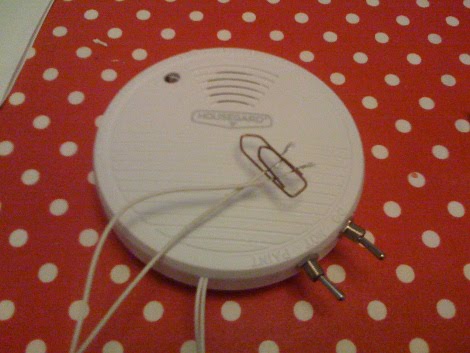
[Anders] tipped us off about his hack that re-purposes a smoke alarm as a burglar alarm. Unfortunately, he came home in the middle of a burglary but wanted to be ready the next time someone tries to break in. By cleverly patching into the test button on an old smoke detector he created a circuit-trip alarm. One side of each piece of wire is secured to the frame and jam of a window. A paper clip completes the circuit by pinching the two bare conductors. If the window is opened the connection is lost and the alarm sounds.

We see a few problems with this system. First off, never hack your ONLY smoke detector, you are putting lives at risk by doing so. But [Anders] says he’ll have a replacement detector and since these things need to be replace every ten years or so, chances are you can find an old one kicking around. We’d recommend disguising the case so that people aren’t confused about it being a smoke detector. Secondly, he’s mounted the alarm right in the window frame so most likely an invader will just smash the thing to bits.

Anyway, it’s still an interesting reuse of these ubiquitous, and life-saving, devices.
Two Input Devices Made With Common Items

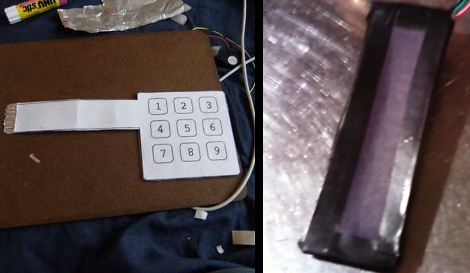
Here’s two input devices you can easily build with materials you already have on hand.

To the left, [John] built a 3×3 keypad matrix from paper and tinfoil. The rows and columns are made up of strips of tin foil on the front and back layers of paper. The layers are separated by spongy double-stick tape. A ‘keypress’ results when the gap between the conductors is compressed with your finger.

In much the same way, [Dave Fletcher] built a touch potentiometer. He made two resistance plates by scribbling pencil lead on sheets of paper. When the two plates face each other, separated by the same type of foam tape as before, they can be pressed together to form a circuit with a variable resistance. This results in a crude version of the SparkFun softpot.

WRT54GL, Meet Alice

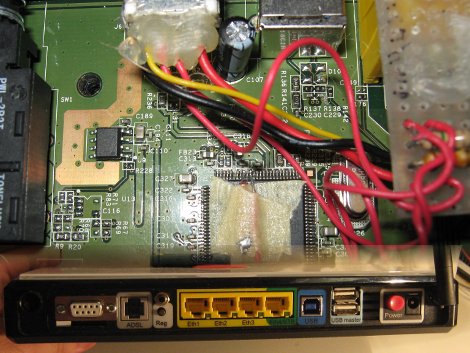
When it comes to routers, there is one that is hacker’s favorite, the WRT54GL. But a slightly lesser known company, Pirelli with their “Alice Gate2 plus Wi-Fi”, seems to be a popular choice among our Italian friends.

[Esteban] has done everything from installing serial and parallel ports, to unlocking firmware while installing Debian. Our personal favorite is the creative wiring of an additional USB port, where he had to custom create a power circuit to run his webcam and external drive.

[Thanks Marco]

[Update: It would appear Roleo, Beghiaro, and Zibri did the actual grunt work at ilpuntotecnicoeadsl and Esteban simply wrote the guides. Thanks for your hard work and hacking skills guys!]

Yet Another Pong-clock

[PT] let us know that Adafruit Industries has just release a pong clock kit. The $80 price tag might seem a bit steep but it does come with a custom-ordered KS0108 display in order to get white on black like the classic video game, as seen after the break. Also included is the laser-cut case, an ATmega328 microcontroller, RTC, and all the other bits needed to get this working.

We just saw a pong clock built on a breadboard using a KS0108 display but that one used a PIC processor. Adafruit always open-sources their designs and code so you can head over to the kit details page if you already have the hardware on hand to throw this together.

Continue reading “Yet Another Pong-clock”

Lower Productivity By Using A Rotary Num Pad

[vimeo=http://vimeo.com/9618204]

[Maximilian Ernestus] sent us a quick little demo that shows him using a rotary phone dial as a num pad. We’re often frustrated when notebooks and netbooks prohibit us from using our mad 10-key skills (alternate key mapping doesn’t count). This makes coding and using GnuCash undesirable on small form factor portables.

Instead of fixing the problem, [Maximilian] made it worse by interfacing a rotary phone as a num pad. An Arduino counts the pulses and feeds them to the computer via a serial connection.  From there it’s just a bit of software handling to issue a keypress.  He mentions that a future version should register as a USB keyboard. This is a great opportunity to ditch the Arduino and use the V-USB library.

Want to dig a bit deeper into this old technology? Don’t miss out on the information available from the Magic Phone hack.

10×10 LED Matrix

[KopfKopfKopfAffe] just finished a 3-year labor of love resulting in this 10 by 10 LED Matrix. This trumps the Shiftbrite table from earlier today by bringing an actual 100 LEDs to the display. These LEDs cost much less than the Shiftbrites, but since they don’t have their own on-board controller this project requires much more back end work. A total of 25 ATmega8 microcontrollers drive this display, in turn controlled via an RS-232 connection to a computer.

We love the Lemmings animations. It made us realize that this would be a great candidate to play Super Pixel Bros on. Check out the video after the break for snapshots of the hardware as well as videos of the matrix at play. You may also want to peruse the translated work log.

Continue reading “10×10 LED Matrix”

Drilling Perfectly Centered Holes

If you’ve ever been caught in the situation of needing to drill a clean straight hole down the center of a bolt or rod, you’ve probably tried and ended up with a broken bit or tilted hole, and a ton of cursing to boot.

[Vik] let us know about this nifty trick for drilling ‘down the middle’ using a simple hobby drill press and vice. He claims it’s ‘physics guiding the bit’ but in reality its just crafty use of a chuck. Either way the quick trick works, and will hopefully save a lot of hackers some headaches in the future.

Let us know in the comments if you have any simple quick tips that you use when you’re out in the shop.