More 555 Projects To Enjoy

We love all of the projects that are coming out for the 555 design contest, so we thought we would share a couple more that have caught our collective eye.  Have a 555 project of your own? Be sure to share it with us, and keep an eye out for the contest submission dates. Read on for a few of our project picks.

Continue reading “More 555 Projects To Enjoy”

Electronic Watering Can

When [Deddies lab] was looking to keep their (rather large) Ficus Lyrata appropriately watered, they followed their motto, stuck a micro controller on it and whipped up an Electronic Watering Can .

The whole thing starts off with power that is switched on once a day for 15 minutes by a traditional mechanical lamp timer, and that is connected to a atmega8 micro controller running @ 1MHz which increments a counter by one. When that counter hits 7 the mega switches on a pump, watering the plant with roughly half a liter of water per week out of a bucket reservoir , which according to the article’s calculations should last about 4 months.

In order to assure that the pump does not run out of water a rubber duck was attached to a string, the other end is attached to a micro switch, and when the water gets too low the string is pulled, switching one of the micro controller’s pins low.

While we agree that it could use a low water indicator, that is trivial to add, and over all the project represents a great hack done on a Sunday using parts and materials already on hand. Join us after the break for a quick video too!

Continue reading “Electronic Watering Can”

Simple RFID Access System Clone

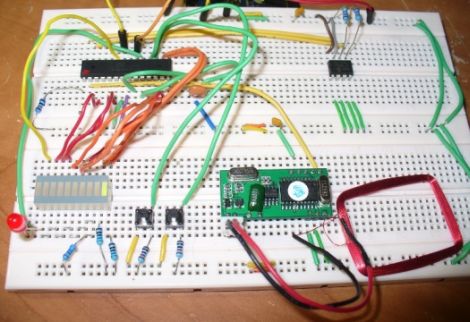
rfidbboards

A few months back, [John] was reading an article about a simple RFID security system kit, and decided he would like to build one himself.  While many of the system’s details, including full schematics were provided, he was dismayed to find that the source code for the project was not published as it was held under copyright by the manufacturer.  Believing that open source is better, he modified the original design, replacing their PIC controller with an ATmega328 armed with an Arduino bootloader.

His system replicates all of the original kit’s functionality, while offering plenty of opportunity for modification beyond the initial design.  The article contains a complete parts list, wiring schematic, and the Arduino code required to get things up and running.  He even has a video of his clone at work, demonstrating the acceptance and rejection of RFID tags as well as the system’s learning mode.

Paintball Chronograph

This slick little chronograph can tell you how fast your paintballs are going, as well as what your firing rate is. In this instructible by [Klash69], you can see how to build one for yourself for less than $40. Chronographs themselves aren’t usually too interesting, but we thing he has done a great job here. You have a nice compact package with a big bright display. All it really needs now is a smooth enclosure. As far as the tech details go, he’s using IR sensors spaced 4 inches apart for detection, at the barrel. We’re not experts, but we think this might not work as well on a gun due to muzzle flash, someone who actually knows should let us know in the comments. The brains are a PIC18F13k50 and you can download a full parts list and schematic on the instructible.

You can see a video of it in use after the break.

Continue reading “Paintball Chronograph”

Versaloon Ported To STM8 And STM32 Discovery Boards

[Bingo] did some work porting Versaloon for STM8 and STM32 discovery boards. Versaloon is a multiple-architecture programmer that we saw a few weeks back. At its center is an STM32 microprocessor, which greatly simplifies the work necessary to use the two discovery boards instead. Flashing the firmware to the boards will zap the ST-link firmware and [Bingo] doesn’t know of a way to restore that so be warned. This hack is still pretty fresh off the bench, but so far it looks like vsprog and OpenOCD both work just fine with the new hardware.

Switched Mode Power Supply Repair Guide

switched_mode_power_supply_repaiir

[Erich] spotted a broken DVD recorder at a local amateur radio meeting and decided to see if he could restore it to working order. While he was fortunate enough that someone labeled it as having a bad power supply, things aren’t always that easy. He gives a broad explanation as to how switched mode power supplies work as well as discusses some of the reasons these devices tend to fail. He identifies a few common components and areas that one should check while diagnosing a non-functioning power supply. While obvious bulging capacitors are easily identifiable, he discusses the need for an ESR meter and uses a kit-built model to test capacitors that do not have any visual signs of damage. While some of his walkthrough might be basic knowledge for readers who have experience in recapping circuit boards, it serves as a nice guide for those who are new to the world of electronics troubleshooting and repair.

Microsimon

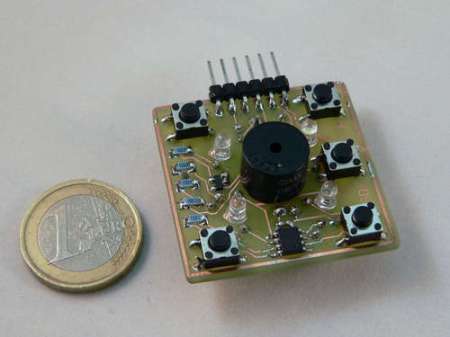
[Simoninns] is hoping to compete in the Sparkfun Microcontroller Contest with this cool little Microsimon instructible. The parts list is pretty small, at around 20 components. At the heart is a PIC 12F683 microcontroller. The whole project is very well documented with schematics, PCB layouts, code, and great pictures. This is a great project that you could put together really quickly and is a perfect introduction to charlieplexing. We find that, especially when teaching a new person, games are often a good project to learn from. The interactive and competitive nature of the finished product usually keeps people interested a little longer. You can catch a video of it after the break.

Continue reading “Microsimon”