These Are The Top Projects In The 2017 Hackaday Prize

For the last eight months, Hackaday has been running the greatest hardware competition on Earth. The Hackaday Prize is a challenge to Build Something That Matters, make an impact, and create the hardware that will transform the world. These projects range from reliable utensils for the disabled, a way to clean drinking water for rural villages, refreshable Braille displays, and even a few high voltage Tesla coil hats. The Hackaday Prize is the preeminent hardware hackathon with a goal of making the world a better place, and this weekend we’re going to see the fruits of everyone’s labor.

Watch It Live

We will announce the winners of the Hackaday Prize live on stage at the Hackaday Superconference this weekend. Even if you can’t make it to the conference, you can join in by watching the livestream (broadcast on YouTube and Facebook) and by joining the Supercon chat room.

What the Judges Have to Say

Over the last few weeks, our fantastic team of judges have been combing over the finalists in the Hackaday Prize. We’ve put together this video roundup with judges discussing the top ten finishers:

https://www.youtube.com/watch?v=bniJs6i6qZE

These ten projects are the best the Hackaday Prize has to offer, and one of these projects will walk away with the Grand Prize of $50,000 USD. The second, third, fourth, and fifth place winners will take away $20,000, $15,000, $10,000 and $5,000, respectively. The top ten projects in the Hackaday Prize are, in no particular order:


5 Top Finishers for Best Product

The Hackaday Prize isn’t just about finding the best projects. We’re also looking for the best products. For that, the Hackaday Prize includes a Best Product award. This promises to awaken the hardware entrepreneurs to build a manufacturable thing that will shake up an industry. Here’s an overview of the five top finishers in the Best Product Category:

From a field of the twenty best product finalists entered into the Hackaday Prize our fantastic panel of judges have winnowed these down to five incredible finalists. They are, in no particular order:

The winner of the Best Product competition will walk away with $30,000 USD and an opportunity to interview for a residency at the Supplyframe Design Lab. Here, the hackers behind the Best Product will have a materials budget, mentoring, and access to some world-class tools that will enable them to turn their prototype into a real product.

These are the best projects and products the 2017 Hackaday Prize has to offer, and we couldn’t ask for more. Watch live as the Hackaday Prize is awarded tomorrow at 6:30pm Pacific. It’s going to be a blast, and a few lucky projects will take away a pile of prize money and the respect of their peers. It really doesn’t get better than that.


I See Rain In Your Future

Who wouldn’t like to have a crystal ball? Unfortunately, our computers aren’t very good at predicting the future. However they do occasionally get the weather correct, so [Jenny Hanell] built a crystal ball to show the weather forecast. She calls it “Sphaera” and you can see a video of it in operation below.

The user interface is entertaining, and relies on 5 photoresistors. The Raspberry Pi inside detects when you cover one of them up, and interprets that as a command. A piece of plastic allows for projection inside the sphere from an LCD display. [Jenny] calls that a hologram although technically it isn’t a true hologram, of course.

Continue reading “I See Rain In Your Future”

The Clutter Manifesto

My basement workshop is so crammed full of stuff I literally can’t use it. My workbench, a sturdy hardwood library table, is covered in junk to the point that I couldn’t find a square foot that didn’t have two layers of detritus on it — the top layer is big things like old projects that no longer work, boxes of stuff, fragile but light things perched on top. Underneath is the magma of bent resistors, snippets of LED strip, #4 screws, mystery fasteners I’ll never use, purple circuit boards from old versions of projects, and a surprising number of SparkFun and Adafruit breakouts that have filtered down from higher up in the heap.

When work on something I bring the parts up to the dining room and work on the table, which is great for many reasons — more space, better light, and superior noms access top the list. The down side is that I don’t devote any time to making my real shop into a viable working place, and it becomes a cluttered store room by default.

I am therefore focusing on a four-part plan to reclaim my work space from heaps of junk.

Continue reading “The Clutter Manifesto”

Shop-Made Fixture Turns Out Dream Welds

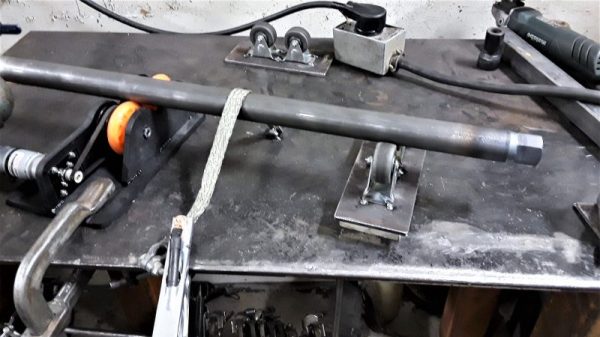
You can tell a lot about a person by the company they keep, and you can tell a lot about a craftsman by the tools and jigs he or she builds. Whether for one-off jobs or long-term use, these ad hoc tools, like this tubing rotator for a welding shop, help deliver results beyond the ordinary.

What we appreciate about [Delrin]’s tool is not how complex it is — with just a motor from an old satellite dish and a couple of scooter wheels, it’s anything but complicated. What we like is that to fabricate some steering links, each of which required three passes of TIG welding to attach a threaded bung to the end of a rod, [Delrin] took the time to build just the tool for the job. The tools slowly rotates the rod, letting the welder keep the torch in one position as the workpiece moves under it. The grounding method is also simple but clever — just a wide strap of braid draped over the rod. The result is some of the prettiest and most consistent welds we’ve seen in a while, and with an order for 28 steering links, it ought to be a huge time saver.

It may be time for a little more TIG welding love around here. Sure, we’ve covered the basics of oxy-acetylene welding, and even talked about brazing aluminum. Perhaps your humble Hackaday writer will take the plunge into a new TIG welder and report from a newbie’s perspective. You know, for science.

[via r/welding]

Hacking When It Counts: Prison Locksmithing

In 1978, Tim Jenkin was a man living on borrowed time, and he knew it. A white South African in his late 20s, he had been born into the apartheid system of brutally enforced racial segregation. By his own admission, he didn’t even realize in his youth that apartheid existed — it was just a part of his world. But while traveling abroad in the early 1970s he began to see the injustice of the South African political system, and spurred on by what he learned, he became an activist in the anti-apartheid underground.

Intent on righting the wrongs he saw in his homeland, he embarked on a year of training in London. He returned to South Africa as a propaganda agent with the mission to spread anti-apartheid news and information to black South Africans. His group’s distribution method of choice was a leaflet bomb, which used a small explosive charge to disperse African National Congress propaganda in public places. Given that the ANC was a banned organization, and that they were setting off explosives in a public place, even though they only had a few grams of gunpowder, it was inevitable that Jenkin would be caught. He and cohort Steven Lee were arrested, tried and convicted;  Jenkin was sentenced to 12 years in prison, while Lee got eight.

Continue reading “Hacking When It Counts: Prison Locksmithing”

Cat Feeder Has Steampunk Flair And A GMail Account

While it is often said that “necessity is the mother of invention”, we can’t say that’s always been our experience here at Hackaday. You won’t need to search too long before you find a project or hack on this site that definitely falls out of the realm of strict necessity. But that’s part of the fun, there’s a reason this site isn’t called AppropriateUseOfTime.com

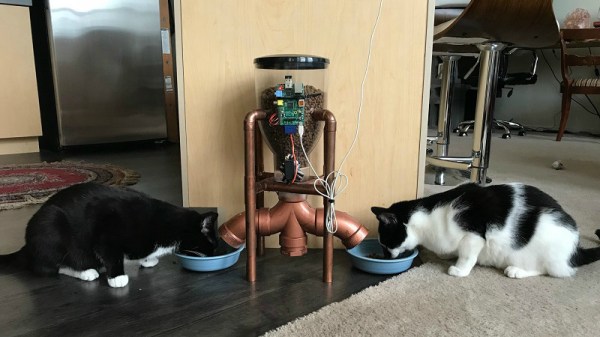
But when [Sam Storino] couldn’t seem to stop his cats from howling for their supper at 3:00 AM, he had the perfect opportunity to fulfill that age-old wisdom. Not only did he manage to turn a trip to the plumbing isle of his local home improvement store into a very Steampunk-looking automatic cat feeder, but he also found the time to write up an exceptionally detailed series of blog posts on what he learned during the process.

The heart of the machine is everyone’s favorite Linux board, the Raspberry Pi. You might be thinking the Pi is overkill for a simple timer, and you’d be right. Rather than just dump the food out on a set schedule, [Sam] decided to get a little fancy and come up with some Python scripts that will monitor a GMail inbox and activate the feeder hardware when it receives an email with the title “feed cats”. He then uses IFTTT to send the appropriately named email to the GMail account of his cat feeder on a specific schedule. Hey, nobody said necessity was the mother of straightforward invention.

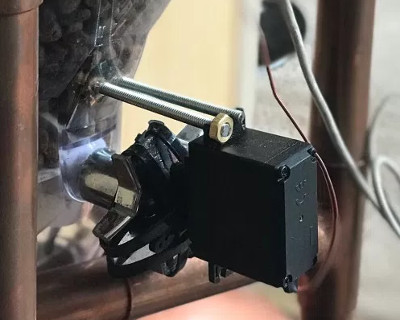
In the final post of the series, [Sam] goes over the hardware side of the device. Copper pipe makes up the frame, which holds a commercial off-the-shelf dry food dispenser. The feeder was designed for manual operation, but by attaching a continuous rotation servo [Sam] can spin it up and dump a pre-measured amount of food via the Pi’s GPIO pins. The addition of some PVC pipe and fittings takes the food and (at least in theory) divides it equally between the two cat bowls below.

If you think [Sam] may have put a bit more thought than was necessary into something as simple as feeding his pets, keep in mind that he’s in exceptionally good company. Paging through the archives, it seems the intersection of felines and hackers is littered with gloriously complex contraptions.

An Awesome Open Mechanical Keyboard

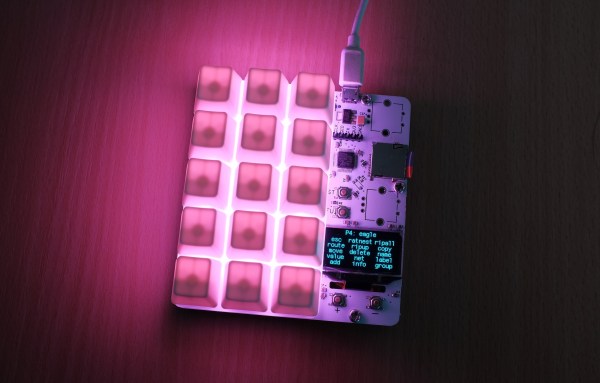
Who doesn’t want a little added functionality to their  lives? Feeling a few shortcut keys would make working in Eagle a bit smoother, [dekuNukem] built his own programmable mechanical keypad: kbord.

It sports vibrant RGB LED backlight effects with different animations, 15 keys that execute scripts — anything from ctrl+c to backdoors — or simple keystrokes, up to 32 profiles, and a small OLED screen to keep track of which key does what!

kbord is using a STM32F072C8T6 microcontroller for its cost, speed, pins, and peripherals, Gateron RGB mechanical keys — but any clear key and keycaps with an opening for the kbord’s LEDs will do — on a light-diffusing switch plate, and SK6812 LEDs for a slick aesthetic.

Check out the timelapse video tour of his build process after the break! (Slightly NSFW, adolescent humor for a few seconds of the otherwise very cool video. Such is life.)

Continue reading “An Awesome Open Mechanical Keyboard”