World Create Day Is The Hackaday Event In Your Neighborhood

Hackaday World Create Day is on March 17th and it’s happening near you. Get together with hackers in your area and create something. Sign up now to host a World Create Day gathering! These are really easy to organize, but we can only do it with your help.

The Hackaday community from around the world will meetup and spend time building together on Saturday, March 17th. Pick one of those projects you’ve been meaning to dive into and get together with some old and new friends to hack on your projects together.

You should make this day your own. As with any hands-on hacking events it’s a good idea to block out a bit of time at the end for lightning talks to show off the builds everyone has been working on. Make the memories live on past a single day by taking pictures and posting the story of your World Create Day meetup. We enjoyed getting a great look at many of last year’s meetups this way and want to expand the builds we feature on the front page this year.

Meetup Organizers Wanted

Fill out this form to let us know you want to host a meetup.

Every year we have World Create Day meetups all over the world which are set up by local organizers. Many of those will happen again this year, but we also need you to organize an event in your area. We’ll help you get things set up and put your event up on the big map so others in your area will plan to join in. Do it now, if we get your shipping info early we’ll send you stickers and other swag to hand out at your gathering.

Build Something that Matters

The core of World Create Day is to stop making excuses and just build something. Great builds start with a plan. The Hackaday Prize will begin soon, and since you’re already getting together with other people, form a team and dream up your entry.

This is your take on building something that matters to the world. Come up with a plan that solves a problem facing humanity and publish your work on Hackaday.io. You may be surprised by the support you get for your idea, but you’ll never know until you put an idea out there. Join in Hackaday’s World Create Day on March 17th and let’s show the world the kind of hope that blossoms when we decide to build something that matters.

Arduino BabyTV Is Big Fun At Low Resolution

What kind of TV do you have? An older 720p model, or the now standard 1080p? Perhaps you’ve made the leap to the next generation, and are rocking a 4K display in the living room. All those are are fine and dandy if you just want to watch the local sportball contest, but where’s the challenge in that? With all the technology and modular components we have access to anymore, nowadays all the real hackers are making their own TVs.

Of course, when [Nikolai] built his very own LED TV, he did have to make a few concessions. For one thing, there’s no tuner on this model. Oh, and there’s the small issue of only having a 16×16 resolution. It might not be your idea of the perfect display, but it’s just perfect for his newborn son.

That’s right, [Nikolai] got his entry for the “Hacker Parent of the Year” award in early, and built an LED display for his son that he’s calling “BabyTV”.

Rather than the shows, trash, advertisements that they play on the kid channels, this TV only shows animated characters from retro games. We’ll concede that this project might be an elaborate Clockwork Orange style attempt at hypnotizing his son to instill an appreciation for classic gaming. But we’ll allow it.

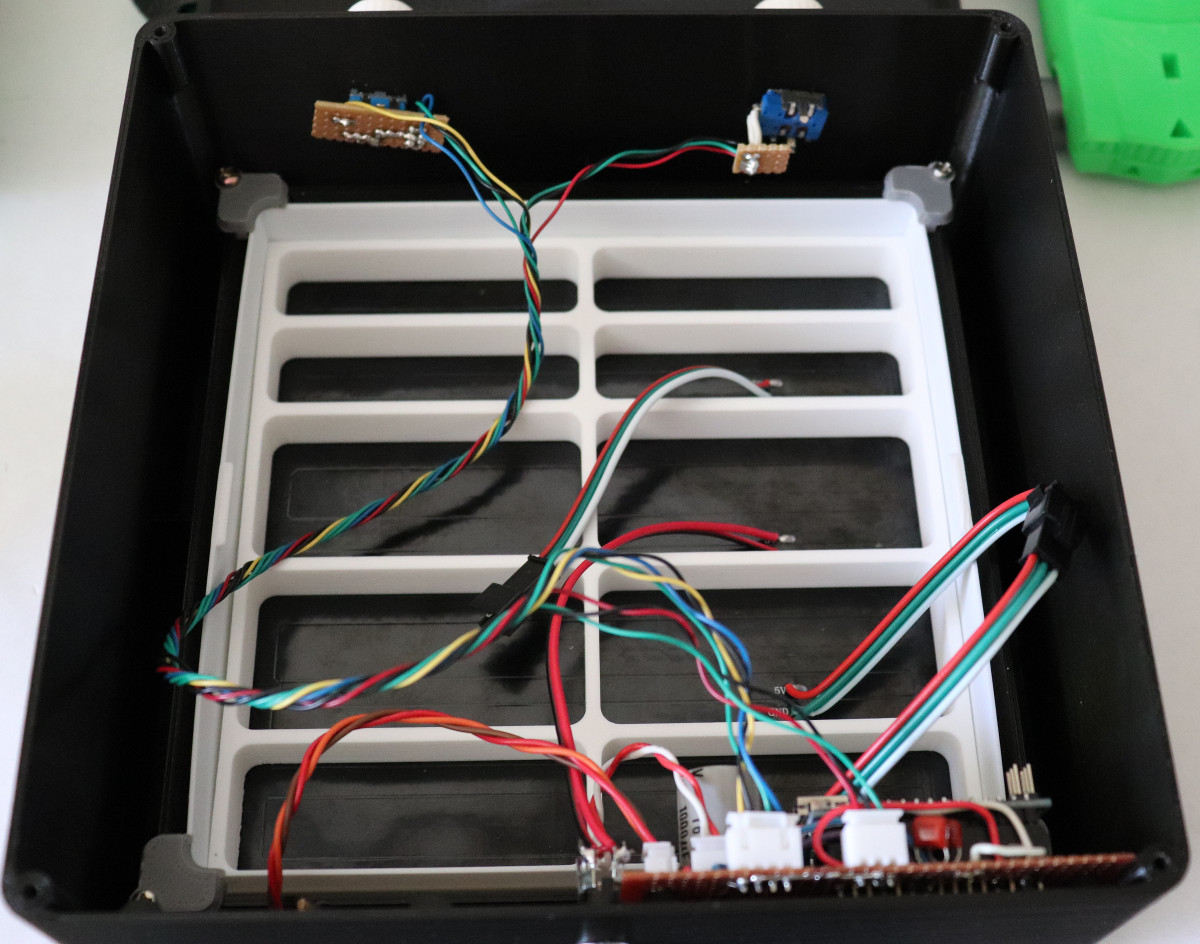
To make his BabyTV go, [Nikolai] used a 16×16 WS2812B LED panel and an Arduino Nano. Two rotary encoders are used to allow adjusting brightness and change the character currently being shown on the screen. As a particularly clever hack, the Arduino has an IR sensor attached and is constantly watching for any signals. If an IR signal is detected, the BabyTV switches to the next image. So if Junior has a standard IR remote in his hands, any button he presses will cause the display to change to the next “channel”.

Historically speaking we haven’t seen much stuff for children here at Hackaday, but 2018 seems to be changing that. Recent projects like the incredible scratch built mini excavator and gorgeous AT-ST high chair would seem to indicate we’re currently witnessing a generation of hackers become parents. Don’t panic folks, but we might be getting old.

Continue reading “Arduino BabyTV Is Big Fun At Low Resolution”

SpaceX Joins In The Long History Of Catching Stuff From Space

On February 22nd, a Falcon 9 rocket lifted off from Vandenberg Air Force Base in California and successfully delivered into orbit an Earth-observation satellite operated by the Spanish company Hisdesat. Compared to the media coverage received by the launch of the Tesla-laden Falcon Heavy earlier in the month, this mission got very little attention. But that’s hardly surprising. With respect to Hisdesat, the payload this time around was not terribly exciting, and even the normally dramatic landing of the Falcon 9’s first stage was skipped in favor of simply allowing the booster to crash into the ocean.

As far as SpaceX launches go, this one was about as low-key as they come. It wouldn’t be a surprise if this is the first time some readers are even hearing about it. But while it didn’t invoke the same media circus as the images of a spacesuit-wearing mannequin traveling into deep space, there was still a historic “first” performed during this mission.

In an effort to increase the re-usability of the Falcon 9 booster, SpaceX attempted to catch the payload fairing (essentially a large protective nose cone) with a huge net as it fell from space. The most interesting thing about this new chapter in the quest for a fully reusable rocket system is that while SpaceX is generally considered to be pioneers in the world of bringing hardware back from space, this particular trick dates all the way back to the 1960’s.

Continue reading “SpaceX Joins In The Long History Of Catching Stuff From Space”

Moltoduino: Arduinos All The Way Down

It is getting difficult to find a desktop or laptop computer with only a single CPU. Even a typical ARM-based computer now probably has multiple cores. Of course, there’s nothing to stop you from using multiple microcontrollers — like the Arduino — together. To make the process neater, [Dimitris Platis] put together Moltoduino, essentially an Arduino on a shield made to plug into another Arduino. And, yes, they will stack. You can see a video about the open source boards, below.

The key is how the board brings the pins out to connections that are easy to jumper between boards. There are several obvious use cases, but one that [Dimitris] is particularly interested in is hardware-in-the-loop testing. The idea is that you can use a simulated I/O device in one computer to exchange fake data with the software under test.

Continue reading “Moltoduino: Arduinos All The Way Down”

Order Drinks With Your Mind

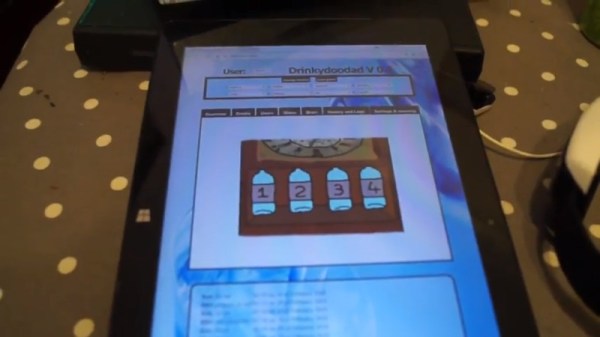
Barbots are a popular project around these parts. With a few pumps and a microcontroller or two, it’s possible to build something that can approximate mixing a drink. If you’ve got the patience and attention to detail, you can probably even get it to the point where it doesn’t just end up as a leaking wet mess on your mantlepiece. [Robert] has taken his build a step further by adding mind control.

To achieve this feat, a Mindflex EEG headset is pressed into service. This picks up brainwaves from the user, and processes them into two output values of concentration and meditation. Through some careful hacking, it’s possible to retrieve these values. [Robert] sends the values over Bluetooth to the barbot controller for processing. Concentration values over a certain threshold are used to cycle through the drink selection, while meditation values are used to confirm the order. Once it’s made, a voice command to “hit me” will see the drink served.

It’s a tidy build that adds a bit of fun to an already cool project. We’d love to see this taken up several levels of complexity to the point where you can directly order the drink you want, just by the power of thought. If your university-grade research project is at that level, be sure to let us know. Else, if you’re interested in how the barbot came to be, check out [Robert]’s earlier work.


Mechanical Clocks That Never Need Winding

What is it about mechanical clocks? Maybe it’s the gears, or the soft tick-tocking that they make? Or maybe it’s the pursuit of implausible mechanical perfection. Combine mechanical clocks with “free” energy harvested from daily temperature and pressure variation, and we’re hooked.

Both the Beverly Clock, built by Arthur Beverly in 1864, and the Atmos series of clocks built between 1929 and 1939, run exclusively on the expansion and contraction of a volume of air (Beverly) or ethyl chloride (Atmos) over the day to wind up the clock via a ratchet. The Beverly Clock was apparently a one-off, and it’s still running today. And with over 500,000 Atmos clocks produced, there must be some out there.

Although we had never heard of it, this basic idea is really old. Clicking through Wikipedia (like you do!) got us to Cox’s Timepiece, which is powered by the movement of 68 kg of mecury under atmospheric pressure. It is currently not running, but housed in the Victoria and Albert Museum in London. Even older is a clock that we couldn’t find any info on that dates from 1620, invented by Cornelius Drebbel. Anyone know anything?

We’ve had energy harvesting on our mind lately, and the article on the Beverly Clock says that it gets 31 μWh over a day when the temperature swings by 3.3 °C. Put into microcontroller perspective, this is 0.39 μA at 3.3 V, so you’ll have to be pretty careful about your sleep modes, and an LED is out of the question. How amazing is it, then, that this can power a mechanical clock?

Thanks [Luke], [hex4def6], and [Wallace Owen] for tipping us off to these in the comment section!

Real-Time Audio For The PocketBeagle

The BeagleBone has long been a favorite for real-time I/O, and now with the release of the PocketBone — the tiny key fob-sized BeagleBone — there are ever increasing uses for this tiny little programmable real-time Linux module. The Bela Mini, just released, is the latest add-on cape to take advantage of the processing power of the micro-sized PocketBone.

The Bela Mini is a shrinkification of the original Bela, a cape add-on for the BeagleBone. The original breaks out eight analog inputs and eight analog outputs, both sixteen-bits deep. With the addition of powered speaker outputs, the Bela turns the BeagleBone into the perfect tiny audio-Linux-thing, with a special emphasis on Pure Data and other audio wizardry.

The Bela Mini does away with the powered speaker outputs, and instead replaces those ports with stereo audio in and stereo audio out on a three-pin connector. Compared to the original Bela, the Mini loses the eight sixteen-bit analog outputs, but still keeps the analog inputs.

There have been many attempts to add real-time audio to microcontrollers and Linux boards, but few examples have lived up to the hype. Most of the time, this comes down to the choice of microcontroller or module; an ATmega-based Arduino doesn’t have real analog outputs and instead relies on PWMing a digital signal. A Raspberry Pi-based Pure Data box does not have a real-time I/O. This is where the choice of the PocketBone shows its strength. The PocketBone uses the same chip as the BeagleBone, and with that comes the Programmable Real-Time Units (PRUs). This enables the Bela to interface with signals with a dedicated controller in real-time. It’s exactly what you want for audio applications.