Edgytokei

Edgytokei’s Incredible Mechanism Shows Time Without A Face

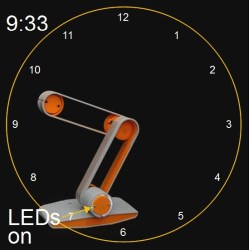
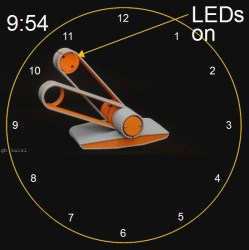
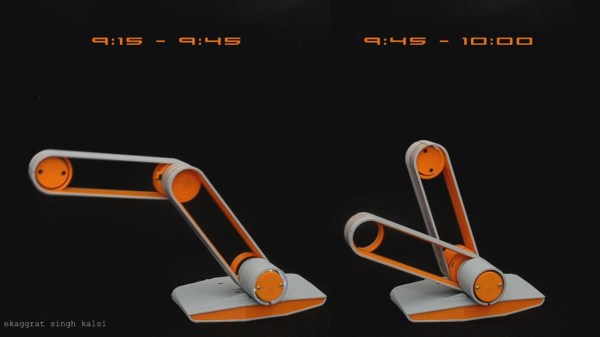
Taking inspiration from Japanese nunchucks, [ekaggrat singh kalsi] came up with a brilliant clock that tells time using only hour and minute hands, and of course a base for them to sit on. The hands at certain parts of the hour seem to float in the air, or as he puts it, to sit on their edges, hence the name, the Edgytokei, translating as “edge clock”.
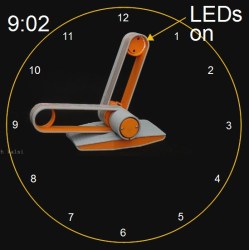
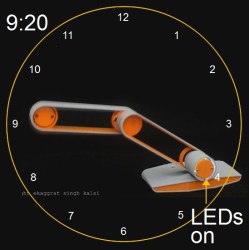
The time is a little difficult to read at first unless you’ve drawn in a clock face with numbers as we’ve done here. 9:02 and 9:54 are simple enough, but 9:20 and 9:33 can be difficult to translate into a time at first glance. Since both hands have to be the same length for the mechanism to work, how do you tell the two hands apart? [ekaggrat] included a ring of LEDs in the hub at the base and another at the end of one of the hands. Whichever ring of LEDs is turned on, indicates the tip of the minute hand. But the best way to get an idea of how it works is to watch it action in the video below.

We have to admire the simplicity and cleanliness of his implementation. The elbow and the hub at the base each hide a stepper motor with attached gear. Gear tracks lining the interior of the hands’ interact with the motor gears to move the hands. And to keep things clean, power is transferred using copper tape lining the exteriors.

On the Hackaday.io page [ekaggrat] talks about how difficult it was to come up with the algorithms and especially the code for homing the hands to the 12:00 position, given that homing can be initiated while the hands can be in any orientation. The hand positions are encoded in G-code, and a borrowed G-code parser running on an Arduino Nano in the base controls it all.

Continue reading “Edgytokei’s Incredible Mechanism Shows Time Without A Face”
The 348,296th Article About Cryptocurrency

The public has latched onto the recent market events with an intense curiosity brought about by a greed for instant riches. In the last year alone, the value of Bitcoin has risen by 1,731%. We’re talking gold rush V2.0, baby. Money talks, and with a resounding $615 billion held up in cryptocurrencies, it is clear why this is assuredly not the first cryptocurrency article you have read — maybe even today. An unfortunate side effect of mass interest in a subject is the wildfire-like spread of misinformation. So, what exactly is a blockchain, and what can you still do now that everyone has finally jumped on the cryptocurrency bandwagon?

Continue reading “The 348,296th Article About Cryptocurrency”

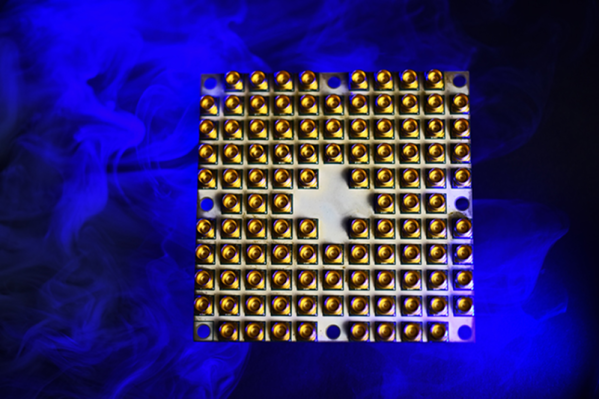
Intel Rolls Out 49 Qubits

With a backdrop of security and stock trading news swirling, Intel’s [Brian Krzanich] opened the 2018 Consumer Electronics Show with a keynote where he looked to future innovations. One of the bombshells: Tangle Lake; Intel’s 49-qubit superconducting quantum test chip. You can catch all of [Krzanch’s] keynote in replay and there is a detailed press release covering the details.

This puts Intel on the playing field with IBM who claims a 50-qubit device and Google, who planned to complete a 49-qubit device. Their previous device only handled 17 qubits. The term qubit refers to “quantum bits” and the number of qubits is significant because experts think at around 49 or 50 qubits, quantum computers won’t be practical to simulate with conventional computers. At least until someone comes up with better algorithms. Keep in mind that — in theory — a quantum computer with 49 qubits can process about 500 trillion states at one time. To put that in some apple and orange perspective, your brain has fewer than 100 billion neurons.

Of course, the number of qubits isn’t the entire story. Error rates can make a larger number of qubits perform like fewer. Quantum computing is more statistical than conventional programming, so it is hard to draw parallels.

We’ve covered what quantum computing might mean for the future. If you want to experiment on a quantum computer yourself, IBM will let you play on a simulator and on real hardware. If nothing else, you might find the beginner’s guide informative.

Image credit: [Walden Kirsch]/Intel Corporation

Henrietta Lacks And Immortal Cell Lines

In early 1951, a woman named Henrietta Lacks visited the “colored ward” at Johns Hopkins hospital for a painful lump she found on her cervix. She was seen by Dr. Howard W. Jones, who indeed found a tumor growing on the surface of her cervix. He took a tissue sample, which confirmed Henrietta’s worst fears: She had cancer.

The treatment at the time was to irradiate the tumor with radium tubes placed in and around the cervix. The hope was that this would kill the cancerous cells while preserving the healthy tissue. Unbeknownst to Henrietta, a biopsy was taken during her radium procedure. Slivers of her tumor and of healthy cervix cells were cut away. The cancer cells were used as part of a research project. Then something amazing happened: the cancerous cells grew and continued to grow outside of her body.

As Henrietta herself lay dying, the HeLa immortal cell line was born. This cell line has been used in nearly every aspect of medical research since the polio vaccine. Millions owe their lives to it. Yet, Henrietta and her family never gave consent for any of this. Her family was not informed or compensated. In fact, until recently, they didn’t fully grasp exactly how Henrietta’s cells were being used.

Continue reading “Henrietta Lacks And Immortal Cell Lines”

Raspberry Pi Ain’t Afraid Of No Spectre And Will Not Meltdown

While there’s broad agreement that Meltdown and Spectre attacks are really bad news at a fundamental level, there is disagreement on its immediate practical impact in the real world. Despite reassurance that no attacks have been detected in the wild and there’s time to roll out the full spectrum of mitigation, some want to find protection right now. If you’re interested in an usable and easy to set up modern desktop that’s free of Meltdown or Spectre threats, a Raspberry Pi can provide the immunity you seek.

[Eben Upton] explained the side channel attacks using fragments of Python for illustration, which was an enlightening read independent of the Raspberry Pi pitch. While these ARM cores perform speculative instruction fetches, they don’t speculatively execute them or modify the cache. Under the current circumstances, that makes all the difference in the world.

A clever security researcher may yet find a way to exploit speculative fetches in the future, and claiming that Raspberry Pi has superior security would be a stretch. The platform has its own set of security problems, but today Meltdown/Spectre is not among them. And that just might be enough to sway some decisions.

If you need to stay in the x86 world, look over what it’d take to to rewind back to an Intel 486.

Thanks to [D00med] for sharing the link in a comment to our overview article.

Improved Perfboard For Surface Mount Parts

Look through the last two decades of electronics project built on perfboard, and you’ll notice a trend. Perfboard is designed for through-hole parts, but ever more frequently, the parts we need are only available as surface mount devices. What does this mean for the future of all those protoboard, veroboard, and tagboard designs? It’s not good, but fortunately, there may be an answer. It’s perfboard designed for mounting SOICs, SOTs, and other surface mount devices.

Perfboard is an extremely simple concept. Most through-hole electronic components are built around 0.1″ or 2.54 mm spacing between pins. Yes, there are exceptions, but you can always bend the middle pin of a transistor and put it in a hole. SMT devices are different. You can’t really bend the pins, and the pin pitch is too small for the 0.1″ holes in traditional perfboard.

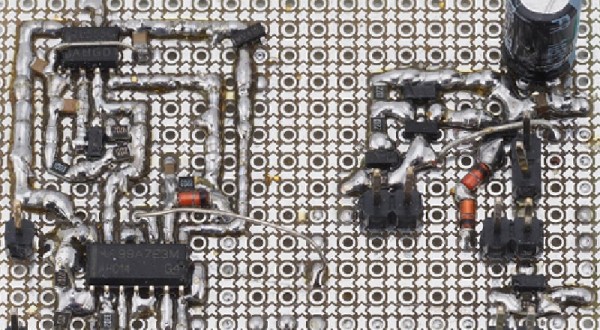
[electronic_eel] is changing that game up with his own design for perfboard. This perfboard has the traditional 0.1″ holes, but there are SMD pads sprinkled about between these holes. The result is being able to solder SOIC, SOT23-6, SOT23 and SOT363 devices directly to a board alongside 0603 and 0805 devices. Connect everything with a few beads of solder and you have a functional circuit made out of surface mount devices on something that’s still compatible with the old protoboard designs.

This isn’t the first time we’ve seen a new type of protoboard make it into production. A few years ago, Perf+, a bizarre ‘bus-based’ protoboard solution came onto the scene, although that wasn’t really designed for SMD parts. While [electronic_eel] doesn’t have any plans to sell his protoboard, the files are available, and you can easily design your own small piece of perfboard.

Eight SEGAs Singing

Way back in the dark ages, before the average computer could play back high quality recorded audio, things were done differently. Music and sounds were stored as instructions to be played back on audio synthesis chips, built into the computers and consoles of the 80s and 90s. These chips and their unique voices hold a special nostalgia that’s key to this era, making them popular to experiment with today. To that end, [little-scale] decided to wire up eight chips from the SEGA Master System to please your ears.

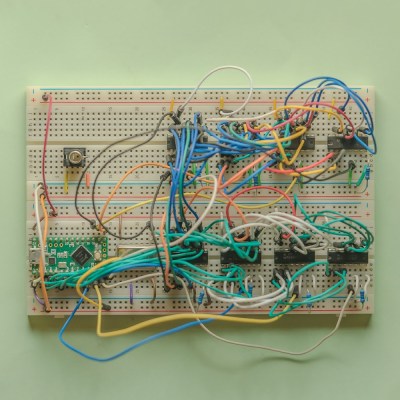
The chips, laid out on a breadboard with a Teensy LC running the show.

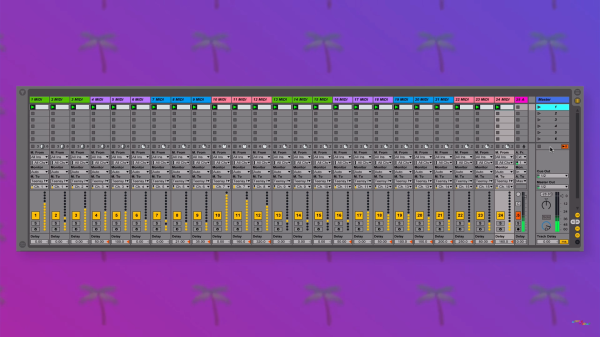
The chip in question is the SN76489, which we’ve also noted is used in the Sega Genesis as well. It packs 3 square wave tone generators, and a noise channel as well. With eight of these to play with, that’s 32 total channels. To drive these, [little-scale] decided to go the MIDI route. To get around the MIDI limit of 16 channels, he decided to split the frequency range in half. Each MIDI channel addresses two SN76489 channels, the top pitches being used for one, the lower pitches being used for the other. All this MIDI data is passed to a Teensy LC, which handles transposition of the note data to get everything back in tune, and addresses the eight chips to create a beautiful square wave symphony.

It’s a great way to create a cacophony of sound in a delightful vintage way, and code is available if you’d like to recreate the feat. What we’d like to know is this – what’s your favourite sound chip from yesteryear, and how badly do you want eight of them to sing in glorious harmony? Continue reading “Eight SEGAs Singing”