Tucoplexing: A New Charliplex For Buttons And Switches

Figuring out the maximum number of peripherals which can be sensed or controlled with a minimum number of IOs is a classic optimization trap with a lot of viable solutions. The easiest might be something like an i2c IO expander, which would give you N outputs for 4 wires (SDA, SCL, Power, Ground). IO expanders are easy to interface with and not too expensive, but that ruins the fun. This is Hackaday, not optimal-cost-saving-engineer-aday! Accordingly there are myriad schemes for using high impedance modes, the directionality of diodes, analog RCs, and more to accomplish the same thing with maximum cleverness and minimum part cost. Tucoplexing is the newest variant we’ve seen, proven out by the the prolific [Micah Elizabeth Scott] (AKA [scanlime]) and not the first thing to be named after her cat Tuco.
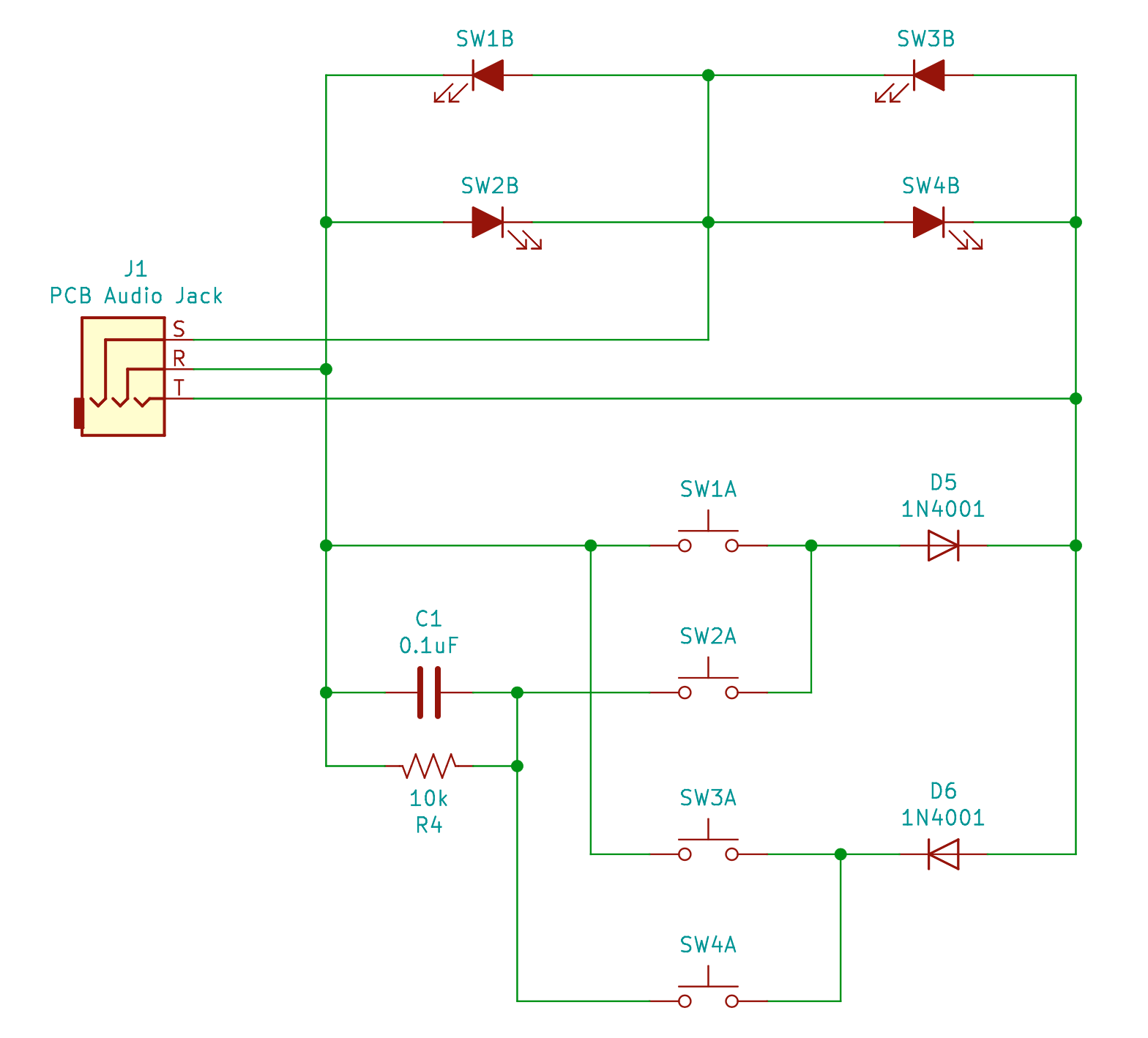
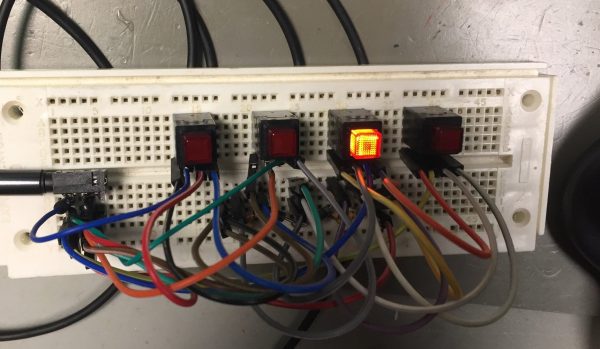
[Micah’s] original problem was that she had a great 4 port USB switch with a crummy one button interface. Forget replacement; the hacker’s solution was to reverse and reprogram the micro to build a new interface that was easier to relocate on the workbench. Given limited IO the Tucoplex delivers 4 individually controllable LEDs and 4 buttons by mixing together a couple different concepts in a new way.

Up top we have 4 LEDs from a standard 3 wire Charlieplex setup. Instead of the remaining 2 LEDs from the 3 wire ‘plex at the bottom we have a two button Charlieplex pair plus two bonus buttons on an RC circuit. Given the scary analog circuit the scan method is pleasingly simple. By driving the R and T lines quickly the micro can check if there is a short, indicating a pressed switch. Once that’s established it can run the same scan again, this time pausing to let the cap charge before sensing. After releasing the line if there is no charge then the cap must have been shorted, meaning that switch was pressed. Else it must be the other non-cap switch. Check out the repo for hardware and firmware sources.

Last time we talked about a similar topic a bunch of readers jumped in to tell us about their favorite ways to add more devices to limited IOs. If you have more clever solutions to this problem, leave them below! If you want to see the Twitter thread with older schematics and naming of Tucoplexing look after the break.

Continue reading “Tucoplexing: A New Charliplex For Buttons And Switches”

Maybe You Really Can Sense Magnetic Fields

We’ve known for years that many animals can somehow sense magnetic fields. Birds apparently use the Earth’s magnetic field to navigate. Dogs can find a box containing a magnet better than they can find a similar box with a food treat in it. But humans, apparently, can’t visualize magnetic fields without help. Several scientists at California, New Jersey, and Japan have done experiments that seem to show that people’s brains do have changes when a magnetic field rotates. If the paper, titled “Transduction of the Geomagnetic Field as Evidenced from Alpha-band Activity in the Human Brain” is a bit much for you, might enjoy the video from Veritasium, below, which is much easier to parse than the paper.

To see it work, a subject sits in a dark isolated room with an electrode cap that picks up the subject’s EEG. The study shows that different people have different sensitivity to the field. Also, picking up a magnetic field in an isolated chamber is different from picking it up on the sidewalk and using it to navigate with. Continue reading “Maybe You Really Can Sense Magnetic Fields”

Raspberry Pi Tracks Humans, Blasts Them With Heat Rays

Given how long humans have been warming themselves up, you’d think we would have worked out all the kinks by now. But even with central heating, and indeed sometimes because of it, some places we frequent just aren’t that cozy. In such cases, it often pays to heat the person, not the room, but that can be awkward, to say the least.

Hacking polymath [Matthias Wandel] worked out a solution to his cold shop with this target-tracking infrared heater. The heater is one of those radiant deals with the parabolic dish, and as anyone who’s walked past one on demo in Costco knows, they throw a lot of heat in a very narrow beam. [Matthias] leveraged a previous project that he whipped up for offline surveillance as the core of the project. Running on a Raspberry Pi with a camera, the custom software analyzes images and locates motion across the width of a frame. That drives a stepper that swivels a platform for the heater. The video below shows the build and the successful tests; however, fans of [Matthias] should prepare themselves for a shock as he very nearly purchases a lazy susan to serve as the base for the heater rather than building one.

We’re never disappointed by [Matthias]’ videos, and we’re always impressed by his range as a hacker. From DIY power tools to wooden logic circuits to his recent Lego chocolate engraver, he always finds ways to make things interesting.

Continue reading “Raspberry Pi Tracks Humans, Blasts Them With Heat Rays”

Create Green, Soldermasked PCBs With Fritzing

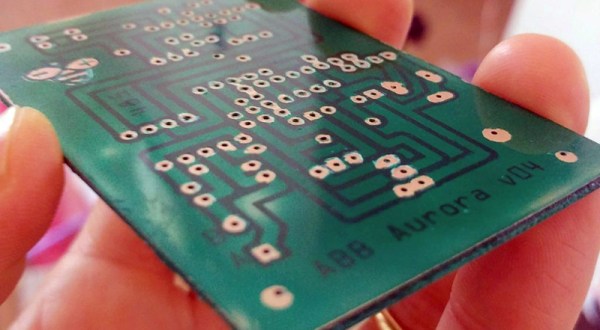
Even though you can easily order a PCB from any one of a dozen board houses and have it on your desk in a few weeks, there’s still a need for home-made circuit boards. If it’s because you have very special or strange requirements, you want to save money, or you need to suffer for your art, you can make printed circuit boards at home. You can even apply soldermask. It’s easy, and [Renzo] is here to show you how.

The beginnings of this tutorial cover well-tread territory such as building a CNC router, laying out a circuit, and cutting a piece of single-sided, copper clad board. If you stopped right there, after milling traces into a board, you would have a functioning circuit. But it wouldn’t look good; a piece of copper does not a PCB make, and you need soldermask. That’s where the real work comes in.

Applying the soldermask meant there needed to be places without soldermask, mostly the vias and through-holes. For this, [Renzo] pulled the copper pad layer out of Fritzing, printed it on a transparency sheet, and finally applied the UV-curing soldermask. This came as a kit, and right now, you can get 10 ml of green, red, blue, yellow, and black UV-curing soldermask, and a UV flashlight for ten dollars on the usual Internet shops. This soldermask was lathered on, rolled out, and exposed with the UV flashlight. After a quick wash in acetone, the result is a perfect PCB.

Automated Cat Feeder Handles Wet Food With Aplomb

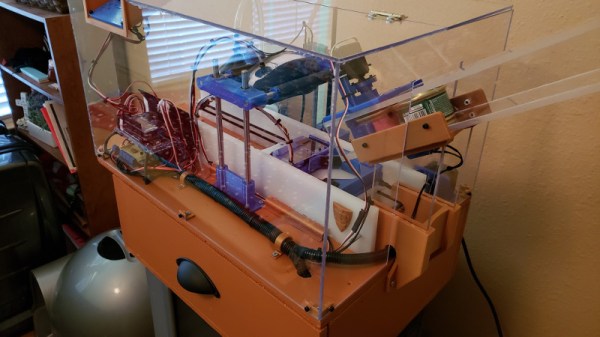
A feline’s appetite is rarely sated, and cat owners around the world are routinely treated to an early morning wake up call to remind them of this fact. To solve this problem, many turn to automated feeders. However, such devices usually handle only dry foods, with a simple hopper system. [Vikram Hao] instead went above and beyond, building a fully automated wet food cat feeder.

The device is a great example of effective automation. It’s fully capable of dispensing a single can of cat food, as well as opening the can, serving the food and disposing of the waste in an integrated bin. Currently, it has a maximum capacity of 9 cans, though this can be increased by simple alterations to the hopper and trash bin. Unsurprisingly, all manner of steppers, servos and brushed motors work in concert to achieve this feat. An Arduino Mega 2560 serves as the brains, providing plenty of IO to run everything as easily as possible.

[Vikram] reports that both the owner and the cat are overjoyed with the invention. We’ve seen a few builds before, with some even featuring armor plating. Video after the break.

Continue reading “Automated Cat Feeder Handles Wet Food With Aplomb”

Kid Rover Is Six Wheels Of Awesome

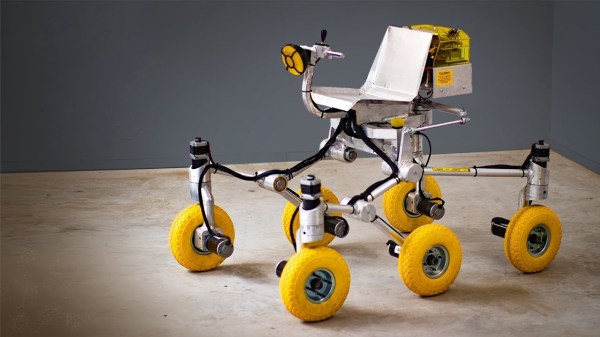
There are plenty of ways to go about learning to TIG weld. Most involve a series of practice parts making butt joints and welding together various sections of pipe. [Kris Temmerman] decided to go a little bit farther, however. The result is a kid rover that’s sure to be the envy of every neighbourhood child for a few zipcodes around.

The chassis is an all-aluminium affair, making TIG welding the perfect choice for the job. Of course, [Kris] wasn’t content to simply build a basic go-kart or buggy. This sweet ride is inspired by the rocker-bogie designs of NASA’s Mars rovers, giving it the ride height and flexibility to roam over serious obstacles. Naturally, there’s six-wheel drive and four-wheel steering to complete the dynamic package. It should also be noted that yellow wheels are a stunning design choice that we just don’t see enough of.

It’s a beautifully crafted vehicle, and a testament to [Kris]’s machining and design skills. We can’t wait to see it given a shakedown run on the muddy fields of Belgium. If you’re eager to start your own rocker-bogie build, NASA’s got the open source designs to get you started. Video after the break.

Continue reading “Kid Rover Is Six Wheels Of Awesome”

Hacker Abroad: Visiting Espressif And Surprising Subway Ads

Thursday was my final day in Shanghai. After spending all of Wednesday at Electronica Asia, I headed over to the Espressif Headquarters which is just one subway stop away. This is of course the company behind the well-known ESP8266 and its younger sibling, the ESP32. My host was Ivan Grotkothov, Director of Software Platforms. The backstory on how he found his way to the company is truly interesting, as are the stories he shared on some of the legend and lore surrounding the WiFi capable chips the company makes — and the new one whose existence just leaked out this week.

Join me below for that and few other fun things from my last day in this city of 26 million people.

Continue reading “Hacker Abroad: Visiting Espressif And Surprising Subway Ads”