Vintage Computer Festival East Is This Weekend

This weekend the InfoAge Science and History Museum in Wall, New Jersey will once again play host to the Vintage Computer Festival East — the annual can’t-miss event for anyone who has even a passing interest in the weird and wonderful machines that paved the way for the supercomputers we now all carry around in our pockets. Ticket holders will have access to a program absolutely jam packed with workshops, talks, and exhibits that center around the dual themes of “Women in Computing” and “Computers for the Masses”, plus a consignment and vendor area that almost guarantees you’ll be going home a little poorer than when you got there. But hey, at least you’ll have some new toys to play with.

For those that can’t make the pilgrimage to the tropical wonderland that is the Jersey Shore in April, all three days of the Festival will be live-streamed to the VCF YouTube page. There’s even an official Discord server where you can chat with other remote attendees. We’re glad to see more events adopting a hybrid approach after two years of COVID-19 lockdown, as it gives the far-flung a chance to participate in something they would otherwise miss completely. That said, there’s no virtual replacement for the experience of browsing the exhibits and consignment areas, so if it’s at all possible we recommend you get yourself to InfoAge for at least one of the days.

Incidentally, don’t worry if you’ve got the sneaking feeling that it hasn’t been anywhere near a year since the last time the VCF descended on Wall Township. The 2021 Festival got pushed to October because of the lingering plague, but rather than permanently change the date going forward, the 2022 Festival has returned to its traditional season. Of course that means the wait until VCF 2023 will seem unusually long after this double-shot, so here’s hoping we see another swap meet at the InfoAge campus before the end of the year.
Gridfinity: 3D Printed Super Quick Tool Storage And Retrieval

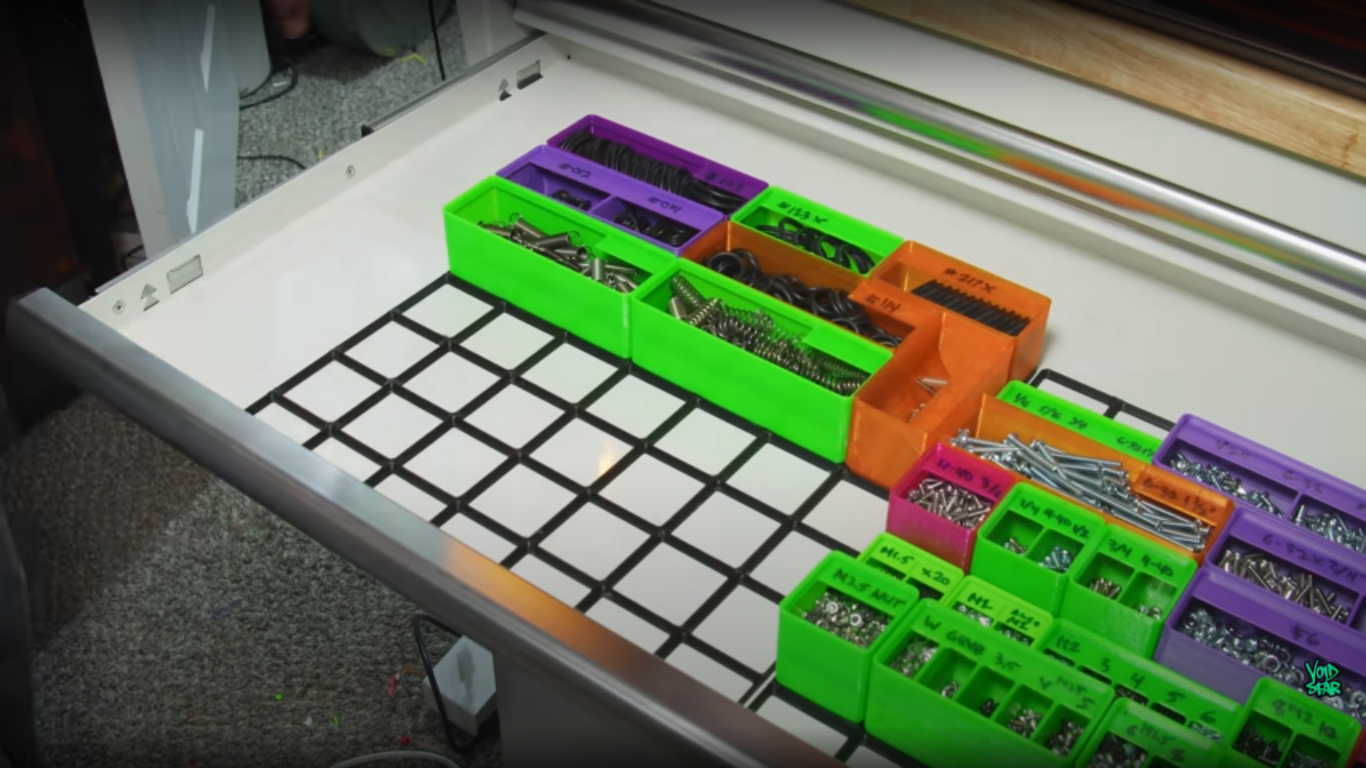
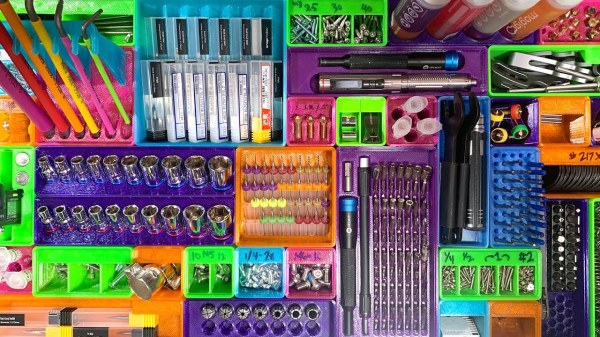
Our favourite cyborg [Zack Freedman] has been stumbling over a common problem many of us will be all too familiar with — that of tool storage and the optimal retrieval thereof. His solution is the Gridfinity: A modular workshop organisation system.

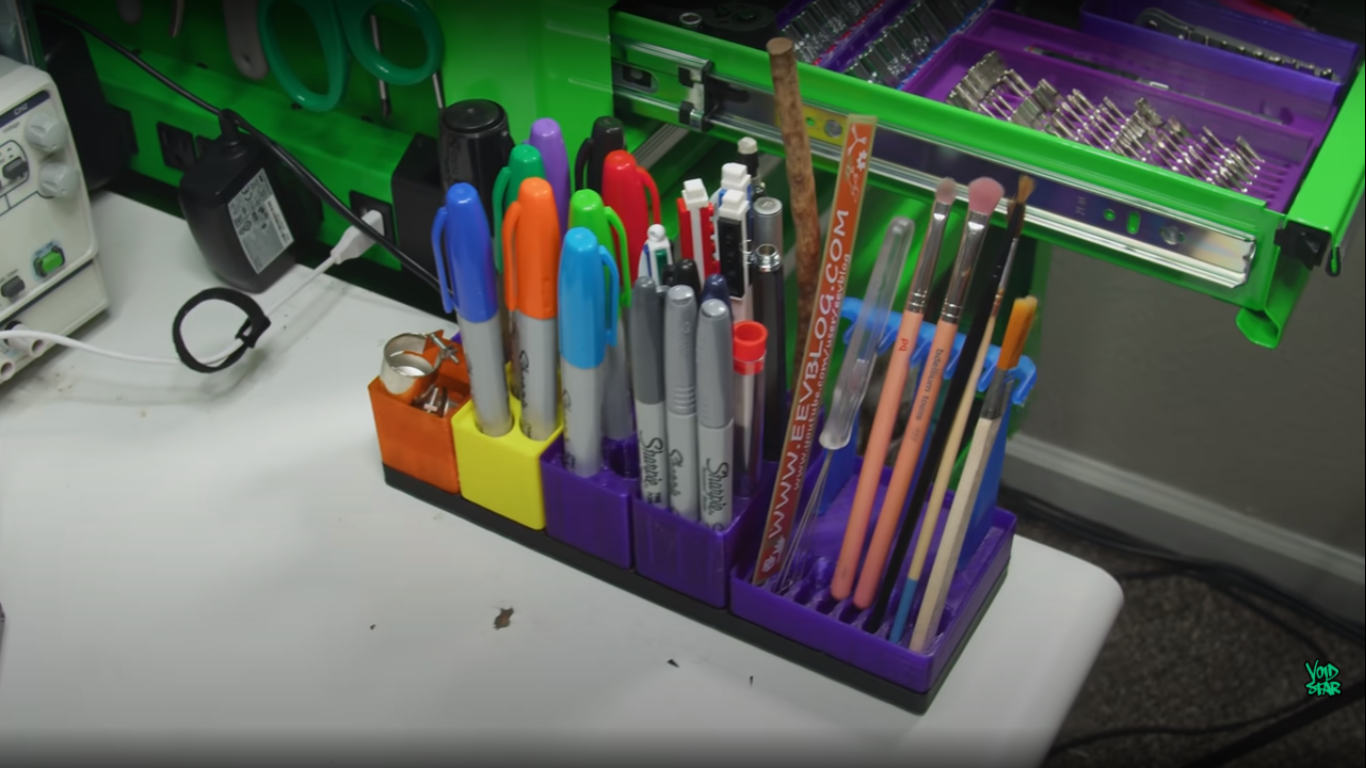
Never chase your pen around on the desk again

In [Zack]’s words, the perfect workshop has tools and materials arranged in the following way: (a) every item has a dedicated home within reach of where you’ll use it. (b) items are exposed and in position for instant grabification. (c) the storage system shields you from accidents like spills and injuries. (d) it is effortless to setup and easy to put back and rearrange. An instant-access storage solution such as the Gridfinity is designed not to help you store more stuff, but finish more projects. The idea is very simple — display your stuff so that you can quickly find what you need and get back to the project as quickly as possible. We think these aims are pretty spot on!

From an implementation perspective, the system consists of a 3D printed base plate with a grid structure. It is angled internally so storage bins drop in, but are not easy to knock out. Storage units drop into the grid in various sizes and orientations, such that everything is contained within the grid’s outer boundary, so the whole assembly will fit inside a drawer with ease. Small part storage bins have a curved inner surface enabling one to easily scoop out a part when required.  A partial lid on the top allows them to be stacked vertically if required.

Super-quick access to fully sorted stock – no more searching

Whilst the system is work in progress, there are still about a hundred different storage units, for anything from 3D printer nozzles to racks for tweezers. Implemented as parameterised models in Fusion360, it is easy to tweak existing models for your stuff, or create totally new ones, from the supplied templates.

No discussion of tool organisation would be complete without first considering the king of tool organisation [Adam Savage], the principle of first order retrieval is a strong one. For a more in-your-face solution, you could go down the pegboard-on-wheels route, or perhaps if you’re less mobile and in a tight squeeze, then get comfortable with the French cleat and build something full custom right into the walls. Whatever solution you come up with, do share it with us!

Continue reading “Gridfinity: 3D Printed Super Quick Tool Storage And Retrieval”

Processing Audio With The RP2040

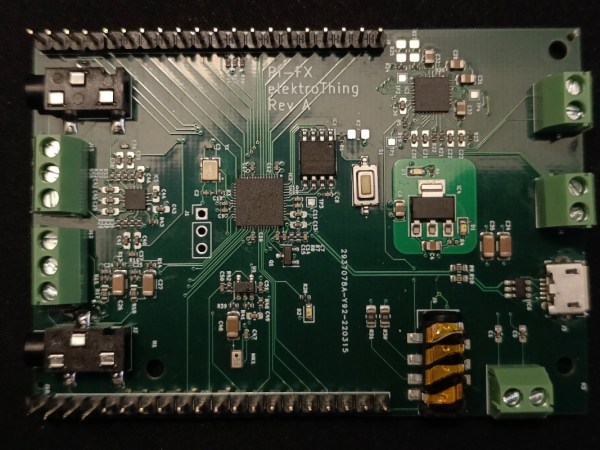
The Raspberry Pi, although first intended as an inexpensive single-board computer for use in education, is now ubiquitous in electronics communities. Its low price as well as Linux platform and accessible GPIO make it useful in many places outside the classroom. But, if you want to abandon the ease-of-use in favor of an even lower price, the Raspberry Pi foundation makes that possible as well with the RP2040 chip, commonly found on the Pico. [Jason] shows us one way to make use of this powerful chip by putting one in an audio digital signal processing board.

While development boards are available for this chip, [Jason] has opted instead for a custom PCB which he designed himself and includes an integrated headphone amplifier and 3.5 mm audio jacks. To do the actual DSP work, the RP2040 chip uses three 12-bit ADC channels and 16 controllable PWM channels. The platform is also equipped with the TLV320AIC3254 codec from Texas Instruments. With all of this put together, he has a functioning open-source platform he calls the DS-Pi.

[Jason] has built this as a platform for guitar effects and as a customizable guitar amp modeler, but with a platform that is Arduino-compatible and fairly easy to program it could be put to use for anything involving other types of music or audio processing, like this specialized MIDI-compatible guitar effects platform which is built around the same processor.

An unfastened piece of pipe in a drill press, rotating away

Drill Press Piece Fastening 101

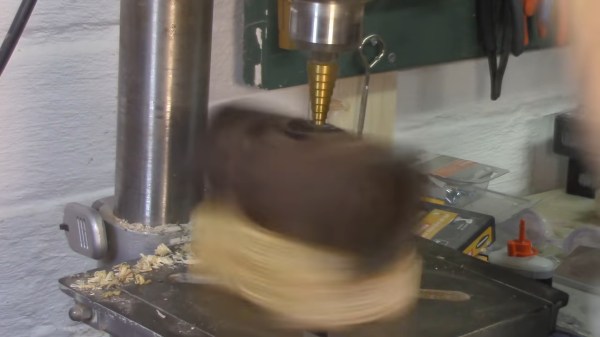
What are the options you have for securing your workpiece to the drill press table? [Rex Krueger] shows us that there’s plenty, and you ought to know about them. He goes through the disadvantages of the usual C-clamps, and shows options like the regular drill press vice and a heavy-duty version that even provides a workpiece tilting mechanism, and points out small niceties like the V-grooves on the clamps helping work with round stock. For larger pieces, he recommends an underappreciated option — woodworkers’ wooden handscrew clamps, which pair surprisingly well with a drill press. Then, he talks about the hold-down drill press clamps, a favourite of his, especially when it comes to flat sheets of stock like sheet metal or plastic.

As a bonus for those of us dealing with round stock, he shows a V-block he’s made for drilling into its side, and round stock clamp, made by carefully drilling a pair of wooden hand screw clamps, for when you need to drill into a dowel from its top. The ten-minute video is a must watch for anyone not up to speed on their drill press piece fastening knowledge, and helps you improve your drilling game without having skin in it.

We’ve covered a few ingenious and unconventional drill piece fastening options before, from this wise held down by repurposed bicycle quick-release parts, to an electromagnetic wise that left our readers with mixed opinions.

Continue reading “Drill Press Piece Fastening 101”

Hackaday Links Column Banner

Hackaday Links: April 17, 2022

There are plenty of stories floating around about the war in Ukraine, and it can be difficult to sort out which ones are fact-based, and which are fabrications. Stories about the technology of the war seem to be a little easier to judge, and so stories about an inside look at a purported Russian drone reveal a lot of interesting technical details. The fixed-wing UAV, reported to be a Russian-made “Orlan,” looks quite the worse for wear as it’s given a good teardown by someone wearing Ukraine military fatigues. In fact, it looks downright homemade, with a fuel tank made from what looks like an old water bottle, liberal use of duct tape to hold things together, and plenty of hot glue sprinkled around — field-expedient repairs, perhaps? The big find, though, is that the surveillance drone carried a rather commonplace — and cheap — Canon EOS Rebel camera. What’s more, the camera is nestled into a 3D printed cradle, strapped in with some hook-and-loop tape, and its controls are staked in place with globs of glue. It’s an interesting collection of hardware for a vehicle said to cost the Russian military something like $100,000 to field. The video below shows a teardown of a different Orlan with similar results, plus a lot of dunking on the Russians by a cheery bunch of Ukrainians.

Continue reading “Hackaday Links: April 17, 2022”

The 555 Gives The CarolinaCon Badge Life

For the electronic badge enthusiast, these last two years have seen something of a famine. While the pandemic may not be over yet, we’re learning to live with it in 2022, and there’s the prospect of a flush of new badges even if not all events are in-person yet. First to reach us is the Carolinacon Online 2 badge, a fairly simple affair which naturally has us pleased as punch because it incorporates the only chip that’s guaranteed to get you through the semiconductor shortage, an NE555 timer. It’s got everything, a flashing LED, and, well, that’s it because with the best will in the world a 555 is no powerhouse on its own. As a memento and a way to support the event it fits the bill, but it’s fair to say that this is no electronic tour de force.

Carolinacon Online 2 launches on Friday 29th of April, and features a schedule of talks and a set of merch including the badge. If you’re thinking of previous Carolinacon badges, this event has always taken the simple-but-effective route. The version they produced in 2021 for example had a hidden message behind the silkscreen, revealed through clever placement of LEDs controlled by an ATtiny microcontroller.

A handheld device to measure electromagnetic fields

Measuring Electromagnetic Fields With Just An Arduino And A Piece Of Wire

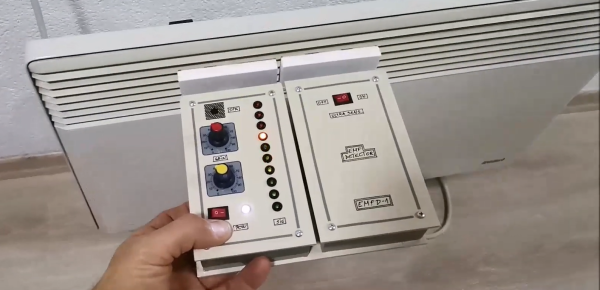
Electromagnetic interference problems can be a real headache to debug. If you need to prove what causes your WiFi to slow down or your digital TV signal to drop, then the ability to measure electromagnetic fields (EMF) can be a big help. Professional equipment is often very expensive, but building an EMF detector yourself is not even that difficult: just take a look at Arduino expert [Mirko Pavleski]’s convenient hand-held electromagnetic field detector.

The basic idea is quite simple: connect an antenna directly to an Arduino’s analog input and visualize the signal that it measures. Because the input of an ADC is high impedance, it is very sensitive to any stray currents that are picked up by the antenna. So sensitive in fact, that a resistor of a few mega-Ohms to ground is required to keep the sensor from triggering on any random kind of noise. [Mirko] made that resistance adjustable with a few knobs and switches so that the detector can be used in both quiet and noisy environments.

Making the whole device work reliably was an interesting exercise in electromagnetic engineering: in the first few iterations, the detector would trigger off its own LEDs and buzzer, trapping itself in a never-ending loop. [Mirko] solved this by encasing the Arduino inside a closed, grounded metal box with only the required wires sticking out. The antenna’s design was largely based on trial-and-error; the current setup with a 7 cm x 3 cm piece of aluminium sheet seemed to work well.

While this is not a calibrated professional-grade instrument, it should come in handy to find sources of interference, or even simply to locate hidden power cables. You can view this as a more advanced version of [Mirko]’s Junk Box EMF Detector; if you have a second Arduino lying around, you can use that one to generate interference instead. Continue reading “Measuring Electromagnetic Fields With Just An Arduino And A Piece Of Wire”