Custom VR Headset Uses Unconventional Displays

Cathode ray tubes (CRTs) are a fascinating display technology that has been largely abandoned outside of retro gaming and a few other niche uses. They use magnets to steer a beam of electrons rapidly across a screen, and while a marvel of engineering for their time, their expense, complexity, and weight all led to them being largely replaced by other displays like LCDs and LEDs. They were also difficult to miniaturize, but there were a few companies who tried. [dooglehead] located a few of the smallest CRT displays he could find and got to work putting them in the most unlikely of situations: a virtual reality headset.

The two displays for his headset come from Sony Watchmans, compact over-the-air black-and-white handheld televisions from the late 1900s. [dooglehead] had to create a method for sending video to these units which originally had no input connections, and then also used an FPGA to split a video signal into two parts, with one for each display. The two displays are placed side by side and attached to a Google Cardboard headset, with an off-the-shelf location tracker attached at the top. An IMU tracks head rotation while this location tracker tracks the motion of the unit through 3D space.

With everything assembled and ready to go, the CRT VR headset only weighs in a few grams heavier than [dooglehead]’s modern HTC headset, although it’s lacking a case (which is sorely needed to cover up the exposed high voltage of the CRTs). He reports surprisingly good performance, with notable interlacing and focus issues. He doesn’t plan to use it to replace any of his modern VR displays anytime soon, but it was an interesting project nonetheless. There are some rumors that CRTs are experiencing a bit of a revival, so we’d advise anyone looking to toss out an old CRT to at least put it on an online market place before sending it to a landfill.

Continue reading “Custom VR Headset Uses Unconventional Displays”

3D Printed Jack Mixes Two Filaments For Great Performance

If you’re looking to jack up your car and you don’t have anything on hand, your 3D printer might not be the first tool you look towards. With that said, [Alan Reiner] had great success with a simple idea to create a surprisingly capable scissor jack with a multi-material print.

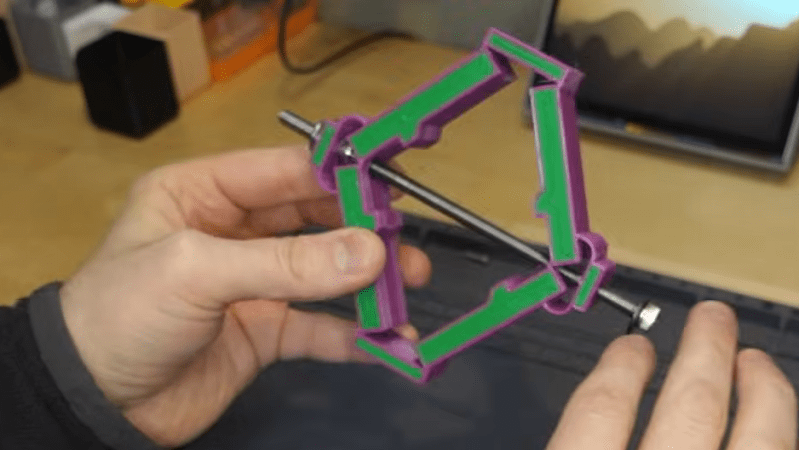
The design will look familiar if you’ve ever pulled the standard jack out of the back of your car. However, this one isn’t made fully out of steel. It relies on an M6 bolt and a rivet nut, but everything else is pure plastic. In this scissor jack design, rigid PETG arms are held in a scissor jack shape with a flexible TPU outer layer. Combined with the screw mechanism, it’s capable of delivering up to 400 pounds of force without failing. It’s an impressive figure for something made out of 80 grams of plastic. The idea came about because of [Alan’s] recent build of a RatRig VCore4 printer, which has independent dual extruders. This allowed the creation of single prints with both rigid and flexible filaments included.

[Alan] did test the jack by lifting up his vehicle, which it kind of achieved. The biggest problem was the short stroke length, which meant it could only raise the back of the car by a couple inches. Printing a larger version could make it a lot more practical for actual use… if you’re willing to trust a 3D-printed device in such use.

Files are on Printables if you wish to make your own. It’s worth paying attention to the warning upfront that [Alan] provides—”THIS CAN CREATE A LOT OF FORCE (400+ lbs!), WHICH MEANS IT CAN STORE A LOT OF ENERGY THAT MIGHT BE RELEASED SUDDENLY.  Please be cautious using 3d-printed objects for high loads and wear appropriate safety equipment!”

Funnily enough, we’ve featured 3D printed jacks before, all the way back in 2015! Video after the break.

Continue reading “3D Printed Jack Mixes Two Filaments For Great Performance”

LEGO Orrery Gets A Real-Time Drive Upgrade

An orrery is a beautiful type of mechanical contrivance, built to demonstrate the motion of heavenly objects. LEGO happens to offer just such a device, built using its Technic line of blocks, shafts, and gears. Only, it has a serious limitation—it has to be cranked manually to make it spin the Earth around the sun. [Görkem] set out to fix this glaring oversight with some good old-fashioned hardware.

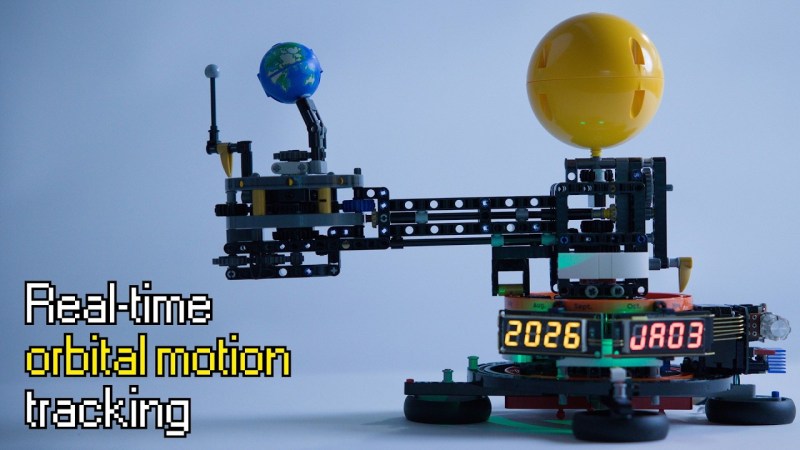
The setup removes just five LEGO pieces from the original design, eliminating the hand crank from the mechanism. In its place, [Görkem] installed a NEMA 17 stepper motor, paired with a custom PCB mounted on the back. That carries an ESP32 microcontroller and a TMC2208 stepper motor driver set up for silent drive. Rigged up like so, the orrery can simulate the motion of the Earth and Moon around the Sun in real time. There’s also a knob to track back and forth in time, and a button to reset the system to the correct real-time position.

The final build looks great, combining the LEGO Technic parts with some chunky electronics and 7-segment displays that make it a wonderful techy desk decoration. Down the line, [Görkem] hopes to offer a plug-and-play kit to others who wish to duly animate their own LEGO orrery sets (set #42179).

We love a good LEGO build around these parts. We’ve featured everything from parts sorters to functional typewriters in the past.

Continue reading “LEGO Orrery Gets A Real-Time Drive Upgrade”

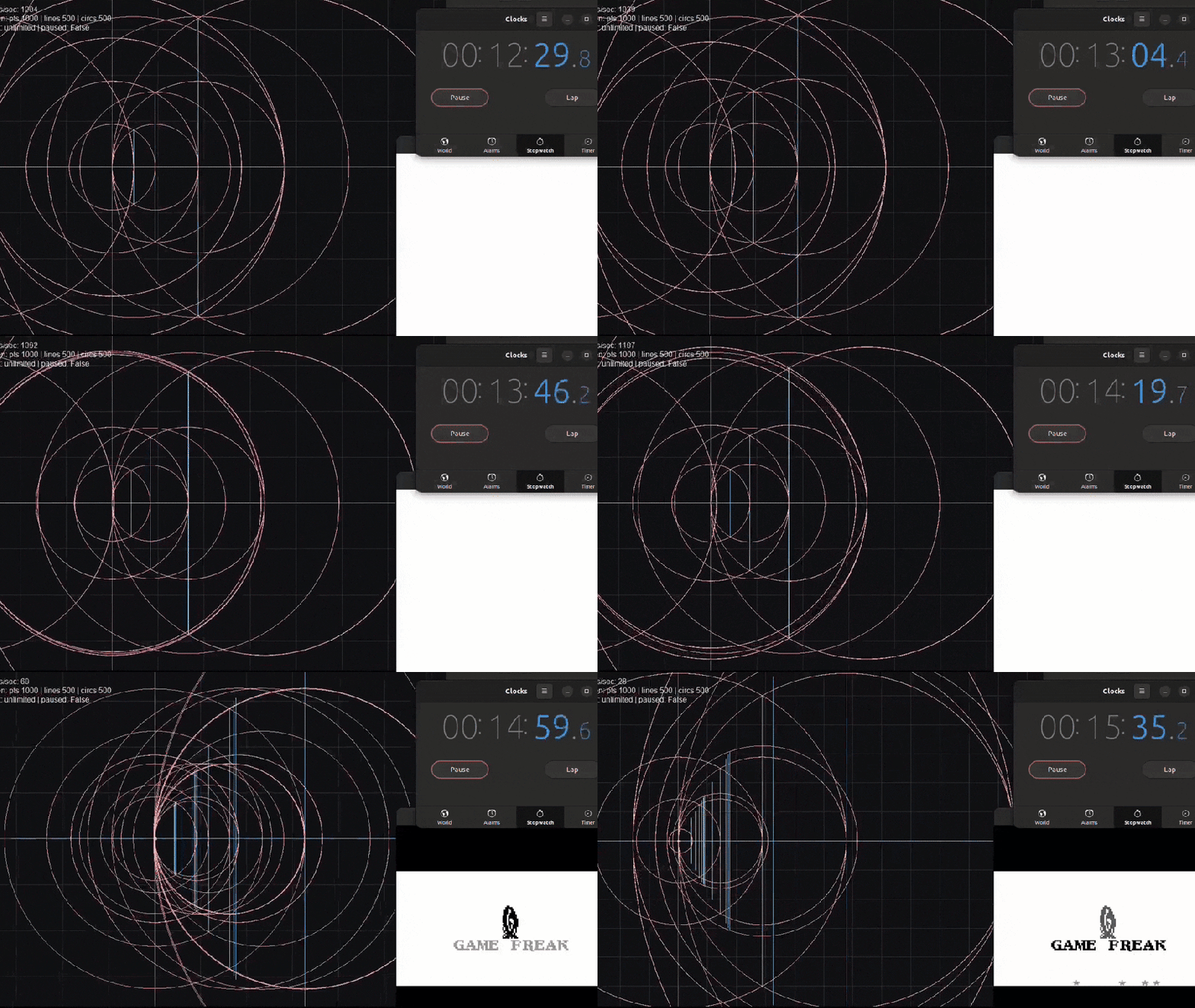
An animated set of circles and lines are drawn on a black screen. Meanwhile, in a smaller window in the lower right corner, the boot screen of a Game Boy is displayed.

Running Pokémon With A Compass And Straightedge

The ancient question of whether or not it’s possible to construct a circle with the same area as a given square using only a drawing compass and straightedge was finally answered in 1882, where it was proved that pi is a transcendental number, meaning it cannot be accurately represented in a compass-and-straightedge system. This inability to accurately represent pi is just one of the ways in which these systems resemble a computer, a similarity that [0x0mer] explored in CasNum.

The core of the program represents operations with a drawing compass and unmarked straightedge. There are only a few operations that can be used for calculation: constructing a line through two points, constructing a circle centered at one point and intersecting another point, and constructing the intersection(s) of two lines, a line and a circle, or two circles. An optional viewer visualizes these operations. Another class builds on top of this basic environment to perform arithmetic and logical operations, representing numbers as points in the Cartesian plane. To add two numbers, for example, it constructs the midpoint between them, then doubles the distance from the origin.

There are some examples available, including the RSA algorithm. [0x0mer] also altered a Game Boy emulator to implement the ALU instructions using compass and straightedge operations. In testing, it took about fifteen minutes to boot, and runs at a “totally almost playable” speed, near one FPS. This is after extensive caching has been applied to minimize computation time; the performance here is impressive, but in a more qualitative than quantitative sense.

Being virtual, this system is discrete, but a physical compass and straightedge form a simple analog computer capable of dealing with continuous values.

The Complicated Legacy Of Mind Controlled Toys

Imagine a line of affordable toys controlled by the player’s brainwaves. By interpreting biosignals picked up by the dry electroencephalogram (EEG) electrodes in an included headset, the game could infer the wearer’s level of concentration, through which it would be possible to move physical objects or interact with virtual characters. You might naturally assume such devices would be on the cutting-edge of modern technology, perhaps even a spin-off from one of the startups currently investigating brain-computer interfaces (BCIs).

But the toys in question weren’t the talk of 2025’s Consumer Electronics Show, nor 2024, or even 2020. In actual fact, the earliest model is now nearly as old as the original iPhone. Such is the fascinating story of a line of high-tech toys based on the neural sensor technology developed by a company called Neurosky, the first of which was released all the way back in 2009.

Yet despite considerable interest leading up to their release — fueled at least in part by the fact that one of the models featured Star Wars branding and gave players the illusion of Force powers — the devices failed to make any lasting impact, and have today largely fallen into obscurity. The last toy based on Neurosky’s technology was released in 2015, and disappeared from the market only a few years later.

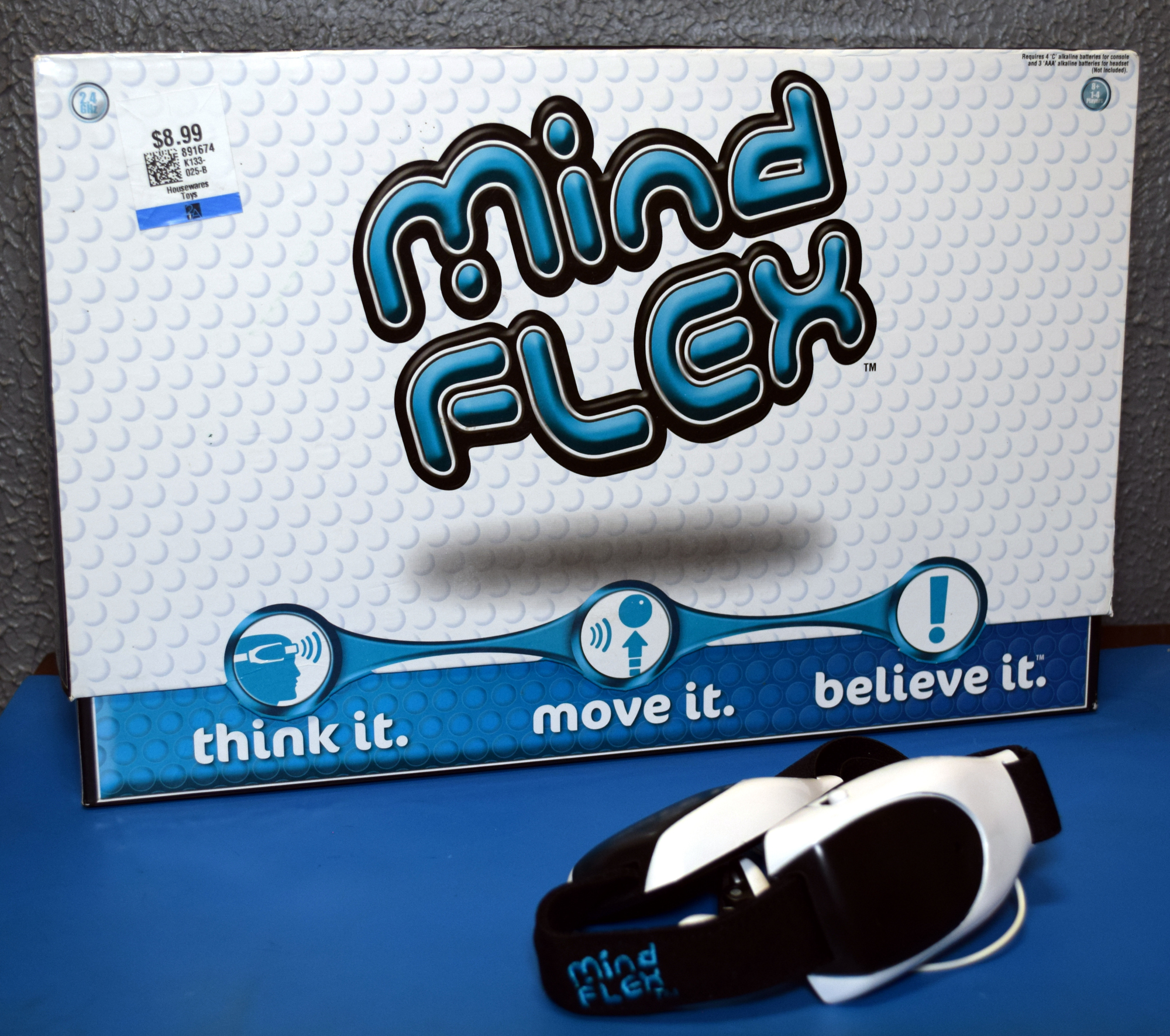
I had all but forgotten about them myself, until I recently came across a complete Mattel Mindflex at a thrift store for $8.99. It seemed a perfect opportunity to not only examine the nearly 20 year old toy, but to take a look at the origins of the product, and find out what ultimately became of Neurosky’s EEG technology. Was the concept simply ahead of its time? In an era when most people still had flip phones, perhaps consumers simply weren’t ready for this type of BCI. Or was the real problem that the technology simply didn’t work as advertised?

Continue reading “The Complicated Legacy Of Mind Controlled Toys”

AirTag Has Hole Behind The Battery? It’s Likely Been Silenced

Apple AirTags have speakers in them, and the speaker is not entirely under the owner’s control. [Shahram] shows how the speaker of an AirTag can be disabled while keeping the device watertight. Because AirTags are not intended to be opened or tampered with, doing so boils down to making a hole in just the right place, as the video demonstrates.

By making a hole in just the right place, the speaker can be disabled while leaving water resistance intact.

How does putting a hole in the enclosure not compromise water resistance? By ensuring the hole is made in an area that is already “inside” the seal. In an AirTag, that seal is integrated into the battery compartment.

Behind the battery, the enclosure has a small area of thinner plastic that sits right above the PCB, and in particular, right above the soldered wire of the speaker. Since this area is “inside” the watertight seal, a hole can be made here without affecting water resistance.

Disabling the speaker consists of melting through that thin plastic with a soldering iron then desoldering the (tiny) wire and using some solder wick to clean up. It’s not the prettiest operation, but there are no components nor any particularly heat-sensitive bits in that spot. The modification has no effect on water resistance, and isn’t even visible unless the battery is removed.

In the video below, [Shahram] uses a second generation AirTag to demonstrate the mod, then shows that the AirTag still works normally while now being permanently silenced.

Continue reading “AirTag Has Hole Behind The Battery? It’s Likely Been Silenced”

Using 3D Printed Breadboards To Accommodate Wide Boards

Although off-the-shelf breadboards are plentiful and cheap, they almost always seem to use the same basic design. Although you can clumsily reassemble most of them by removing the voltage rail section and merging a few boards together, wouldn’t it be nice if you had a breadboard that you could stick e.g. one of those wide ESP32 development boards onto and still have plenty of holes to poke wires and component leads into? Cue [Ludwin]’s 3D printable breadboard design that adds a big hole where otherwise wasted contact holes would be.

The related Instructables article provides a visual overview of the rationale and the assembly process. Obviously only the plastic shell of the breadboard is printed, after which the standard metal contacts are inserted. These contacts can be ‘borrowed’ from commercial boards, or you can buy the contacts separately.

For the design files there is a GitHub repository, with breadboard designs that target the ESP32, Raspberry Pi Pico, and the Arduino Nano. An overview of the currently available board designs is found on the Hackaday.io project page, with the top image showing many of them. In addition to the single big space design there are also a few variations that seek to accommodate just about any component and usage, making it rather versatile.