How The Vagus Nerve Promotes Healthy Cognition Via Acetylcholine Signaling

It’s been said for centuries that you cannot think on an empty stomach, and that love goes through the stomach. Although these may seem like merely cute jabs at the simplicity of human nature, recent research in rat models by [Logan Tierno Lauer] et al. indicates that the gut may be more influential in something as fundamental as memory formation and cognitive function than previously assumed.

Key to the gut-brain connection is the vagus nerve, an essential part of the autonomic nervous system that wires the brain into the body’s organs, including the gastrointestinal (GI) tract. It provides both sensory and motor fibers, so that the brain can literally sense the state of said GI tract, with various triggers as result. One of these is – as demonstrated in the paper – the release of acetylcholine (aCh) an important neurotransmitters in the CNS for cognitive functions including attention, memory and motivation.

Using in vivo fiber photometry it was found that during eating medial septum neurons released aCh, with various ways to impair this mechanism along the vagus nerve leading to this response disappearing. This also confirms earlier research that points the finger at a so-called early life Western Diet (WD) causing impaired memory and overall cognitive function, likely due this high fat and high sugar diet causing dysfunction in this aCh regulation mechanism.

Beyond once again reinforcing the need to eat healthily, this research also provides further insights in condition with declining cognitive function, such as Alzheimer’s and dementia.


Improving The Microcontroller Gaming Performance With PicoGame

The ability to write Python on microcontrollers with the likes of MicroPython and later CiruitPython has made them much more accessible. [MakerClassCZ] brings that to game development with PicoGame.

Like any good project, it starts with a problem that needs solving. Put simply, the existing CircuitPython libraries aren’t too impressive for gaming. The DisplayIO library tends to do full display refreshes, which are slow on such tiny displays, and the Stage library just wasn’t flexible enough for [MakerClassCZ]’s liking. So he built his own.

PicoGame, like the others, implements the performance-sensitive things in C, but does partial updates for the screen, on its own massively increasing the framerate. On the other end, it uses fixed-point math–much cheaper than soft-float–and makes an active effort to keep the RAM usage low so Python can have it. What’s even more clever is using the downtime between sending one tiny portion of frame to calculate the next just in time.

Of course, the display is still the limit. If you need to update a lot of it, you might end up with 10 FPS if you’re lucky. But if you can settle for less motion, you could see 100.

Why Is Textile Work Not Taught To Engineers?

A talk from the recent Electromagnetic Field event in the UK caught our eye, in which [Amy Jeskins] looked at the overlooked engineering skill of pattern cutting. She takes us through the mechanics of creating a pattern for a piece of clothing, and asks why it is not a skill taught to engineers.

She’s a specialist in theatrical costume, and the talk takes us through some examples of her work before looking at the history of tailoring and pattern making. She explores flat cutting and draping a pattern on a form before coming into the present day with CAD packages designed for clothing work. It’s the social aspect of the talk that’s perhaps the most interesting, looking at how it has become a gendered skill and thus not something considered where it should belong, as engineering. We’re reminded of one of the most important additions for a healthy hackerspace, a textile room, as we’ve seen people there bridge this divide from both directions.

If you have never made a piece of clothing then we’d suggest giving this talk a watch, and maybe taking up a sewing machine to give it a try. In the past we’ve taken you through some of the prerequisites for a textile bench. The full talk is below the break.

Continue reading “Why Is Textile Work Not Taught To Engineers?”

Samsung’s SmartThings API Terminates Free Access

If there’s one constant in the world of commercial home automation solutions, it is that of decreasing availability and higher costs as time goes on. So too with Samsung’s SmartThings, the API of which will cease free access in October of 2026.

While this does not affect people who use the SmartThings app, any system that relies on access to this API will soon face a $4.99 per month fee for non-commercial users, with various commercial tiers also in the pipeline. While the rest of the blog post has all the elegance of the output of a ‘please generate a list of plausible excuses’ query to ChatGPT, the most likely reason is that offering free services after the sale of an Internet of Things device will never be profitable.

SmartThings was originally a 2012 Kickstarter campaign that ended up becoming successful enough that the company was bought by Samsung in 2014. Its current offerings are very much like other so-called Smart Home products, with recently support for Matter and thus interoperability with third-party devices added.

If you have SmartThings integrated with your Home Assistant installation, you are also likely affected by this change if at any point you use the API. Of course, this isn’t the first time that SmartThings customers had to scramble to fix broken infrastructure, such as when in 2021 the original hubs got discontinued.

Sharkfin Bites Attack Shark

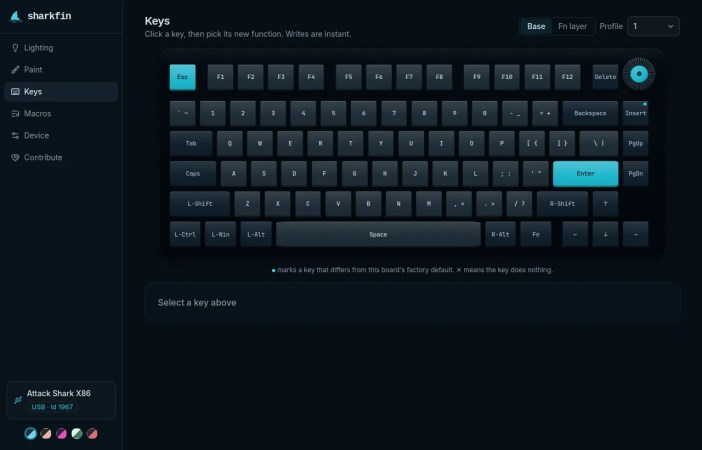
The Attack Shark is a modern keyboard with fancy magnetic keyswitches, macros, configurable blinky LEDs, and more. The problem is that the configuration software only works on Windows, so [JR Lanteigne] set out to fix that. Along the way, he completely worked out the configuration protocol that this keyboard needs, and wrote the comfortable sharkfin web-app so that you can flash yours too.

Don’t have an Attack Shark? Well, you might have one of the 522 other boards that are made on the same ROYUAN hardware, but are re-branded under 100 different names. Want to find out if yours is supported? Look it up in the list here, or just plug it in and find out.

[RJ]’s path to reverse engineering the config protocol wasn’t entirely straightforward, but since the “Windows only” application was actually an Electron app under the hood, he patched it to run on Linux and logged a few configuration sessions. Of course there are gotchas like two different firmware generations and the fact that writing to flash too fast put the keyboard into a boot loop, but after these problems were surmounted, it just remained to map all of the bytes out, and wrap it all up in a user-friendly application.

We don’t have one of these fancy-schmancy keyboards, but if we did, we’d certainly be glad to have the configuration protocol documented. Nothing is worse than finding out that the company that made your keyboard has gone belly-up, and you’re left with a backlight setup that doesn’t match your new deskpad. If you’re a keyboard-head and you don’t already follow [Kristina]’s series, well you should.

Breaking The Parental Lock On An XBox 360 Is Very Much An Inconvenience

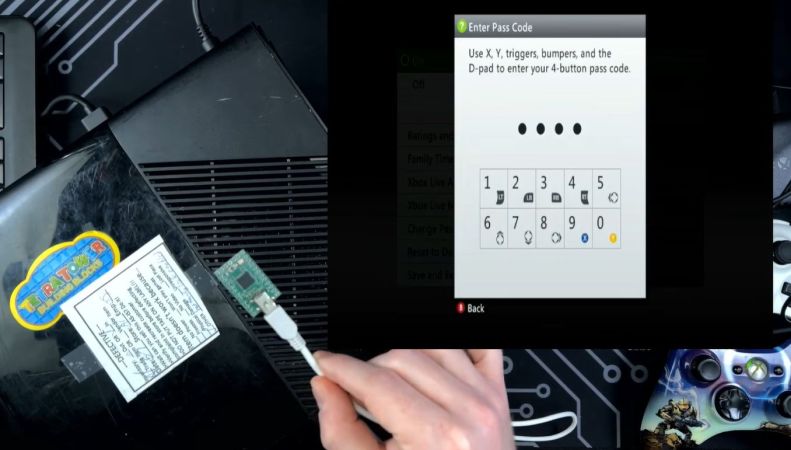
There are many ways to soft-brick a device to the point where it cannot easily be used again, and “Cloud locks” or parental locks are probably at the top of the list here. [eWastelander] recently got an XBox 360 console for a mere $15 that had been tossed out without removing said parental lock. This led him down the fun path of exploring just how deep this lock goes that’s supposed to keep little Timmy from doing naughty things on the family gaming console.

The short version is that, unless you want to go medieval on the hardware and perform a NAND Flash-level reset, your best bet is probably to brute-force the pass code. You do not even have to mash in the thousands of codes yourself, but can use a keyboard emulator on something like a Teensy development board. This got [eWastelander] into the console after a mere five hours of the little MCU running through the combinations.

There used to be a reset code as well, as detailed over at Console Mods, but this is unique to each console and this feature got removed in newer firmware revisions. In the video, attempts to modify the console via a soft mod failed due to the compromised games that provide a backdoor not being ‘Everyone’ rated, which is probably a common outcome here.

Ultimately it seems that either you plug in an MCU board or you break out the NAND Flash programmer. Brute-forcing the XBox 360 pass code is something that we covered back in 2013 already, with in 2020 [Agent24] porting the code to the Teensy, with the code download link provided in the video description. Since Microsoft long since stopped providing the reset service via its support, this might be the only way to revive an otherwise junk XBox 360.

Continue reading “Breaking The Parental Lock On An XBox 360 Is Very Much An Inconvenience”

FreeBSD Just Removed The Last Of Its GPL-Licensed Code

With a recent change that removed dialog in favor of bsddialog, FreeBSD has now retired the last piece of GPL-licensed code in its base system. Although the impact of this change will be minor for users, it does highlight once again the Open Source divide that has split developers since the 1990s, when [Linus Torvalds] attached a scribbled set of notes to the v0.01 Linux kernel release that would later be replaced with the very similar GPL license and its derivatives.

This history and its impacts are also the subject of a recent video by [Brodie Robertson]. For the FreeBSD project the biggest change here is probably that the entire GNU subtree in the codebase is now gone, As detailed in the video, this is the end of a very long-running project, whereby FreeBSD in its early days incorporated GNU code for userland tools. These components and its replacements are detailed in the FreeBSD wiki.

Naturally, this change has upset some people for reasons best known to themselves, but from a project management perspective this makes a lot of sense. Not having BSD-incompatible licenses like GPL in your source code massively simplifies matters. The main difference being that the GPL is reciprocal, requiring that derivative works also be released under the GPL — a feature that is often at odds with commercial projects. Meanwhile, the BSD licenses merely require the use of BSD-licensed code to be declared.

The upshot of the BSD-license in the case of FreeBSD is that it has found it and its components used in many commercial products, including MacOS/OS X, the PlayStation’s Orbis OS, and of course the BSD networking stack is happily used in Windows, macOS and just about anywhere else. Meanwhile the GPL forced Linksys to open the firmware to its WRT54G series of routers, ultimately leading to the development of OpenWrt and similar projects.

Although the OSS licensing flamewars will likely never end, it’s hard to disagree that FreeBSD is pretty healthy at over thirty years old, even if using it as a desktop OS comes with a few asterisks.

Continue reading “FreeBSD Just Removed The Last Of Its GPL-Licensed Code”